
News News
Cricket Bat Certifications: What Every Player Needs Cricket Bat Certifications: What Every Player Needs
Finding a cricket bat that feels perfect in your hands is only part of the story—making sure your bat meets global certification standards matters just as much for every serious player. With the Marylebone Cricket Club and International Cricket Council setting strict rules on bat size, materials, and legitimacy, your choice influences not just performance, but whether you can step onto the pitch with confidence. This guide breaks down how certifications protect you, ensure fair play, and help you purchase equipment that’s match-ready anywhere from London to Mumbai.
Table of Contents
- Cricket Bat Certifications Demystified
- Key Global Standards And Certifying Bodies
- ICC, MCC, BIS And Regional Rules
- Certification Process: Testing And Grading
- Compliance For Players And Retailers
- Avoiding Non-Compliant And Counterfeit Bats
Key Takeaways
| Point | Details |
|---|---|
| Certification Ensures Fair Play | Cricket bat certifications guarantee that your equipment meets global standards set by governing bodies, ensuring fair competition. |
| Understand Bat Specifications | Certified bats must adhere to specific dimensions and material requirements to prevent unfair advantages during play. |
| Check Certification Documentation | Always verify the certification of a bat through official documentation to ensure it meets the requirements for your competition level. |
| Be Aware of Counterfeits | Counterfeit bats may look authentic but often fail to meet safety and performance standards; always request certification numbers when purchasing. |
Cricket Bat Certifications Demystified
Cricket bat certifications exist to protect you and ensure fair competition. Without standardised rules, players could simply purchase bats with unfair advantages, and matches wouldn’t be played on level ground. The reason certifications matter is straightforward: they guarantee that the bat you’re holding meets global standards recognised by governing bodies. When you pick up a certified bat, you’re investing in equipment that’s been tested and validated to work within the rules you’ll actually play under.
The core specifications that define a certified bat come from the Laws of Cricket, maintained by the Marylebone Cricket Club. These laws set strict measurements: your bat cannot exceed 38 inches in length or 4.25 inches in width. The blade must be made entirely from wood, whilst the handle can use cane, binding, and other approved materials. These aren’t arbitrary restrictions. They exist because a bat that’s too large or made from unapproved materials gives you an unfair hitting advantage. When you’re shopping for a new bat, these dimensions form the foundation of what “certified” actually means.
Here’s where it gets practical for you as a player. Different cricket formats have different certification bodies and sometimes slightly different requirements. Test cricket, county cricket, and Twenty20 leagues all recognise the same basic Laws of Cricket, but some competitions might add their own regulations. If you’re playing serious amateur cricket or working towards semi-professional cricket, you need to check what certification your local or state association requires. Some bats are certified for all formats, whilst others might have restrictions. The manufacturing process itself also matters—understanding how cricket bats are manufactured gives you insight into why certifications focus on specific measurements and materials rather than just weight or balance.
Don’t assume all bats in a shop are certified just because they’re expensive or from a known brand. Ask the seller directly about certification. Look for official certification marks or documentation that proves the bat meets the Laws of Cricket. Some premium bats cost more because of brand reputation or aesthetics, not because they’re certified for official play. This distinction matters when you’re spending money on equipment.
Pro tip: Before purchasing any bat for official match play, request the certification documentation from the seller and verify it matches your specific league’s requirements, not just general cricket standards.
Key Global Standards And Certifying Bodies
When you’re buying a cricket bat, you’re relying on organisations that most players have never heard of. The International Cricket Council and the Marylebone Cricket Club are the two bodies that decide what’s legal and what isn’t. These aren’t random associations—they’re the actual authorities that govern competitive cricket worldwide. The ICC handles international playing conditions and enforcement, whilst the MCC maintains the Laws of Cricket that form the foundation of everything. Together, they ensure that whether you’re playing in London, Mumbai, or Melbourne, the bat regulations are identical. This global uniformity matters because it means your investment in a certified bat works across different competitions and countries.
The ICC’s role centres on international playing conditions, which incorporate bat specifications into Law 5 of the Laws of Cricket. The MCC, based at Lord’s in London, maintains these laws and updates them as the game evolves. Both bodies work together to set exact measurements, material requirements, and testing standards that manufacturers must follow. English willow remains the preferred material for blades because of its performance characteristics and the historical standardisation around it. When you see a bat advertised as ICC or MCC certified, it means independent testing has verified that the bat meets these precise specifications. The certifying bodies don’t just set rules and hope manufacturers comply—they enforce these standards through regular testing and match officiating.
Regional and national cricket boards follow the ICC guidelines to maintain consistency. Your state cricket association, county board, or local league all operates within the framework set by these global bodies. This cascading system means a bat certified for international play will be legal in your local competition, but the reverse isn’t always true. A bat that meets only your local association’s standards might not be approved for national tournaments. This distinction is crucial when you’re investing in equipment. If you’re serious about progressing beyond amateur cricket, purchasing a bat that meets ICC and MCC standards rather than just regional requirements gives you flexibility. You won’t need to buy different equipment if you move to a higher level of competition.
Here is a summary of key cricket bat certifying bodies and their main roles:
| Certifying Body | Main Responsibility | Scope of Influence |
|---|---|---|
| Marylebone Cricket Club (MCC) | Maintains Laws of Cricket and standards | Global foundational authority |
| International Cricket Council (ICC) | Enforces standards in international play | International tournaments and play |
| Bureau of Indian Standards (BIS) | Ensures domestic bats comply with national rules | Indian domestic competitions |
| Regional/National Boards | Adapt and implement rules locally | Local and national competitions |
The practical implication for you is straightforward: always buy from sellers who provide documentation confirming ICC or MCC certification. Don’t settle for vague claims that a bat is “legal” or “approved”—ask for specific certification details. Reputable manufacturers and sellers will have this information readily available because it’s a major selling point. When browsing online or in shops, look for certification marks or serial numbers that can be verified with the manufacturer.
Pro tip: Purchase a bat certified to ICC and MCC standards rather than just your local competition requirements—this gives you future flexibility if you progress to higher levels of play without needing to replace your equipment.
ICC, MCC, BIS And Regional Rules
You might think there’s one set of rules that applies everywhere, but cricket bat certifications actually work in layers. The MCC sets the foundation through Law 5 of the Laws of Cricket, which governs bat dimensions, materials, and permissible modifications. The ICC then adopts these universal standards and enforces them internationally. But here’s where it gets interesting for you as a player: some countries have their own certification bodies that sit between the ICC and regional boards. India’s Bureau of Indian Standards, known as BIS, is a prime example. BIS ensures that bats sold and used in Indian cricket comply with national standards that align with ICC rules. This multi-layered approach means a bat certified by BIS is also ICC compliant, but the certification process adds an extra layer of local oversight.
Understanding this hierarchy matters because it affects what you can actually use in competition. At the international level, ICC regulations are absolute. If you’re playing in a Test match, Twenty20 International, or ICC tournament, your bat must meet ICC standards. At the national level, your country’s cricket board operates within the ICC framework but may have additional requirements. In India, for instance, bats must pass BIS certification before they’re legal for domestic cricket. Regional and state-level competitions follow national standards, which flow from ICC rules. The key principle is that rules cascade downwards but never contradict each other. A bat approved at the international level will work at every regional level, but a bat approved only at regional level might not be legal nationally or internationally.
The practical reality is this: when you’re shopping for a bat, ask whether it’s certified under ICC playing conditions rather than just your local association’s rules. A bat certified internationally gives you the broadest possible scope for competition. If you’re in India and buying a bat, BIS certification combined with ICC approval is your target. Different countries may have different certification bodies, but they all work to the same ICC baseline. This means researching your specific country’s requirements takes just a few minutes but saves you from buying a bat that’s legal locally but won’t work if you progress to national competitions. The investment in the right certification protects your future cricket ambitions.
One common misconception is that premium pricing guarantees ICC compliance. Price and certification are separate issues. A bat can be expensive yet only certified regionally, or affordable yet fully ICC approved. Always request documentation proving certification rather than assuming the seller’s word or the bat’s price point. Reputable sellers provide this information without hesitation because transparency builds trust.
Pro tip: If you’re playing in any country, prioritise bats certified to ICC standards rather than just local or regional certifications—this ensures your equipment remains legal if you progress to higher levels of competition.
Certification Process: Testing And Grading
A bat doesn’t become certified just because a manufacturer says it meets standards. Behind every certified bat is a rigorous testing process that checks everything from precise measurements to how the bat performs when it strikes a ball. When you pick up a certified bat, that certification is backed by physical evidence, not marketing claims. The testing process involves checking the bat’s exact dimensions (length, width, thickness), verifying that the blade is made entirely of approved wood, and assessing the handle’s construction. Manufacturers submit their bats to independent testing facilities where equipment measures these specifications to tolerances measured in millimetres. A bat that’s even slightly oversized or contains unapproved materials fails certification immediately. This rigorous approach exists because even small variations in bat specifications can create unfair performance advantages.
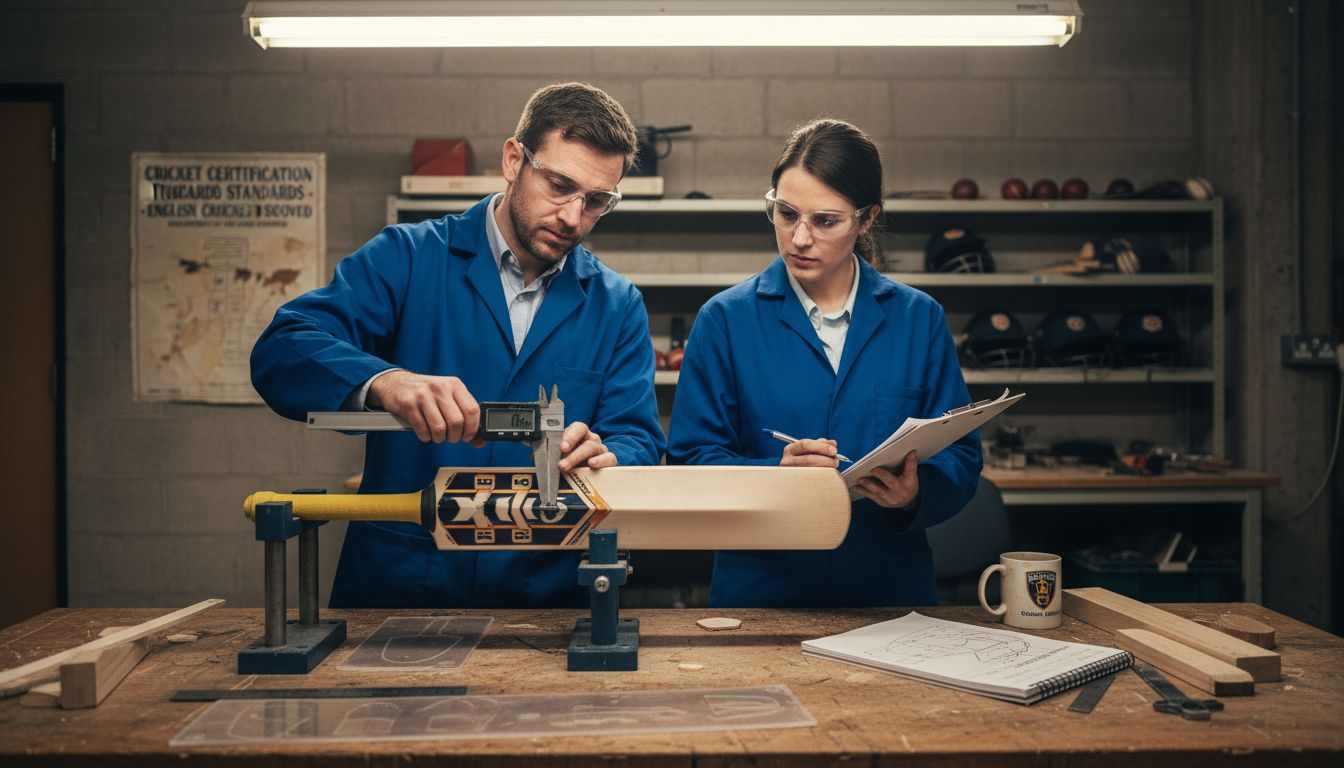
Beyond dimensional testing, bat certification includes performance testing that measures how the bat behaves when it strikes a cricket ball. Testing equipment applies consistent impact forces to different areas of the blade and records how the ball responds. This performance data ensures that a bat doesn’t impart excessive energy to the ball, which would give batsmen an unfair advantage. The testing also verifies that the bat’s construction remains sound under normal playing conditions. Bats that pass this performance testing receive classification grades, typically ranging from Type A to Type D, depending on their compliance level and intended use. A Type A classification means the bat meets all standards for international play, whilst lower classifications indicate restrictions on where the bat can be used.
Grading classifications directly affect where you can actually use your bat. A Type A bat works everywhere: international matches, national tournaments, county cricket, and local club competitions. A Type C bat might be legal for domestic play but restricted from international matches. A Type D bat is typically reserved for practice or lower-level amateur play. When you’re purchasing a bat, always check which classification it carries because this determines its legitimacy for your specific competition level. Many players make the mistake of assuming all certified bats are equal, but the classification system creates important distinctions. If you’re planning to play in serious amateur or semi-professional cricket, investing in a Type A classified bat saves you from future disappointment or disqualification.
The table below explains the bat classification system and where each type can be used:
| Classification | Eligible Competitions | Usage Limitations |
|---|---|---|
| Type A | All levels, including international | No restrictions |
| Type C | Domestic and local competitions | Not suitable for international |
| Type D | Practice and amateur levels | Ineligible for most matches |
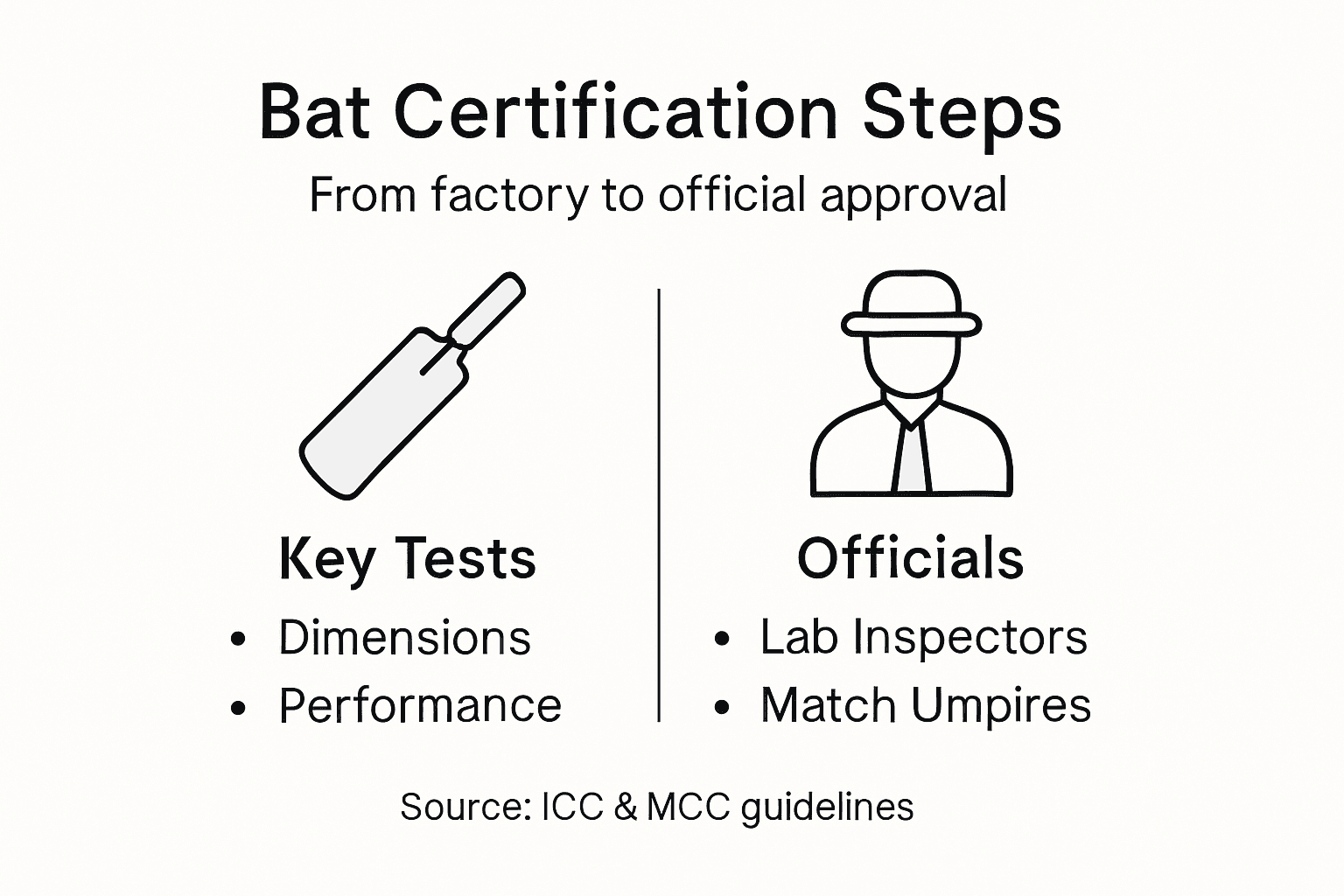
Testing doesn’t stop after initial certification. Umpires and match officials conduct spot checks during actual matches to ensure bats remain compliant. If a bat fails on-field inspection, it’s removed from play immediately. This ongoing enforcement maintains integrity because it prevents players from attempting to modify bats after certification or use equipment that’s suffered damage affecting its compliance status.
Pro tip: Always purchase a bat with Type A classification if you’re serious about playing competitive cricket, as this guarantees your equipment is legal across all match levels and prevents needing to replace your bat as you progress.
Compliance For Players And Retailers
Compliance with bat certifications isn’t optional if you want to play official cricket. As a player, using an uncertified bat in a sanctioned match risks disqualification and potential bans from competitions. Retailers who sell non-compliant bats face consequences ranging from loss of trading privileges to legal action from governing bodies. This shared responsibility between players and sellers creates a system where everyone has incentive to follow the rules. When you buy from a reputable retailer, you’re not just getting a bat; you’re getting assurance that someone else has already verified its compliance. But that doesn’t mean you can ignore your own responsibility to confirm the bat meets standards for your specific competition.
As a player, your compliance obligations are straightforward but non-negotiable. You must use only certified bats that meet ICC bat regulations for dimensions and materials during official matches. Before stepping onto the pitch, understand which classification your bat carries and whether it’s legal for your competition level. If you’re playing in a tournament, check the specific requirements because some competitions have additional restrictions beyond ICC minimums. Keep your bat in good condition because damage can affect compliance. A cracked blade or separated handle might render your bat non-compliant even if it passed initial certification. Match officials will inspect your bat before play begins, and if it fails inspection, you’ll be unable to bat. This isn’t a technicality; it’s the enforcement mechanism that keeps the game fair.
Retailers carry substantial responsibility for compliance. They must stock only certified bats and maintain documentation proving certification. Reputable retailers understand this obligation and display certification information prominently. When you buy online or in shops, legitimate sellers provide detailed specification sheets and certification details without hesitation. If a retailer can’t or won’t provide certification documentation, that’s a red flag. You’re not just getting poor customer service; you’re potentially buying equipment that’s illegal for official play. Quality retailers also educate customers about which bats suit different competition levels, preventing you from accidentally purchasing a bat that’s legal locally but restricted nationally. This education protects both you and the retailer from compliance issues.
Match officials enforce compliance through pre-match inspections and spot checks during play. They measure bats, inspect construction, and can reject equipment that fails standards. If your bat is rejected, you must leave the field. This enforcement exists to maintain fairness and integrity. Understanding compliance isn’t bureaucratic nonsense; it’s the foundation that makes competitive cricket meaningful. Your investment in a compliant bat is an investment in playing legitimately.
Pro tip: Before purchasing any bat, request written certification documentation from the retailer and verify it matches your specific competition’s requirements rather than relying on verbal assurances or seller claims.
Avoiding Non-Compliant And Counterfeit Bats
Counterfeit bats represent a genuine threat to your cricket investment and playing legitimacy. Counterfeiters replicate popular bat designs and packaging so convincingly that casual buyers struggle to spot the difference. A fake bat might look identical to the real thing on your shelf, but the internal construction often uses inferior wood, inadequate treatment, or non-compliant dimensions. When you swing a counterfeit bat in a match, you risk catastrophic failure—the blade shatters mid-shot, embarrassing you publicly and potentially injuring nearby fielders. Beyond safety concerns, using a counterfeit bat in official play results in disqualification and potential bans from competitions. The ICC enforces strict protocols against counterfeit equipment because it undermines the entire integrity of competitive cricket.
Identifying authentic bats requires knowing what to look for. Legitimate manufacturers place official markings and certification numbers on every bat they produce. These markings aren’t cosmetic; they’re traceable identifiers that verify the bat’s legitimacy. When you buy online or in shops, request the certification number and verify it directly with the manufacturer. Reputable sellers provide this information instantly because they stand behind their inventory. Counterfeiters struggle with this step because they can’t access genuine certification systems. The bat’s weight, balance, and wood grain should match the manufacturer’s specifications—counterfeits often feel slightly different because the materials are substandard. Examine the handle construction closely; genuine bats use quality cane binding and finishing, whilst counterfeits cut corners with cheap materials. The price itself offers clues. If a bat that normally costs £150 is suddenly available for £60, that dramatic discount usually signals counterfeiting, not a bargain.
Your purchasing strategy matters enormously. Buy from certified retailers and authorised dealers rather than unknown sellers on discount marketplaces. Established cricket shops, both online and physical, have reputation stakes that make them unlikely to stock counterfeits. They maintain relationships with manufacturers and can provide full documentation. When shopping online, check seller ratings and customer reviews specifically mentioning authentication. Ask whether the seller offers return guarantees if the bat fails certification inspection. Quality retailers stand behind their products with guarantees that counterfeiters can’t match. The ICC and major manufacturers publish identification guides highlighting counterfeit tactics so you recognise red flags. Familiarising yourself with these common counterfeiting methods takes twenty minutes but protects you from costly mistakes. Proper bat maintenance practices also help because you’ll notice earlier when something’s wrong with your equipment’s construction or performance characteristics.
If you suspect you’ve purchased a counterfeit bat, stop using it immediately. Report it to the seller and the manufacturer. Contact your local cricket association if you suspect counterfeits are circulating in your region. Your vigilance protects other players and supports the integrity of competitive cricket.
Pro tip: Always request the certification number from your seller before purchasing and verify it directly with the manufacturer’s website—this five-minute check eliminates counterfeit risk entirely.
Ensure Your Bat Meets Every Standard with Confidence
The challenge every cricketer faces is finding a bat that is not only high-quality but also fully compliant with ICC and MCC certifications as highlighted in the article. Navigating the complexities of bat classifications and regional rules can be overwhelming especially when your cricket ambitions are serious. You want assurance that your equipment meets global standards, preventing costly mistakes such as purchasing non-compliant or counterfeit bats that could jeopardize your playing eligibility.
At cricketbats.com, we understand these pain points and provide a carefully curated selection of certified cricket bats including trusted brands like New Balance Cricket Bats and adidas Cricket Bats. Our commitment to offering fully documented, ICC and MCC certified bats ensures you invest in gear that supports your performance and compliance.
Start your cricket journey with confidence by exploring our range of certified bats. Shop now at cricketbats.com to secure equipment that matches your passion and meets the highest standards. Don’t risk your match eligibility or safety; make a smart choice today and elevate your game with verified cricket bats.
Frequently Asked Questions
What are the main specifications that define a certified cricket bat?
The main specifications for a certified cricket bat include a maximum length of 38 inches and a maximum width of 4.25 inches. The blade must be entirely made from wood, while the handle can use cane and other approved materials.
How can I verify if a cricket bat is certified for official play?
To verify if a bat is certified, look for official certification marks or documentation from the manufacturer. You can also request certification information from the seller to confirm it meets the Laws of Cricket.
What is the difference between bat classifications?
Bat classifications range from Type A to Type D. Type A bats are suitable for all levels of play, including international matches, while Type C bats are for domestic competitions only. Type D bats are typically used for practice or lower-level games.
What should I do if I suspect my cricket bat is counterfeit?
If you suspect your bat is counterfeit, stop using it immediately. Report it to the seller and the manufacturer and contact your local cricket association to inform them about potential counterfeit products circulating in your region.
Recommended
Finding a cricket bat that feels perfect in your hands is only part of the story—making sure your bat meets global certification standards matters just as much for every serious player. With the Marylebone Cricket Club and International Cricket Council setting strict rules on bat size, materials, and legitimacy, your choice influences not just performance, but whether you can step onto the pitch with confidence. This guide breaks down how certifications protect you, ensure fair play, and help you purchase equipment that’s match-ready anywhere from London to Mumbai.
Table of Contents
- Cricket Bat Certifications Demystified
- Key Global Standards And Certifying Bodies
- ICC, MCC, BIS And Regional Rules
- Certification Process: Testing And Grading
- Compliance For Players And Retailers
- Avoiding Non-Compliant And Counterfeit Bats
Key Takeaways
| Point | Details |
|---|---|
| Certification Ensures Fair Play | Cricket bat certifications guarantee that your equipment meets global standards set by governing bodies, ensuring fair competition. |
| Understand Bat Specifications | Certified bats must adhere to specific dimensions and material requirements to prevent unfair advantages during play. |
| Check Certification Documentation | Always verify the certification of a bat through official documentation to ensure it meets the requirements for your competition level. |
| Be Aware of Counterfeits | Counterfeit bats may look authentic but often fail to meet safety and performance standards; always request certification numbers when purchasing. |
Cricket Bat Certifications Demystified
Cricket bat certifications exist to protect you and ensure fair competition. Without standardised rules, players could simply purchase bats with unfair advantages, and matches wouldn’t be played on level ground. The reason certifications matter is straightforward: they guarantee that the bat you’re holding meets global standards recognised by governing bodies. When you pick up a certified bat, you’re investing in equipment that’s been tested and validated to work within the rules you’ll actually play under.
The core specifications that define a certified bat come from the Laws of Cricket, maintained by the Marylebone Cricket Club. These laws set strict measurements: your bat cannot exceed 38 inches in length or 4.25 inches in width. The blade must be made entirely from wood, whilst the handle can use cane, binding, and other approved materials. These aren’t arbitrary restrictions. They exist because a bat that’s too large or made from unapproved materials gives you an unfair hitting advantage. When you’re shopping for a new bat, these dimensions form the foundation of what “certified” actually means.
Here’s where it gets practical for you as a player. Different cricket formats have different certification bodies and sometimes slightly different requirements. Test cricket, county cricket, and Twenty20 leagues all recognise the same basic Laws of Cricket, but some competitions might add their own regulations. If you’re playing serious amateur cricket or working towards semi-professional cricket, you need to check what certification your local or state association requires. Some bats are certified for all formats, whilst others might have restrictions. The manufacturing process itself also matters—understanding how cricket bats are manufactured gives you insight into why certifications focus on specific measurements and materials rather than just weight or balance.
Don’t assume all bats in a shop are certified just because they’re expensive or from a known brand. Ask the seller directly about certification. Look for official certification marks or documentation that proves the bat meets the Laws of Cricket. Some premium bats cost more because of brand reputation or aesthetics, not because they’re certified for official play. This distinction matters when you’re spending money on equipment.
Pro tip: Before purchasing any bat for official match play, request the certification documentation from the seller and verify it matches your specific league’s requirements, not just general cricket standards.
Key Global Standards And Certifying Bodies
When you’re buying a cricket bat, you’re relying on organisations that most players have never heard of. The International Cricket Council and the Marylebone Cricket Club are the two bodies that decide what’s legal and what isn’t. These aren’t random associations—they’re the actual authorities that govern competitive cricket worldwide. The ICC handles international playing conditions and enforcement, whilst the MCC maintains the Laws of Cricket that form the foundation of everything. Together, they ensure that whether you’re playing in London, Mumbai, or Melbourne, the bat regulations are identical. This global uniformity matters because it means your investment in a certified bat works across different competitions and countries.
The ICC’s role centres on international playing conditions, which incorporate bat specifications into Law 5 of the Laws of Cricket. The MCC, based at Lord’s in London, maintains these laws and updates them as the game evolves. Both bodies work together to set exact measurements, material requirements, and testing standards that manufacturers must follow. English willow remains the preferred material for blades because of its performance characteristics and the historical standardisation around it. When you see a bat advertised as ICC or MCC certified, it means independent testing has verified that the bat meets these precise specifications. The certifying bodies don’t just set rules and hope manufacturers comply—they enforce these standards through regular testing and match officiating.
Regional and national cricket boards follow the ICC guidelines to maintain consistency. Your state cricket association, county board, or local league all operates within the framework set by these global bodies. This cascading system means a bat certified for international play will be legal in your local competition, but the reverse isn’t always true. A bat that meets only your local association’s standards might not be approved for national tournaments. This distinction is crucial when you’re investing in equipment. If you’re serious about progressing beyond amateur cricket, purchasing a bat that meets ICC and MCC standards rather than just regional requirements gives you flexibility. You won’t need to buy different equipment if you move to a higher level of competition.
Here is a summary of key cricket bat certifying bodies and their main roles:
| Certifying Body | Main Responsibility | Scope of Influence |
|---|---|---|
| Marylebone Cricket Club (MCC) | Maintains Laws of Cricket and standards | Global foundational authority |
| International Cricket Council (ICC) | Enforces standards in international play | International tournaments and play |
| Bureau of Indian Standards (BIS) | Ensures domestic bats comply with national rules | Indian domestic competitions |
| Regional/National Boards | Adapt and implement rules locally | Local and national competitions |
The practical implication for you is straightforward: always buy from sellers who provide documentation confirming ICC or MCC certification. Don’t settle for vague claims that a bat is “legal” or “approved”—ask for specific certification details. Reputable manufacturers and sellers will have this information readily available because it’s a major selling point. When browsing online or in shops, look for certification marks or serial numbers that can be verified with the manufacturer.
Pro tip: Purchase a bat certified to ICC and MCC standards rather than just your local competition requirements—this gives you future flexibility if you progress to higher levels of play without needing to replace your equipment.
ICC, MCC, BIS And Regional Rules
You might think there’s one set of rules that applies everywhere, but cricket bat certifications actually work in layers. The MCC sets the foundation through Law 5 of the Laws of Cricket, which governs bat dimensions, materials, and permissible modifications. The ICC then adopts these universal standards and enforces them internationally. But here’s where it gets interesting for you as a player: some countries have their own certification bodies that sit between the ICC and regional boards. India’s Bureau of Indian Standards, known as BIS, is a prime example. BIS ensures that bats sold and used in Indian cricket comply with national standards that align with ICC rules. This multi-layered approach means a bat certified by BIS is also ICC compliant, but the certification process adds an extra layer of local oversight.
Understanding this hierarchy matters because it affects what you can actually use in competition. At the international level, ICC regulations are absolute. If you’re playing in a Test match, Twenty20 International, or ICC tournament, your bat must meet ICC standards. At the national level, your country’s cricket board operates within the ICC framework but may have additional requirements. In India, for instance, bats must pass BIS certification before they’re legal for domestic cricket. Regional and state-level competitions follow national standards, which flow from ICC rules. The key principle is that rules cascade downwards but never contradict each other. A bat approved at the international level will work at every regional level, but a bat approved only at regional level might not be legal nationally or internationally.
The practical reality is this: when you’re shopping for a bat, ask whether it’s certified under ICC playing conditions rather than just your local association’s rules. A bat certified internationally gives you the broadest possible scope for competition. If you’re in India and buying a bat, BIS certification combined with ICC approval is your target. Different countries may have different certification bodies, but they all work to the same ICC baseline. This means researching your specific country’s requirements takes just a few minutes but saves you from buying a bat that’s legal locally but won’t work if you progress to national competitions. The investment in the right certification protects your future cricket ambitions.
One common misconception is that premium pricing guarantees ICC compliance. Price and certification are separate issues. A bat can be expensive yet only certified regionally, or affordable yet fully ICC approved. Always request documentation proving certification rather than assuming the seller’s word or the bat’s price point. Reputable sellers provide this information without hesitation because transparency builds trust.
Pro tip: If you’re playing in any country, prioritise bats certified to ICC standards rather than just local or regional certifications—this ensures your equipment remains legal if you progress to higher levels of competition.
Certification Process: Testing And Grading
A bat doesn’t become certified just because a manufacturer says it meets standards. Behind every certified bat is a rigorous testing process that checks everything from precise measurements to how the bat performs when it strikes a ball. When you pick up a certified bat, that certification is backed by physical evidence, not marketing claims. The testing process involves checking the bat’s exact dimensions (length, width, thickness), verifying that the blade is made entirely of approved wood, and assessing the handle’s construction. Manufacturers submit their bats to independent testing facilities where equipment measures these specifications to tolerances measured in millimetres. A bat that’s even slightly oversized or contains unapproved materials fails certification immediately. This rigorous approach exists because even small variations in bat specifications can create unfair performance advantages.
Beyond dimensional testing, bat certification includes performance testing that measures how the bat behaves when it strikes a cricket ball. Testing equipment applies consistent impact forces to different areas of the blade and records how the ball responds. This performance data ensures that a bat doesn’t impart excessive energy to the ball, which would give batsmen an unfair advantage. The testing also verifies that the bat’s construction remains sound under normal playing conditions. Bats that pass this performance testing receive classification grades, typically ranging from Type A to Type D, depending on their compliance level and intended use. A Type A classification means the bat meets all standards for international play, whilst lower classifications indicate restrictions on where the bat can be used.
Grading classifications directly affect where you can actually use your bat. A Type A bat works everywhere: international matches, national tournaments, county cricket, and local club competitions. A Type C bat might be legal for domestic play but restricted from international matches. A Type D bat is typically reserved for practice or lower-level amateur play. When you’re purchasing a bat, always check which classification it carries because this determines its legitimacy for your specific competition level. Many players make the mistake of assuming all certified bats are equal, but the classification system creates important distinctions. If you’re planning to play in serious amateur or semi-professional cricket, investing in a Type A classified bat saves you from future disappointment or disqualification.
The table below explains the bat classification system and where each type can be used:
| Classification | Eligible Competitions | Usage Limitations |
|---|---|---|
| Type A | All levels, including international | No restrictions |
| Type C | Domestic and local competitions | Not suitable for international |
| Type D | Practice and amateur levels | Ineligible for most matches |
Testing doesn’t stop after initial certification. Umpires and match officials conduct spot checks during actual matches to ensure bats remain compliant. If a bat fails on-field inspection, it’s removed from play immediately. This ongoing enforcement maintains integrity because it prevents players from attempting to modify bats after certification or use equipment that’s suffered damage affecting its compliance status.
Pro tip: Always purchase a bat with Type A classification if you’re serious about playing competitive cricket, as this guarantees your equipment is legal across all match levels and prevents needing to replace your bat as you progress.
Compliance For Players And Retailers
Compliance with bat certifications isn’t optional if you want to play official cricket. As a player, using an uncertified bat in a sanctioned match risks disqualification and potential bans from competitions. Retailers who sell non-compliant bats face consequences ranging from loss of trading privileges to legal action from governing bodies. This shared responsibility between players and sellers creates a system where everyone has incentive to follow the rules. When you buy from a reputable retailer, you’re not just getting a bat; you’re getting assurance that someone else has already verified its compliance. But that doesn’t mean you can ignore your own responsibility to confirm the bat meets standards for your specific competition.
As a player, your compliance obligations are straightforward but non-negotiable. You must use only certified bats that meet ICC bat regulations for dimensions and materials during official matches. Before stepping onto the pitch, understand which classification your bat carries and whether it’s legal for your competition level. If you’re playing in a tournament, check the specific requirements because some competitions have additional restrictions beyond ICC minimums. Keep your bat in good condition because damage can affect compliance. A cracked blade or separated handle might render your bat non-compliant even if it passed initial certification. Match officials will inspect your bat before play begins, and if it fails inspection, you’ll be unable to bat. This isn’t a technicality; it’s the enforcement mechanism that keeps the game fair.
Retailers carry substantial responsibility for compliance. They must stock only certified bats and maintain documentation proving certification. Reputable retailers understand this obligation and display certification information prominently. When you buy online or in shops, legitimate sellers provide detailed specification sheets and certification details without hesitation. If a retailer can’t or won’t provide certification documentation, that’s a red flag. You’re not just getting poor customer service; you’re potentially buying equipment that’s illegal for official play. Quality retailers also educate customers about which bats suit different competition levels, preventing you from accidentally purchasing a bat that’s legal locally but restricted nationally. This education protects both you and the retailer from compliance issues.
Match officials enforce compliance through pre-match inspections and spot checks during play. They measure bats, inspect construction, and can reject equipment that fails standards. If your bat is rejected, you must leave the field. This enforcement exists to maintain fairness and integrity. Understanding compliance isn’t bureaucratic nonsense; it’s the foundation that makes competitive cricket meaningful. Your investment in a compliant bat is an investment in playing legitimately.
Pro tip: Before purchasing any bat, request written certification documentation from the retailer and verify it matches your specific competition’s requirements rather than relying on verbal assurances or seller claims.
Avoiding Non-Compliant And Counterfeit Bats
Counterfeit bats represent a genuine threat to your cricket investment and playing legitimacy. Counterfeiters replicate popular bat designs and packaging so convincingly that casual buyers struggle to spot the difference. A fake bat might look identical to the real thing on your shelf, but the internal construction often uses inferior wood, inadequate treatment, or non-compliant dimensions. When you swing a counterfeit bat in a match, you risk catastrophic failure—the blade shatters mid-shot, embarrassing you publicly and potentially injuring nearby fielders. Beyond safety concerns, using a counterfeit bat in official play results in disqualification and potential bans from competitions. The ICC enforces strict protocols against counterfeit equipment because it undermines the entire integrity of competitive cricket.
Identifying authentic bats requires knowing what to look for. Legitimate manufacturers place official markings and certification numbers on every bat they produce. These markings aren’t cosmetic; they’re traceable identifiers that verify the bat’s legitimacy. When you buy online or in shops, request the certification number and verify it directly with the manufacturer. Reputable sellers provide this information instantly because they stand behind their inventory. Counterfeiters struggle with this step because they can’t access genuine certification systems. The bat’s weight, balance, and wood grain should match the manufacturer’s specifications—counterfeits often feel slightly different because the materials are substandard. Examine the handle construction closely; genuine bats use quality cane binding and finishing, whilst counterfeits cut corners with cheap materials. The price itself offers clues. If a bat that normally costs £150 is suddenly available for £60, that dramatic discount usually signals counterfeiting, not a bargain.
Your purchasing strategy matters enormously. Buy from certified retailers and authorised dealers rather than unknown sellers on discount marketplaces. Established cricket shops, both online and physical, have reputation stakes that make them unlikely to stock counterfeits. They maintain relationships with manufacturers and can provide full documentation. When shopping online, check seller ratings and customer reviews specifically mentioning authentication. Ask whether the seller offers return guarantees if the bat fails certification inspection. Quality retailers stand behind their products with guarantees that counterfeiters can’t match. The ICC and major manufacturers publish identification guides highlighting counterfeit tactics so you recognise red flags. Familiarising yourself with these common counterfeiting methods takes twenty minutes but protects you from costly mistakes. Proper bat maintenance practices also help because you’ll notice earlier when something’s wrong with your equipment’s construction or performance characteristics.
If you suspect you’ve purchased a counterfeit bat, stop using it immediately. Report it to the seller and the manufacturer. Contact your local cricket association if you suspect counterfeits are circulating in your region. Your vigilance protects other players and supports the integrity of competitive cricket.
Pro tip: Always request the certification number from your seller before purchasing and verify it directly with the manufacturer’s website—this five-minute check eliminates counterfeit risk entirely.
Ensure Your Bat Meets Every Standard with Confidence
The challenge every cricketer faces is finding a bat that is not only high-quality but also fully compliant with ICC and MCC certifications as highlighted in the article. Navigating the complexities of bat classifications and regional rules can be overwhelming especially when your cricket ambitions are serious. You want assurance that your equipment meets global standards, preventing costly mistakes such as purchasing non-compliant or counterfeit bats that could jeopardize your playing eligibility.
At cricketbats.com, we understand these pain points and provide a carefully curated selection of certified cricket bats including trusted brands like New Balance Cricket Bats and adidas Cricket Bats. Our commitment to offering fully documented, ICC and MCC certified bats ensures you invest in gear that supports your performance and compliance.
Start your cricket journey with confidence by exploring our range of certified bats. Shop now at cricketbats.com to secure equipment that matches your passion and meets the highest standards. Don’t risk your match eligibility or safety; make a smart choice today and elevate your game with verified cricket bats.
Frequently Asked Questions
What are the main specifications that define a certified cricket bat?
The main specifications for a certified cricket bat include a maximum length of 38 inches and a maximum width of 4.25 inches. The blade must be entirely made from wood, while the handle can use cane and other approved materials.
How can I verify if a cricket bat is certified for official play?
To verify if a bat is certified, look for official certification marks or documentation from the manufacturer. You can also request certification information from the seller to confirm it meets the Laws of Cricket.
What is the difference between bat classifications?
Bat classifications range from Type A to Type D. Type A bats are suitable for all levels of play, including international matches, while Type C bats are for domestic competitions only. Type D bats are typically used for practice or lower-level games.
What should I do if I suspect my cricket bat is counterfeit?
If you suspect your bat is counterfeit, stop using it immediately. Report it to the seller and the manufacturer and contact your local cricket association to inform them about potential counterfeit products circulating in your region.