
News News
Why choose English willow for top cricket bat performance Why choose English willow for top cricket bat performance
Many players believe all cricket bats perform similarly if they look the part, but material choice fundamentally shapes your game. English willow stands apart from alternatives through specific physical properties that directly enhance shot power, control, and durability. This guide reveals the science behind English willow’s advantages and shows you exactly what to look for when selecting your next bat.
Table of Contents
- English Willow’s Unique Physical Properties And What They Mean For Performance
- Grain Structure And Grading: Decoding What Makes An English Willow Bat Top-Tier
- Comparing English Willow With Other Willow Types In Cricket Bats
- Ensuring Authenticity: Sourcing And Grading Transparency For English Willow Bats
- Explore Premium English Willow Cricket Bats And Accessories
- Why Choose English Willow Cricket Bats?
Key takeaways
| Point | Details |
|---|---|
| Cellular structure advantage | English willow’s unique cell arrangement delivers superior shock absorption and resilience compared to other materials. |
| Grain count matters | Higher grain density (10+ per inch) correlates with better energy transfer and more consistent performance across all shot types. |
| Weight and durability balance | Professional players favour English willow for its lighter pickup combined with exceptional longevity under match conditions. |
| Grading affects quality significantly | Willow grading systems vary between manufacturers, requiring careful verification to ensure authentic top-tier wood. |
| Traceability ensures authenticity | Legitimate English willow bats include batch numbers and harvest details that guarantee consistent performance characteristics. |
English willow’s unique physical properties and what they mean for performance
The performance difference you feel when using an English willow bat starts at the cellular level. English willow’s density ranges between 320–360 kg/m³, creating an optimal balance between lightness and structural integrity. This specific density range allows the wood to compress slightly on ball impact, then spring back instantly to transfer maximum energy.
The cellular makeup creates exceptional shock absorption that you’ll notice immediately. When you middle the ball, English willow reduces the jarring vibration that travels up the handle. This soft yet durable wood provides exceptional performance characteristics precisely because its cell walls flex without breaking under repeated high-speed impacts.
Energy transfer efficiency separates English willow from heavier alternatives. The wood’s natural flexibility allows it to store kinetic energy during the millisecond of ball contact, then release that energy as the ball leaves the bat face. This mechanical advantage translates to greater shot power without requiring additional swing force from you.
Pro Tip: When testing bats, tap the blade lightly with your knuckles. English willow produces a crisp, resonant sound rather than a dull thud, indicating proper density and moisture content for optimal performance.
Professional cricketers consistently choose English willow because the weight distribution feels natural through the swing arc. A Grade 1 English willow bat typically weighs between 1.1 and 1.2 kilograms yet plays lighter than Kashmir willow bats of similar mass. This perception comes from the wood’s even grain structure distributing mass more uniformly from toe to shoulder.
The scientific foundation explains why willow used in cricket bats outperforms other timber species. Other woods either lack the necessary flexibility, possess excessive density that adds unwanted weight, or fail to provide adequate shock dampening during aggressive stroke play.
“The right wood doesn’t just improve your shots; it transforms how confidently you approach each delivery.”
These physical properties work together to create the distinctive feel that experienced players recognise instantly. The combination of low density, high resilience, and superior shock absorption forms the foundation for every other performance advantage English willow offers.
Grain structure and grading: decoding what makes an English willow bat top-tier
Grain patterns visible on your bat’s face tell you more about performance potential than price tags do. Grain count indicates wood density because each line represents a year of tree growth. Tighter grains mean slower growth in cooler conditions, producing denser cellulose alignment that transfers energy more efficiently when you strike the ball.
| Grain Count Range | Quality Tier | Performance Characteristics |
|---|---|---|
| 10+ grains per inch | Premium Grade 1 | Maximum energy transfer, lightest pickup, superior durability |
| 7-9 grains per inch | Mid-range Grade 2 | Good performance, slight weight increase, adequate longevity |
| 5-6 grains per inch | Entry Grade 3 | Moderate response, heavier feel, shorter lifespan |
| 4 or fewer grains | Budget Grade 4 | Basic performance, significant weight, limited durability |
Straightness matters as much as density. Grains running parallel from toe to shoulder indicate the cleft was cut from the tree’s centre, where wood fibres align most uniformly. This alignment creates consistent flex across the entire hitting zone, giving you predictable shot behaviour whether you’re driving through cover or pulling square.
Willow grading lacks statutory definition across the industry, creating significant variation between manufacturers. One brand’s Grade 2 might match another’s Grade 1 specifications. This inconsistency means you cannot rely solely on grade labels when comparing bats from different makers.
Colour provides additional quality signals beyond grain structure. Pale, creamy willow with minimal red or brown heartwood indicates the cleft came from the tree’s outer sapwood layers. Sapwood delivers better performance than darker heartwood because its cellular structure remains more uniform and responsive.
Pro Tip: Count grains yourself rather than trusting grade labels. Examine the face between the maker’s sticker and the toe, where grains appear most clearly. Legitimate Grade 1 bats consistently show 10 or more distinct lines per inch in this section.
Manufacturers sometimes disguise lower-grade willow through strategic sticker placement or surface treatments. Remove protective plastic and inspect the entire face under good lighting. Irregular grain spacing, sudden colour changes, or knots hidden near edges all indicate compromised quality regardless of printed grade claims.
Understanding these grading signals helps you recognise cricket bat grading step by step and make informed decisions. The relationship between grain structure and performance remains consistent even when grade labels vary between brands.
Price correlates with grain quality because premium willow represents a tiny fraction of each harvest. Trees producing 10+ grain wood grow slowly in specific microclimates, making this timber genuinely scarce. When you see bat grade cricket bat options at vastly different prices, grain count usually explains the gap.
Comparing English willow with other willow types in cricket bats
Physical differences between willow species create measurable performance variations you’ll notice from your first practice session. English willow provides better shock absorption and lighter weight than Kashmir willow, the most common alternative material. This advantage comes from cellular structure differences that affect how each wood type responds to ball impact.
| Characteristic | English Willow | Kashmir Willow |
|---|---|---|
| Average Density | 320-360 kg/m³ | 400-450 kg/m³ |
| Typical Bat Weight | 1.1-1.2 kg | 1.3-1.5 kg |
| Grain Visibility | Pronounced, fine lines | Less distinct, wider spacing |
| Professional Adoption | 95%+ of international players | Primarily recreational use |
| Shock Absorption | Excellent | Moderate |
| Price Range | £150-£500+ | £40-£120 |
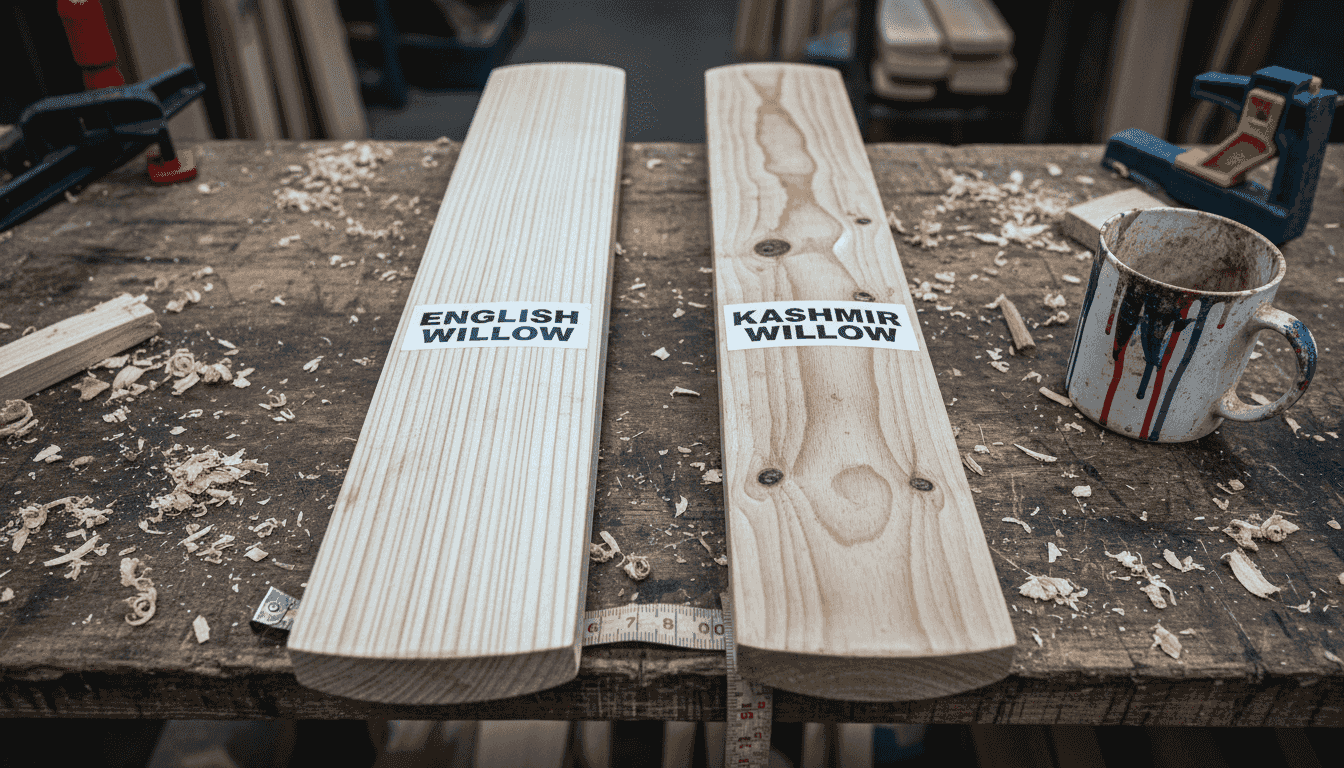
The grain patterns reveal fundamental structural differences. English willow displays fine, closely-spaced lines that feel smooth when you run your fingers across the face. Kashmir willow shows wider grain spacing with less pronounced definition, indicating faster growth and looser cellular arrangement.
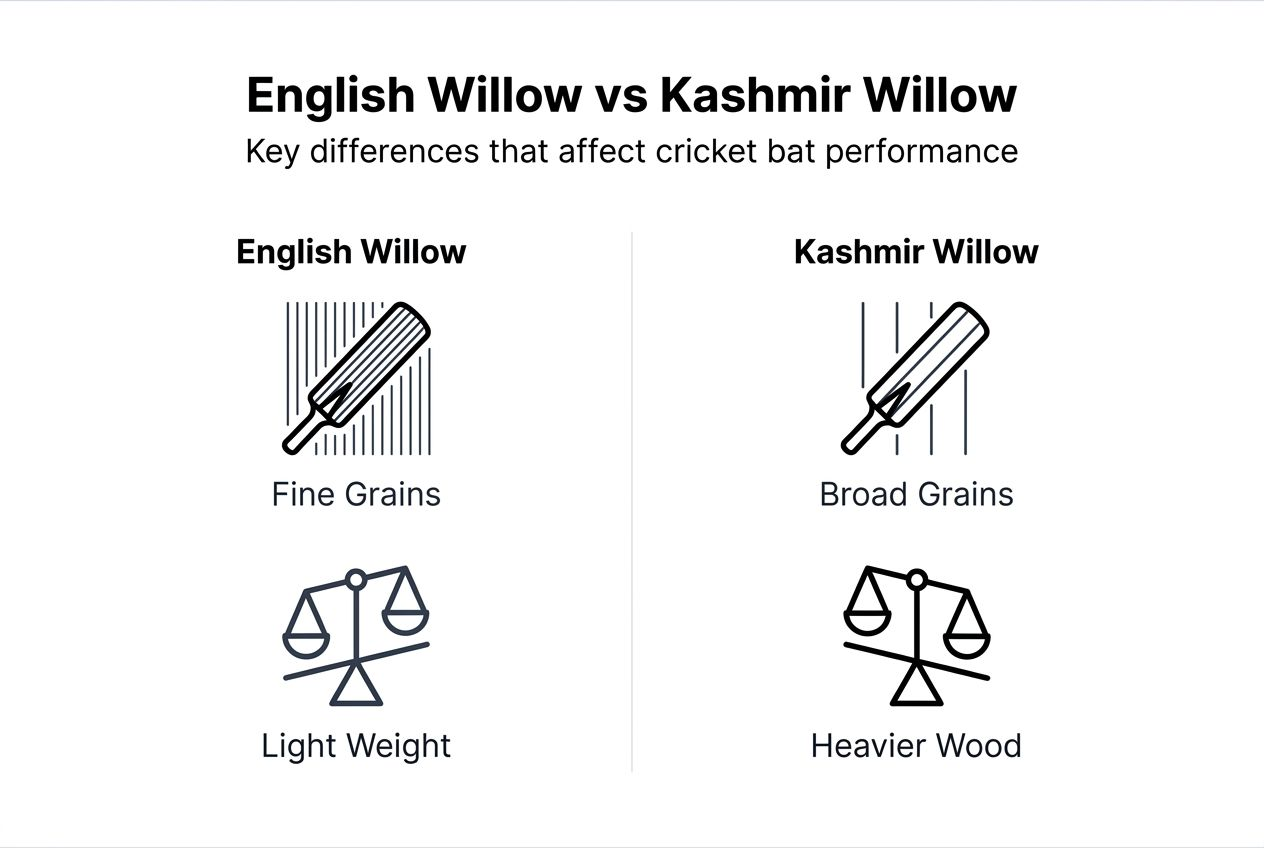
Weight distribution affects your batting mechanics more than total mass does. A 1.2 kg English willow bat balances differently than a 1.2 kg Kashmir alternative because English willow’s lower density requires more volume to reach the same weight. This volume distribution creates a lighter pickup feel that improves bat speed through your swing.
Professional cricketers overwhelmingly select English willow when performance matters most. International matches, domestic first-class cricket, and elite amateur competitions feature English willow bats almost exclusively. This preference reflects measurable advantages in shot power, control precision, and consistent response across diverse playing conditions.
Pro Tip: Identify genuine English willow by examining grain ends at the bat’s edge. English willow shows tight, uniform cell structure resembling fine honeycomb. Kashmir willow displays larger, irregular cells visible even without magnification.
Kashmir willow serves recreational players effectively when budget constraints outweigh performance needs. The wood provides adequate durability for casual matches and practice sessions. However, the additional weight and reduced shock absorption become limiting factors as your skill level advances.
Price differences reflect supply economics and performance capabilities. English willow grows only in specific English counties under particular climate conditions, creating natural scarcity. Kashmir willow grows more abundantly in northern India, making it more accessible but less refined for high-performance applications.
Texture differences become apparent when you handle both types. English willow feels smoother and denser despite its lower mass. Kashmir willow has a coarser grain that sometimes splinters more readily under repeated impact stress.
Understanding these comparisons helps you recognise features of top cricket bats and match your equipment to your playing level. The performance gap justifies the price premium when you’re ready to invest in your development.
Ensuring authenticity: sourcing and grading transparency for English willow bats
Verifying genuine English willow protects your investment and ensures you receive the performance characteristics you’re paying for. Reputable makers provide batch numbers linked directly to specific estates or cooperatives where the willow originated. These traceability markers appear on toe stickers or stamped into the bat’s shoulder.
Harvest year and drying duration indicate quality control in the manufacturing process. Premium English willow requires at least two years of controlled drying after harvest. Bats marked with harvest year two or more years before manufacture date demonstrate proper seasoning that stabilises the wood’s moisture content and cellular structure.
Authenticity markers you should verify before purchase include:
- Batch or lot number traceable to English willow estates
- Harvest year and drying duration clearly stated
- Maker’s mark or signature from bat craftsman
- Grain count matching stated grade specifications
- Certificate of authenticity from recognised manufacturers
Poorly sourced willow delivers inconsistent performance even when sold at premium prices. Immature willow that hasn’t dried adequately cracks prematurely, develops dead spots in the hitting zone, and loses structural integrity after minimal use. These failures occur regardless of the grade label printed on the bat.
Supplier reputation matters as much as physical inspection. Established bat makers maintain relationships with specific willow estates spanning decades. They control quality from tree selection through cleft preparation, ensuring consistency that occasional importers cannot match. Research manufacturer history and customer feedback before committing to higher-priced bats.
Pro Tip: Request photographs of the toe sticker before purchasing online. Legitimate English willow bats display detailed information about origin, grade, and processing. Vague labels or missing details suggest questionable provenance worth avoiding.
Misgraded willow represents a common authentication challenge. Some retailers upgrade Kashmir willow to “English” status or inflate grade numbers to justify inflated prices. Physical inspection reveals these deceptions through grain analysis, density assessment, and careful examination of colour patterns.
Transparent sourcing reduces your risk of expensive mistakes. Makers who openly share their willow sources, processing methods, and grading criteria demonstrate confidence in their product quality. This traceability ensures authenticity across luxury goods markets, and cricket equipment follows the same principles.
Direct relationships between bat makers and English willow estates create supply chain visibility that benefits you. When makers purchase entire tree lots from known growers, they control quality throughout processing. This vertical integration produces more consistent results than sourcing through middlemen or commodity markets.
Verification protects you from the disappointment of discovering your premium-priced bat uses inferior materials. Taking time to confirm authenticity before purchase ensures you receive genuine performance advantages that justify why choose English willow bats over alternatives.
Explore premium English willow cricket bats and accessories
Now that you understand what separates exceptional English willow from ordinary alternatives, you can explore equipment that meets these exacting standards. Our curated selection features verified English willow bats from established manufacturers who maintain transparent sourcing and grading practices.

Each bat in our collection includes detailed specifications covering grain count, willow grade, harvest information, and performance characteristics. You’ll find options ranging from entry-level English willow to premium Grade 1 selections favoured by professional players. Our cricket bats discount selection features equipment from trusted brands including Gunn & Moore, New Balance, and Gray-Nicolls.
The New Balance DC 1080 cricket bat exemplifies the performance advantages discussed throughout this guide. Crafted from Grade 1 English willow with 10+ grains per inch, it delivers the shock absorption, energy transfer, and lightweight pickup that enhance your game.
Complement your bat with professional accessories like the Gray-Nicolls ball bag black and red, designed to protect your equipment investment during transport and storage. We offer free shipping on qualifying orders plus dedicated customer service to help you select equipment matching your playing style and skill level.
Why choose English willow cricket bats?
What makes English willow better than Kashmir willow for cricket bats?
English willow’s cellular structure provides superior shock absorption and lighter weight, creating better energy transfer when striking the ball. The wood’s natural flexibility reduces vibration while its lower density (320-360 kg/m³ versus Kashmir’s 400-450 kg/m³) improves bat speed through your swing.
How many grains should a quality English willow bat have?
Premium Grade 1 English willow displays 10 or more grains per inch, indicating slow growth and dense cellular alignment. Mid-range bats show 7-9 grains, whilst budget options typically have 6 or fewer grains per inch affecting performance and durability.
Do English willow bats require special maintenance compared to other materials?
English willow needs regular oiling to maintain moisture balance and prevent surface cracking. Apply linseed oil every 3-4 weeks during active use, avoiding the splice area. Kashmir willow requires similar care but tolerates moisture variation better due to its denser structure.
How can I verify my bat uses genuine English willow?
Check for batch numbers linking to English estates, examine grain patterns for fine parallel lines, and verify the wood feels light relative to its size. Genuine English willow shows pale, creamy colouring with minimal heartwood and produces a crisp sound when tapped.
Are English willow bats suitable for amateur players or only professionals?
Amateur players benefit significantly from English willow’s performance advantages once they develop consistent technique. The improved shock absorption and energy transfer help intermediate players progress faster, whilst the lighter pickup reduces fatigue during extended practice sessions.
Recommended
Many players believe all cricket bats perform similarly if they look the part, but material choice fundamentally shapes your game. English willow stands apart from alternatives through specific physical properties that directly enhance shot power, control, and durability. This guide reveals the science behind English willow’s advantages and shows you exactly what to look for when selecting your next bat.
Table of Contents
- English Willow’s Unique Physical Properties And What They Mean For Performance
- Grain Structure And Grading: Decoding What Makes An English Willow Bat Top-Tier
- Comparing English Willow With Other Willow Types In Cricket Bats
- Ensuring Authenticity: Sourcing And Grading Transparency For English Willow Bats
- Explore Premium English Willow Cricket Bats And Accessories
- Why Choose English Willow Cricket Bats?
Key takeaways
| Point | Details |
|---|---|
| Cellular structure advantage | English willow’s unique cell arrangement delivers superior shock absorption and resilience compared to other materials. |
| Grain count matters | Higher grain density (10+ per inch) correlates with better energy transfer and more consistent performance across all shot types. |
| Weight and durability balance | Professional players favour English willow for its lighter pickup combined with exceptional longevity under match conditions. |
| Grading affects quality significantly | Willow grading systems vary between manufacturers, requiring careful verification to ensure authentic top-tier wood. |
| Traceability ensures authenticity | Legitimate English willow bats include batch numbers and harvest details that guarantee consistent performance characteristics. |
English willow’s unique physical properties and what they mean for performance
The performance difference you feel when using an English willow bat starts at the cellular level. English willow’s density ranges between 320–360 kg/m³, creating an optimal balance between lightness and structural integrity. This specific density range allows the wood to compress slightly on ball impact, then spring back instantly to transfer maximum energy.
The cellular makeup creates exceptional shock absorption that you’ll notice immediately. When you middle the ball, English willow reduces the jarring vibration that travels up the handle. This soft yet durable wood provides exceptional performance characteristics precisely because its cell walls flex without breaking under repeated high-speed impacts.
Energy transfer efficiency separates English willow from heavier alternatives. The wood’s natural flexibility allows it to store kinetic energy during the millisecond of ball contact, then release that energy as the ball leaves the bat face. This mechanical advantage translates to greater shot power without requiring additional swing force from you.
Pro Tip: When testing bats, tap the blade lightly with your knuckles. English willow produces a crisp, resonant sound rather than a dull thud, indicating proper density and moisture content for optimal performance.
Professional cricketers consistently choose English willow because the weight distribution feels natural through the swing arc. A Grade 1 English willow bat typically weighs between 1.1 and 1.2 kilograms yet plays lighter than Kashmir willow bats of similar mass. This perception comes from the wood’s even grain structure distributing mass more uniformly from toe to shoulder.
The scientific foundation explains why willow used in cricket bats outperforms other timber species. Other woods either lack the necessary flexibility, possess excessive density that adds unwanted weight, or fail to provide adequate shock dampening during aggressive stroke play.
“The right wood doesn’t just improve your shots; it transforms how confidently you approach each delivery.”
These physical properties work together to create the distinctive feel that experienced players recognise instantly. The combination of low density, high resilience, and superior shock absorption forms the foundation for every other performance advantage English willow offers.
Grain structure and grading: decoding what makes an English willow bat top-tier
Grain patterns visible on your bat’s face tell you more about performance potential than price tags do. Grain count indicates wood density because each line represents a year of tree growth. Tighter grains mean slower growth in cooler conditions, producing denser cellulose alignment that transfers energy more efficiently when you strike the ball.
| Grain Count Range | Quality Tier | Performance Characteristics |
|---|---|---|
| 10+ grains per inch | Premium Grade 1 | Maximum energy transfer, lightest pickup, superior durability |
| 7-9 grains per inch | Mid-range Grade 2 | Good performance, slight weight increase, adequate longevity |
| 5-6 grains per inch | Entry Grade 3 | Moderate response, heavier feel, shorter lifespan |
| 4 or fewer grains | Budget Grade 4 | Basic performance, significant weight, limited durability |
Straightness matters as much as density. Grains running parallel from toe to shoulder indicate the cleft was cut from the tree’s centre, where wood fibres align most uniformly. This alignment creates consistent flex across the entire hitting zone, giving you predictable shot behaviour whether you’re driving through cover or pulling square.
Willow grading lacks statutory definition across the industry, creating significant variation between manufacturers. One brand’s Grade 2 might match another’s Grade 1 specifications. This inconsistency means you cannot rely solely on grade labels when comparing bats from different makers.
Colour provides additional quality signals beyond grain structure. Pale, creamy willow with minimal red or brown heartwood indicates the cleft came from the tree’s outer sapwood layers. Sapwood delivers better performance than darker heartwood because its cellular structure remains more uniform and responsive.
Pro Tip: Count grains yourself rather than trusting grade labels. Examine the face between the maker’s sticker and the toe, where grains appear most clearly. Legitimate Grade 1 bats consistently show 10 or more distinct lines per inch in this section.
Manufacturers sometimes disguise lower-grade willow through strategic sticker placement or surface treatments. Remove protective plastic and inspect the entire face under good lighting. Irregular grain spacing, sudden colour changes, or knots hidden near edges all indicate compromised quality regardless of printed grade claims.
Understanding these grading signals helps you recognise cricket bat grading step by step and make informed decisions. The relationship between grain structure and performance remains consistent even when grade labels vary between brands.
Price correlates with grain quality because premium willow represents a tiny fraction of each harvest. Trees producing 10+ grain wood grow slowly in specific microclimates, making this timber genuinely scarce. When you see bat grade cricket bat options at vastly different prices, grain count usually explains the gap.
Comparing English willow with other willow types in cricket bats
Physical differences between willow species create measurable performance variations you’ll notice from your first practice session. English willow provides better shock absorption and lighter weight than Kashmir willow, the most common alternative material. This advantage comes from cellular structure differences that affect how each wood type responds to ball impact.
| Characteristic | English Willow | Kashmir Willow |
|---|---|---|
| Average Density | 320-360 kg/m³ | 400-450 kg/m³ |
| Typical Bat Weight | 1.1-1.2 kg | 1.3-1.5 kg |
| Grain Visibility | Pronounced, fine lines | Less distinct, wider spacing |
| Professional Adoption | 95%+ of international players | Primarily recreational use |
| Shock Absorption | Excellent | Moderate |
| Price Range | £150-£500+ | £40-£120 |
The grain patterns reveal fundamental structural differences. English willow displays fine, closely-spaced lines that feel smooth when you run your fingers across the face. Kashmir willow shows wider grain spacing with less pronounced definition, indicating faster growth and looser cellular arrangement.
Weight distribution affects your batting mechanics more than total mass does. A 1.2 kg English willow bat balances differently than a 1.2 kg Kashmir alternative because English willow’s lower density requires more volume to reach the same weight. This volume distribution creates a lighter pickup feel that improves bat speed through your swing.
Professional cricketers overwhelmingly select English willow when performance matters most. International matches, domestic first-class cricket, and elite amateur competitions feature English willow bats almost exclusively. This preference reflects measurable advantages in shot power, control precision, and consistent response across diverse playing conditions.
Pro Tip: Identify genuine English willow by examining grain ends at the bat’s edge. English willow shows tight, uniform cell structure resembling fine honeycomb. Kashmir willow displays larger, irregular cells visible even without magnification.
Kashmir willow serves recreational players effectively when budget constraints outweigh performance needs. The wood provides adequate durability for casual matches and practice sessions. However, the additional weight and reduced shock absorption become limiting factors as your skill level advances.
Price differences reflect supply economics and performance capabilities. English willow grows only in specific English counties under particular climate conditions, creating natural scarcity. Kashmir willow grows more abundantly in northern India, making it more accessible but less refined for high-performance applications.
Texture differences become apparent when you handle both types. English willow feels smoother and denser despite its lower mass. Kashmir willow has a coarser grain that sometimes splinters more readily under repeated impact stress.
Understanding these comparisons helps you recognise features of top cricket bats and match your equipment to your playing level. The performance gap justifies the price premium when you’re ready to invest in your development.
Ensuring authenticity: sourcing and grading transparency for English willow bats
Verifying genuine English willow protects your investment and ensures you receive the performance characteristics you’re paying for. Reputable makers provide batch numbers linked directly to specific estates or cooperatives where the willow originated. These traceability markers appear on toe stickers or stamped into the bat’s shoulder.
Harvest year and drying duration indicate quality control in the manufacturing process. Premium English willow requires at least two years of controlled drying after harvest. Bats marked with harvest year two or more years before manufacture date demonstrate proper seasoning that stabilises the wood’s moisture content and cellular structure.
Authenticity markers you should verify before purchase include:
- Batch or lot number traceable to English willow estates
- Harvest year and drying duration clearly stated
- Maker’s mark or signature from bat craftsman
- Grain count matching stated grade specifications
- Certificate of authenticity from recognised manufacturers
Poorly sourced willow delivers inconsistent performance even when sold at premium prices. Immature willow that hasn’t dried adequately cracks prematurely, develops dead spots in the hitting zone, and loses structural integrity after minimal use. These failures occur regardless of the grade label printed on the bat.
Supplier reputation matters as much as physical inspection. Established bat makers maintain relationships with specific willow estates spanning decades. They control quality from tree selection through cleft preparation, ensuring consistency that occasional importers cannot match. Research manufacturer history and customer feedback before committing to higher-priced bats.
Pro Tip: Request photographs of the toe sticker before purchasing online. Legitimate English willow bats display detailed information about origin, grade, and processing. Vague labels or missing details suggest questionable provenance worth avoiding.
Misgraded willow represents a common authentication challenge. Some retailers upgrade Kashmir willow to “English” status or inflate grade numbers to justify inflated prices. Physical inspection reveals these deceptions through grain analysis, density assessment, and careful examination of colour patterns.
Transparent sourcing reduces your risk of expensive mistakes. Makers who openly share their willow sources, processing methods, and grading criteria demonstrate confidence in their product quality. This traceability ensures authenticity across luxury goods markets, and cricket equipment follows the same principles.
Direct relationships between bat makers and English willow estates create supply chain visibility that benefits you. When makers purchase entire tree lots from known growers, they control quality throughout processing. This vertical integration produces more consistent results than sourcing through middlemen or commodity markets.
Verification protects you from the disappointment of discovering your premium-priced bat uses inferior materials. Taking time to confirm authenticity before purchase ensures you receive genuine performance advantages that justify why choose English willow bats over alternatives.
Explore premium English willow cricket bats and accessories
Now that you understand what separates exceptional English willow from ordinary alternatives, you can explore equipment that meets these exacting standards. Our curated selection features verified English willow bats from established manufacturers who maintain transparent sourcing and grading practices.
Each bat in our collection includes detailed specifications covering grain count, willow grade, harvest information, and performance characteristics. You’ll find options ranging from entry-level English willow to premium Grade 1 selections favoured by professional players. Our cricket bats discount selection features equipment from trusted brands including Gunn & Moore, New Balance, and Gray-Nicolls.
The New Balance DC 1080 cricket bat exemplifies the performance advantages discussed throughout this guide. Crafted from Grade 1 English willow with 10+ grains per inch, it delivers the shock absorption, energy transfer, and lightweight pickup that enhance your game.
Complement your bat with professional accessories like the Gray-Nicolls ball bag black and red, designed to protect your equipment investment during transport and storage. We offer free shipping on qualifying orders plus dedicated customer service to help you select equipment matching your playing style and skill level.
Why choose English willow cricket bats?
What makes English willow better than Kashmir willow for cricket bats?
English willow’s cellular structure provides superior shock absorption and lighter weight, creating better energy transfer when striking the ball. The wood’s natural flexibility reduces vibration while its lower density (320-360 kg/m³ versus Kashmir’s 400-450 kg/m³) improves bat speed through your swing.
How many grains should a quality English willow bat have?
Premium Grade 1 English willow displays 10 or more grains per inch, indicating slow growth and dense cellular alignment. Mid-range bats show 7-9 grains, whilst budget options typically have 6 or fewer grains per inch affecting performance and durability.
Do English willow bats require special maintenance compared to other materials?
English willow needs regular oiling to maintain moisture balance and prevent surface cracking. Apply linseed oil every 3-4 weeks during active use, avoiding the splice area. Kashmir willow requires similar care but tolerates moisture variation better due to its denser structure.
How can I verify my bat uses genuine English willow?
Check for batch numbers linking to English estates, examine grain patterns for fine parallel lines, and verify the wood feels light relative to its size. Genuine English willow shows pale, creamy colouring with minimal heartwood and produces a crisp sound when tapped.
Are English willow bats suitable for amateur players or only professionals?
Amateur players benefit significantly from English willow’s performance advantages once they develop consistent technique. The improved shock absorption and energy transfer help intermediate players progress faster, whilst the lighter pickup reduces fatigue during extended practice sessions.