
News News
Why Willow Is Used in Cricket Bats: Performance Benefits Why Willow Is Used in Cricket Bats: Performance Benefits
Finding the perfect cricket bat can make all the difference when you step up to the crease in a British summer league match. For young and ambitious players, understanding why willow is trusted by professionals unlocks a real competitive edge. Crafted from tough and lightweight Salix alba var caerulea, cricket bat willow absorbs shock and resists splintering while enabling quick bat movement. This introduction reveals how material choice impacts your batting power, durability, and comfort so you can play your best every innings.
Table of Contents
- Willow In Cricket Bats: Core Properties Explained
- Types Of Willow Used For Bat Making
- Grain Structure And Grading Systems
- Material Advantages For Players
- Comparing Willow To Other Wood Choices
- Maintenance, Longevity And Common Mistakes
Key Takeaways
| Point | Details |
|---|---|
| Willow’s Unique Properties | Cricket bat willow is prized for its shock absorption, lightweight nature, and dense structure, making it the ideal material for crafting high-performance bats. |
| Choosing the Right Willow | English Willow, with its superior grain structure, is recommended for professional use, while Kashmir Willow serves as an affordable alternative for club players. |
| Importance of Grain Structure | The quality of a bat’s grain impacts performance; straight, tight grains enhance shock absorption and longevity of the bat. |
| Maintenance Practices | Proper care, including knocking-in and mindful storage, is essential to prolong the life and maintain the performance of cricket bats made from willow. |
Willow in Cricket Bats: Core Properties Explained
Willow represents a remarkable material uniquely suited to cricket bat manufacturing, offering exceptional performance characteristics that make it the gold standard for bat construction. Cricket bat willow’s distinctive properties stem from its remarkable structural composition, which enables superior shock absorption and lightweight manoeuvrability.
The specific variety used in cricket bat production, known scientifically as Salix alba var. caerulea, possesses several extraordinary attributes that distinguish it from other timber types:
- Exceptional shock resistance that prevents bat splintering during high-impact strikes
- Lightweight construction enabling rapid bat movement
- Dense cellular structure that maintains structural integrity
- Natural vibration dampening qualities that reduce energy loss during ball contact
Bat manufacturers carefully select cricket bat willow for its ability to withstand immense kinetic forces while remaining incredibly light. Specialised willow varieties developed specifically for sporting equipment provide cricket players with an optimised performance tool that balances strength, flexibility, and weight management.
The wood’s unique cellular composition allows it to absorb and redistribute energy effectively, meaning batsmen can generate more power with less physical effort. This biomechanical advantage transforms willow from a simple timber into a sophisticated sporting instrument.
Pro tip: When selecting a cricket bat, always examine the willow’s grain structure and ensure tight, straight lines for optimal performance.
Types of Willow Used for Bat Making
When it comes to cricket bat manufacturing, not all willow varieties are created equal. Specialised cricket bat willow represents a carefully cultivated timber variety with exceptional characteristics specifically designed for sporting performance.
The primary varieties used in bat production include:
- English Willow (Salix alba ‘Caerulea’): The gold standard for cricket bats
- Kashmir Willow: A more affordable alternative with slightly different properties
- Salix viminalis: Primarily used in basketry, not bat manufacturing
- Salix pentandra: Another variety unsuitable for cricket bat construction
English Willow, scientifically known as Salix alba ‘Caerulea’, stands out as the premier choice for professional and high-performance cricket bats. This variety features a remarkably straight grain structure, exceptional shock absorption, and a lightweight composition that enables rapid bat movement.
The genetic characteristics of cricket bat willow make it unique among timber varieties. Unlike other woods, this specialised willow offers an optimal balance between density, flexibility, and durability. Manufacturers carefully select trees with tight, straight grains that can withstand the immense kinetic forces experienced during cricket matches.
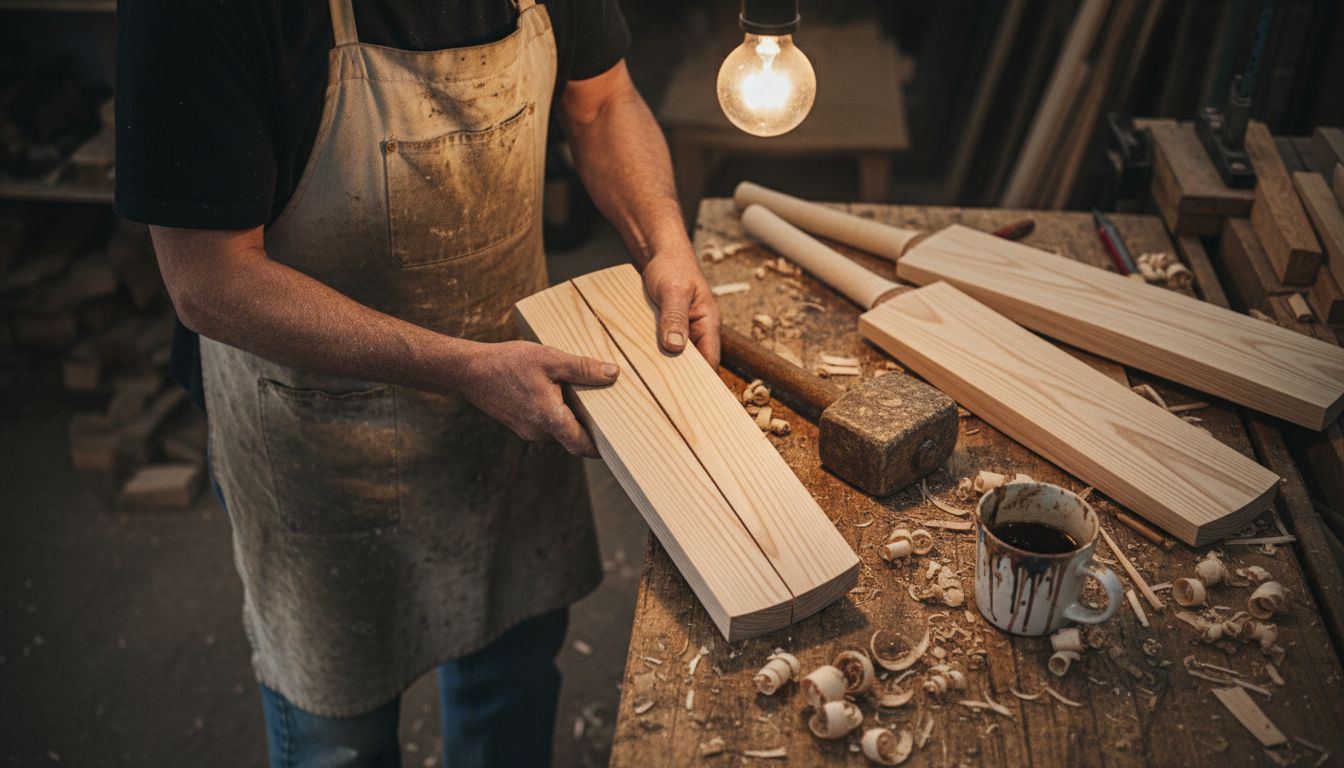
Regional variations in willow cultivation play a significant role in determining bat quality. English Willow grown in specific regions of the United Kingdom demonstrates superior performance characteristics compared to willow sourced from other geographical locations.
Here is a summary comparing the key willow varieties and their cricket bat suitability:
| Willow Variety | Main Application | Performance Profile | Common Use Level |
|---|---|---|---|
| English Willow | Professional bats | Outstanding shock absorption | Elite/professional |
| Kashmir Willow | Entry-level/intermediate | Slightly heavier, less power | Club and school levels |
| Salix viminalis | Basketry/crafts | Too soft for bat use | Not used for bats |
| Salix pentandra | Non-sporting timber | Insufficient durability | Not used for bats |
Pro tip: When selecting a cricket bat, prioritise English Willow varieties with straight, tight grains for maximum performance and durability.
Grain Structure and Grading Systems
Understanding the intricacies of cricket bat wood grain is crucial for selecting a high-performance bat. The grain structure represents more than just aesthetic lines – it’s a critical indicator of the wood’s potential performance and durability.
Professional bat grading typically involves assessing several key grain characteristics:
- Grain Straightness: Perfectly straight lines indicate superior wood quality
- Grain Density: Tighter, more compact grains suggest enhanced strength
- Grain Count: Number of growth rings per inch impacts bat performance
- Grain Uniformity: Consistent grain patterns indicate more reliable wood
Grain Grades are typically classified into several categories, ranging from the highest quality Grade 1+ to more affordable lower grades. The top-tier grades feature:
- Extremely straight and narrow grain lines
- Minimal visual imperfections
- Consistent wood density
- Maximum potential for shock absorption
Environmental factors play a significant role in willow wood grain development. The growing conditions, soil composition, and climate directly influence the wood’s cellular structure, ultimately determining its suitability for cricket bat manufacturing.
Manufacturers and professional players understand that grain structure is not just about visual appeal, but a critical performance metric. A bat with superior grain characteristics can significantly enhance a player’s striking power, control, and overall batting experience.
Pro tip: Always inspect a cricket bat’s grain structure carefully, looking for straight, tight, and uniform lines to ensure optimal performance.
Material Advantages for Players
Willow’s extraordinary performance characteristics transform cricket bats from simple sporting equipment into precision instruments that enhance a player’s natural abilities. The material’s unique properties provide cricketers with significant competitive advantages across multiple aspects of gameplay.
Key performance advantages include:
- Lightweight Manoeuvrability: Enables faster bat swing and quicker reaction times
- Shock Absorption: Reduces vibration and hand fatigue during intense matches
- Energy Transfer: Maximises power transmission from bat to ball
- Durability: Withstands repeated high-impact strikes without compromising structural integrity
Biomechanical Benefits emerge from willow’s remarkable structural composition. Willow’s shock-absorbing properties allow players to generate more powerful strikes while minimising physical strain. The wood’s natural resilience means less energy is lost during ball contact, translating directly into improved batting performance.
Professional players appreciate willow’s nuanced performance characteristics. The material’s high strength-to-weight ratio means cricketers can maintain precise control without sacrificing striking power. Subtle variations in grain structure and wood density further personalise each bat’s unique playing characteristics.
These material advantages represent more than technical specifications – they’re a critical interface between human skill and sophisticated sporting technology. A well-crafted willow bat becomes an extension of the player’s physical capabilities.
Pro tip: Select a cricket bat that feels like a natural extension of your body, with willow characteristics that complement your individual batting style.
Comparing Willow to Other Wood Choices
When evaluating timber for cricket bat manufacturing, willow stands distinctively superior compared to alternative wood options. Its unique combination of properties makes it practically unrivalled in sporting equipment construction.
Key comparative advantages of willow include:
- Lightweight Performance: Significantly lighter than oak, maple, or ash
- Impact Resistance: Superior shock absorption compared to denser woods
- Energy Transmission: More efficient power transfer than alternative timber
- Structural Integrity: Less prone to splintering or structural breakdown
Mechanical Comparisons reveal willow’s remarkable engineering advantages. Wood selection for cricket equipment demands precise material characteristics that most commercial timbers cannot match. Oak, for instance, proves too heavy and rigid, while pine lacks the necessary structural strength.
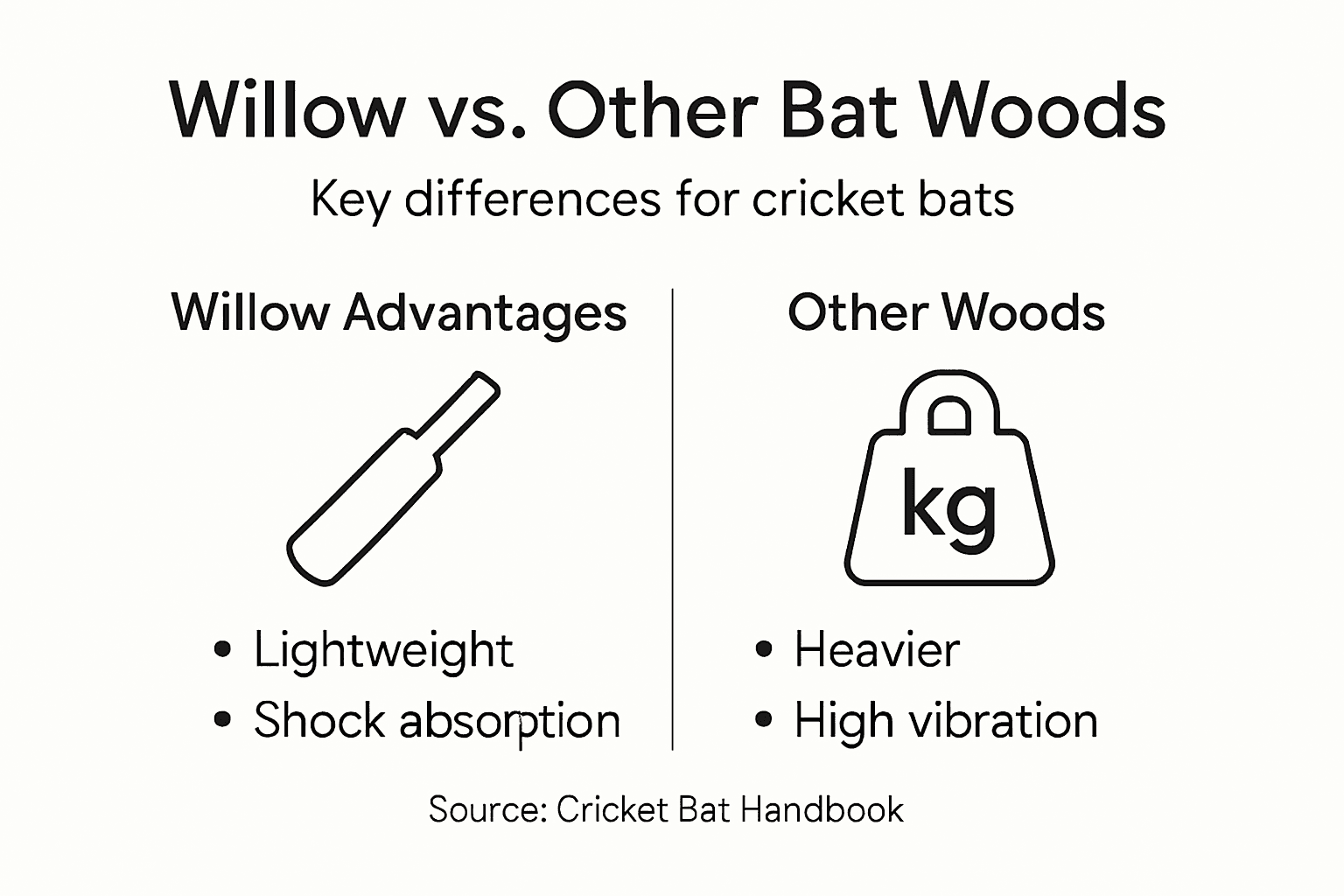
Other wood types fundamentally compromise batting performance. Hardwoods like hickory or maple create excessive vibration and reduce bat manoeuvrability. Their dense cellular structures absorb less kinetic energy, directly impacting a player’s striking power and control.
The sporting regulations further underscore willow’s unparalleled suitability. Professional cricket associations mandate willow as the primary bat material, recognising its extraordinary performance characteristics that cannot be replicated by alternative wood choices.
Pro tip: Always prioritise willow’s unique performance attributes over aesthetic considerations when selecting a cricket bat.
Maintenance, Longevity and Common Mistakes
Maintaining a cricket bat requires understanding its delicate nature and specific care requirements. Willow’s unique composition demands careful handling to preserve its performance characteristics and extend its usable lifespan.
Common maintenance mistakes include:
- Neglecting initial preparation: Failing to properly knock-in a new bat
- Inconsistent moisture management: Exposing bat to extreme humidity or dryness
- Improper storage: Leaving bat in direct sunlight or damp environments
- Ignoring minor damage: Not addressing small cracks or splits immediately
Preservation Techniques are crucial for maintaining bat performance. Willow wood care involves several critical steps to prevent premature deterioration. Regular oiling with raw linseed oil helps maintain the wood’s moisture balance and prevents cracking, while careful storage protects against environmental damage.
Knocking-in represents a critical initial maintenance process that many amateur players overlook. This technique involves gradually compressing the soft wood fibres to create a dense surface capable of withstanding high-impact strikes. Players should spend considerable time gently striking the bat with a specialised mallet, ensuring even compression across the bat’s surface.
Environmental factors significantly impact willow bat longevity. Extreme temperatures, high humidity, and direct sunlight can rapidly degrade the wood’s structural integrity. Serious players invest in protective bat covers and maintain consistent storage conditions to maximise their equipment’s performance and lifespan.
The following table outlines common cricket bat maintenance mistakes and their long-term effects:
| Maintenance Error | Consequence | Prevention Strategy |
|---|---|---|
| Skipping knocking-in | Increased risk of cracking | Gradually compress bat face |
| Poor moisture control | Warping or splitting | Store in dry, stable area |
| Leaving in sunlight | Drying, brittleness, surface peel | Use bat cover, avoid heat |
| Ignoring small cracks | Escalation to major splits | Repair promptly |
Pro tip: Always store your cricket bat in a cool, dry place and apply light linseed oil every few months to maintain its structural integrity.
Experience the Power of Willow with the Perfect Cricket Bat
Choosing the right willow for your cricket bat is crucial for unlocking superior performance. This article highlights the unique qualities of willow such as exceptional shock absorption, lightweight manoeuvrability and natural vibration dampening. If you want to feel the difference that expertly selected willow brings to your game, browse our extensive selection of high-quality bats crafted for every skill level including juniors. Start your journey with our Junior Cricket Bats | Cheap Junior Cricket Bats – Cricket Bats Com collection, designed with the finest willow to deliver both durability and control.

Don’t settle for anything less than a willow bat tailored for excellence. Visit cricketbats.com now and explore premium options like adidas Cricket Bats – Cricket Bats Com featuring renowned brands trusted by professionals. Take advantage of our free shipping and expert customer service to upgrade your cricket gear today and feel the willow difference on the pitch.
Frequently Asked Questions
What are the main advantages of using willow in cricket bats?
Willow provides exceptional shock absorption, lightweight construction, and natural vibration dampening, making it ideal for cricket bats. These properties enhance performance by allowing for powerful strikes with less physical effort.
How does the grain structure of willow affect cricket bat performance?
The grain structure of willow directly impacts bat performance, with straighter, tighter grains indicating stronger, more durable wood. Higher-quality grain typically results in improved shock absorption and more reliable performance on the field.
What types of willow are commonly used in cricket bat manufacturing?
The primary types of willow used for cricket bats are English Willow, known for its top-tier performance, and Kashmir Willow, which offers a more affordable option though with slightly different characteristics.
How should I maintain my willow cricket bat for longevity?
To maintain a willow cricket bat, ensure proper knocking-in, manage moisture levels carefully, avoid direct sunlight, and address any minor damage immediately. Regular oiling with raw linseed oil will also help preserve its performance characteristics.
Recommended
Finding the perfect cricket bat can make all the difference when you step up to the crease in a British summer league match. For young and ambitious players, understanding why willow is trusted by professionals unlocks a real competitive edge. Crafted from tough and lightweight Salix alba var caerulea, cricket bat willow absorbs shock and resists splintering while enabling quick bat movement. This introduction reveals how material choice impacts your batting power, durability, and comfort so you can play your best every innings.
Table of Contents
- Willow In Cricket Bats: Core Properties Explained
- Types Of Willow Used For Bat Making
- Grain Structure And Grading Systems
- Material Advantages For Players
- Comparing Willow To Other Wood Choices
- Maintenance, Longevity And Common Mistakes
Key Takeaways
| Point | Details |
|---|---|
| Willow’s Unique Properties | Cricket bat willow is prized for its shock absorption, lightweight nature, and dense structure, making it the ideal material for crafting high-performance bats. |
| Choosing the Right Willow | English Willow, with its superior grain structure, is recommended for professional use, while Kashmir Willow serves as an affordable alternative for club players. |
| Importance of Grain Structure | The quality of a bat’s grain impacts performance; straight, tight grains enhance shock absorption and longevity of the bat. |
| Maintenance Practices | Proper care, including knocking-in and mindful storage, is essential to prolong the life and maintain the performance of cricket bats made from willow. |
Willow in Cricket Bats: Core Properties Explained
Willow represents a remarkable material uniquely suited to cricket bat manufacturing, offering exceptional performance characteristics that make it the gold standard for bat construction. Cricket bat willow’s distinctive properties stem from its remarkable structural composition, which enables superior shock absorption and lightweight manoeuvrability.
The specific variety used in cricket bat production, known scientifically as Salix alba var. caerulea, possesses several extraordinary attributes that distinguish it from other timber types:
- Exceptional shock resistance that prevents bat splintering during high-impact strikes
- Lightweight construction enabling rapid bat movement
- Dense cellular structure that maintains structural integrity
- Natural vibration dampening qualities that reduce energy loss during ball contact
Bat manufacturers carefully select cricket bat willow for its ability to withstand immense kinetic forces while remaining incredibly light. Specialised willow varieties developed specifically for sporting equipment provide cricket players with an optimised performance tool that balances strength, flexibility, and weight management.
The wood’s unique cellular composition allows it to absorb and redistribute energy effectively, meaning batsmen can generate more power with less physical effort. This biomechanical advantage transforms willow from a simple timber into a sophisticated sporting instrument.
Pro tip: When selecting a cricket bat, always examine the willow’s grain structure and ensure tight, straight lines for optimal performance.
Types of Willow Used for Bat Making
When it comes to cricket bat manufacturing, not all willow varieties are created equal. Specialised cricket bat willow represents a carefully cultivated timber variety with exceptional characteristics specifically designed for sporting performance.
The primary varieties used in bat production include:
- English Willow (Salix alba ‘Caerulea’): The gold standard for cricket bats
- Kashmir Willow: A more affordable alternative with slightly different properties
- Salix viminalis: Primarily used in basketry, not bat manufacturing
- Salix pentandra: Another variety unsuitable for cricket bat construction
English Willow, scientifically known as Salix alba ‘Caerulea’, stands out as the premier choice for professional and high-performance cricket bats. This variety features a remarkably straight grain structure, exceptional shock absorption, and a lightweight composition that enables rapid bat movement.
The genetic characteristics of cricket bat willow make it unique among timber varieties. Unlike other woods, this specialised willow offers an optimal balance between density, flexibility, and durability. Manufacturers carefully select trees with tight, straight grains that can withstand the immense kinetic forces experienced during cricket matches.
Regional variations in willow cultivation play a significant role in determining bat quality. English Willow grown in specific regions of the United Kingdom demonstrates superior performance characteristics compared to willow sourced from other geographical locations.
Here is a summary comparing the key willow varieties and their cricket bat suitability:
| Willow Variety | Main Application | Performance Profile | Common Use Level |
|---|---|---|---|
| English Willow | Professional bats | Outstanding shock absorption | Elite/professional |
| Kashmir Willow | Entry-level/intermediate | Slightly heavier, less power | Club and school levels |
| Salix viminalis | Basketry/crafts | Too soft for bat use | Not used for bats |
| Salix pentandra | Non-sporting timber | Insufficient durability | Not used for bats |
Pro tip: When selecting a cricket bat, prioritise English Willow varieties with straight, tight grains for maximum performance and durability.
Grain Structure and Grading Systems
Understanding the intricacies of cricket bat wood grain is crucial for selecting a high-performance bat. The grain structure represents more than just aesthetic lines – it’s a critical indicator of the wood’s potential performance and durability.
Professional bat grading typically involves assessing several key grain characteristics:
- Grain Straightness: Perfectly straight lines indicate superior wood quality
- Grain Density: Tighter, more compact grains suggest enhanced strength
- Grain Count: Number of growth rings per inch impacts bat performance
- Grain Uniformity: Consistent grain patterns indicate more reliable wood
Grain Grades are typically classified into several categories, ranging from the highest quality Grade 1+ to more affordable lower grades. The top-tier grades feature:
- Extremely straight and narrow grain lines
- Minimal visual imperfections
- Consistent wood density
- Maximum potential for shock absorption
Environmental factors play a significant role in willow wood grain development. The growing conditions, soil composition, and climate directly influence the wood’s cellular structure, ultimately determining its suitability for cricket bat manufacturing.
Manufacturers and professional players understand that grain structure is not just about visual appeal, but a critical performance metric. A bat with superior grain characteristics can significantly enhance a player’s striking power, control, and overall batting experience.
Pro tip: Always inspect a cricket bat’s grain structure carefully, looking for straight, tight, and uniform lines to ensure optimal performance.
Material Advantages for Players
Willow’s extraordinary performance characteristics transform cricket bats from simple sporting equipment into precision instruments that enhance a player’s natural abilities. The material’s unique properties provide cricketers with significant competitive advantages across multiple aspects of gameplay.
Key performance advantages include:
- Lightweight Manoeuvrability: Enables faster bat swing and quicker reaction times
- Shock Absorption: Reduces vibration and hand fatigue during intense matches
- Energy Transfer: Maximises power transmission from bat to ball
- Durability: Withstands repeated high-impact strikes without compromising structural integrity
Biomechanical Benefits emerge from willow’s remarkable structural composition. Willow’s shock-absorbing properties allow players to generate more powerful strikes while minimising physical strain. The wood’s natural resilience means less energy is lost during ball contact, translating directly into improved batting performance.
Professional players appreciate willow’s nuanced performance characteristics. The material’s high strength-to-weight ratio means cricketers can maintain precise control without sacrificing striking power. Subtle variations in grain structure and wood density further personalise each bat’s unique playing characteristics.
These material advantages represent more than technical specifications – they’re a critical interface between human skill and sophisticated sporting technology. A well-crafted willow bat becomes an extension of the player’s physical capabilities.
Pro tip: Select a cricket bat that feels like a natural extension of your body, with willow characteristics that complement your individual batting style.
Comparing Willow to Other Wood Choices
When evaluating timber for cricket bat manufacturing, willow stands distinctively superior compared to alternative wood options. Its unique combination of properties makes it practically unrivalled in sporting equipment construction.
Key comparative advantages of willow include:
- Lightweight Performance: Significantly lighter than oak, maple, or ash
- Impact Resistance: Superior shock absorption compared to denser woods
- Energy Transmission: More efficient power transfer than alternative timber
- Structural Integrity: Less prone to splintering or structural breakdown
Mechanical Comparisons reveal willow’s remarkable engineering advantages. Wood selection for cricket equipment demands precise material characteristics that most commercial timbers cannot match. Oak, for instance, proves too heavy and rigid, while pine lacks the necessary structural strength.
Other wood types fundamentally compromise batting performance. Hardwoods like hickory or maple create excessive vibration and reduce bat manoeuvrability. Their dense cellular structures absorb less kinetic energy, directly impacting a player’s striking power and control.
The sporting regulations further underscore willow’s unparalleled suitability. Professional cricket associations mandate willow as the primary bat material, recognising its extraordinary performance characteristics that cannot be replicated by alternative wood choices.
Pro tip: Always prioritise willow’s unique performance attributes over aesthetic considerations when selecting a cricket bat.
Maintenance, Longevity and Common Mistakes
Maintaining a cricket bat requires understanding its delicate nature and specific care requirements. Willow’s unique composition demands careful handling to preserve its performance characteristics and extend its usable lifespan.
Common maintenance mistakes include:
- Neglecting initial preparation: Failing to properly knock-in a new bat
- Inconsistent moisture management: Exposing bat to extreme humidity or dryness
- Improper storage: Leaving bat in direct sunlight or damp environments
- Ignoring minor damage: Not addressing small cracks or splits immediately
Preservation Techniques are crucial for maintaining bat performance. Willow wood care involves several critical steps to prevent premature deterioration. Regular oiling with raw linseed oil helps maintain the wood’s moisture balance and prevents cracking, while careful storage protects against environmental damage.
Knocking-in represents a critical initial maintenance process that many amateur players overlook. This technique involves gradually compressing the soft wood fibres to create a dense surface capable of withstanding high-impact strikes. Players should spend considerable time gently striking the bat with a specialised mallet, ensuring even compression across the bat’s surface.
Environmental factors significantly impact willow bat longevity. Extreme temperatures, high humidity, and direct sunlight can rapidly degrade the wood’s structural integrity. Serious players invest in protective bat covers and maintain consistent storage conditions to maximise their equipment’s performance and lifespan.
The following table outlines common cricket bat maintenance mistakes and their long-term effects:
| Maintenance Error | Consequence | Prevention Strategy |
|---|---|---|
| Skipping knocking-in | Increased risk of cracking | Gradually compress bat face |
| Poor moisture control | Warping or splitting | Store in dry, stable area |
| Leaving in sunlight | Drying, brittleness, surface peel | Use bat cover, avoid heat |
| Ignoring small cracks | Escalation to major splits | Repair promptly |
Pro tip: Always store your cricket bat in a cool, dry place and apply light linseed oil every few months to maintain its structural integrity.
Experience the Power of Willow with the Perfect Cricket Bat
Choosing the right willow for your cricket bat is crucial for unlocking superior performance. This article highlights the unique qualities of willow such as exceptional shock absorption, lightweight manoeuvrability and natural vibration dampening. If you want to feel the difference that expertly selected willow brings to your game, browse our extensive selection of high-quality bats crafted for every skill level including juniors. Start your journey with our Junior Cricket Bats | Cheap Junior Cricket Bats – Cricket Bats Com collection, designed with the finest willow to deliver both durability and control.
Don’t settle for anything less than a willow bat tailored for excellence. Visit cricketbats.com now and explore premium options like adidas Cricket Bats – Cricket Bats Com featuring renowned brands trusted by professionals. Take advantage of our free shipping and expert customer service to upgrade your cricket gear today and feel the willow difference on the pitch.
Frequently Asked Questions
What are the main advantages of using willow in cricket bats?
Willow provides exceptional shock absorption, lightweight construction, and natural vibration dampening, making it ideal for cricket bats. These properties enhance performance by allowing for powerful strikes with less physical effort.
How does the grain structure of willow affect cricket bat performance?
The grain structure of willow directly impacts bat performance, with straighter, tighter grains indicating stronger, more durable wood. Higher-quality grain typically results in improved shock absorption and more reliable performance on the field.
What types of willow are commonly used in cricket bat manufacturing?
The primary types of willow used for cricket bats are English Willow, known for its top-tier performance, and Kashmir Willow, which offers a more affordable option though with slightly different characteristics.
How should I maintain my willow cricket bat for longevity?
To maintain a willow cricket bat, ensure proper knocking-in, manage moisture levels carefully, avoid direct sunlight, and address any minor damage immediately. Regular oiling with raw linseed oil will also help preserve its performance characteristics.