
News News
Why Avoid Cheap Bats: Impact on Performance and Safety Why Avoid Cheap Bats: Impact on Performance and Safety
Struggling to find a cricket bat that lasts through intense practice sessions is a common frustration for young players worldwide. As research highlights, the difference between premium English willow and lower-grade Kashmir willow bats is more than price alone – it affects durability, power, and how consistently you can improve your skills. This guide demystifies budget cricket bats, clears up common misconceptions, and helps you choose gear that supports both performance and long-term reliability.
Table of Contents
- Cheap Cricket Bats Defined And Misconceptions
- Materials And Construction Differences Explained
- Performance Impacts Of Budget Cricket Bats
- Durability And Safety Concerns For Players
- Comparing Cheap Versus Premium Cricket Bats
Key Takeaways
| Point | Details |
|---|---|
| Material Quality Matters | Cheap cricket bats often use lower-grade woods, diminishing performance and durability. |
| Craftsmanship Impacts Performance | Handcrafted bats offer superior quality over machine-produced options, affecting shot consistency and power. |
| Potential Safety Risks | Budget bats may lead to injury due to inadequate shock absorption and structural integrity. |
| Long-term Investment Considerations | Premium bats, while costlier, provide enhanced durability and performance, making them a better investment for serious players. |
Cheap Cricket Bats Defined And Misconceptions
Understanding what constitutes a cheap cricket bat requires a nuanced perspective beyond simple price tags. Historical bat development research reveals that low-cost bats typically emerge from compromises in material quality, craftsmanship, and manufacturing standards.
Cheap cricket bats generally share several defining characteristics:
- Made from lower-grade timber like Kashmir willow instead of premium English willow
- Minimal hand-crafting or machine-produced manufacturing
- Thinner wood grains with less structural integrity
- Reduced moisture content and improper wood seasoning
- Limited durability and performance consistency
Many amateur players harbour misconceptions about budget cricket bats, believing price is the sole determinant of quality. However, comprehensive material analyses demonstrate significant performance variations between different wood grades and manufacturing techniques.
The primary misconceptions include:
- Believing all willow woods perform equally
- Assuming cheaper bats provide comparable power and control
- Thinking manufacturing standards are uniform across price points
- Underestimating the impact of material selection on bat longevity
Performance limitations in cheap bats often manifest through reduced power transfer, increased likelihood of structural failure, and inconsistent ball response. Professional players understand that a cricket bat represents an investment in one’s sporting capabilities, not merely a purchasing decision.
Pro Tip: Always inspect wood grain density, moisture content, and manufacturing certifications before purchasing a budget cricket bat.
Materials And Construction Differences Explained
Cricket bat materials are far more complex than most players realise. Cricket bat materials research reveals profound differences between premium and budget bat constructions that directly impact performance and durability.
Two primary wood types dominate cricket bat manufacturing:
-
English Willow:
- Premium grade with tight, straight wood grains
- Lighter weight and superior power transfer
- Preferred by professional players
- Excellent rebound characteristics
-
Kashmir Willow:
- Denser and heavier timber
- Less responsive ball striking surface
- Lower cost alternative
- More suitable for casual or junior players
Construction techniques further differentiate bat quality. Handcrafted bats involve meticulous processes where skilled artisans carefully shape, balance, and finish each bat. Machine-produced bats, conversely, prioritise volume over precision, resulting in less refined performance characteristics.
The manufacturing nuances significantly impact bat behaviour:
- Grain straightness determines power transmission
- Wood moisture content affects long-term durability
- Pressing techniques influence bat responsiveness
- Craftsmanship determines overall structural integrity
Professional-grade bats represent precision engineering, not merely wooden implements for striking a ball.
Structural differences between cheap and premium bats extend beyond mere visual appearance. Expensive bats undergo rigorous quality control, ensuring consistent weight distribution, balanced pick-up, and optimal grain alignment.

Pro Tip: Always examine wood grain alignment and request detailed bat specifications before making a purchase.
Performance Impacts Of Budget Cricket Bats
Performance analysis research reveals critical insights into how budget cricket bats dramatically compromise a player’s technical capabilities. Cheap bats are not merely affordable alternatives but significant performance limiters that can hinder skill development and match-day effectiveness.
The primary performance impacts of budget cricket bats include:
- Reduced ball rebound velocity
- Smaller effective sweet spot
- Increased unwanted bat vibration
- Less precise shot control
- Inconsistent weight distribution
Technical limitations emerge from fundamental manufacturing constraints. Budget bats typically suffer from inferior wood quality, which directly translates to suboptimal energy transfer during ball striking. This means less power, reduced accuracy, and diminished shot precision.
Cheap cricket bats transform potential batting brilliance into mediocre performance.
The performance penalties become increasingly pronounced at higher skill levels. Systematic performance reviews demonstrate that equipment quality significantly influences a player’s ability to adapt to complex batting scenarios. Specifically, budget bats create challenges in:
- Maintaining consistent bat speed
- Managing shot trajectory
- Controlling ball deflection angles
- Minimising unnecessary energy loss
Skill progression depends on equipment that provides reliable, predictable feedback. Budget bats introduce unpredictability that can fundamentally impede a player’s technical refinement.
Pro Tip: Invest in quality bats that offer consistent performance characteristics to support your skill development.
Durability And Safety Concerns For Players
Cricket bat durability research reveals critical safety challenges associated with budget cricket equipment. Cheap bats compromise player protection through fundamental structural weaknesses that extend far beyond mere monetary considerations.
Key durability and safety risks include:
- Increased likelihood of sudden bat fracture
- Higher vibration transmission to player’s hands
- Reduced shock absorption capabilities
- Greater potential for unpredictable ball rebounds
- Compromised structural integrity under repeated impacts
The material composition of budget bats significantly elevates injury risks. Lower-quality woods lack the resilience required to dissipate energy effectively, creating dangerous playing conditions that can lead to hand, wrist, and arm strain.
Cheap cricket bats are not just poor performance tools, but potential injury hazards.
Safety impact studies demonstrate that inferior bat materials dramatically increase player vulnerability. Specifically, budget bats create safety challenges through:
- Inadequate vibration dampening
- Reduced structural stability
- Higher risk of unexpected equipment failure
- Compromised energy dissipation mechanisms
Biomechanical risks emerge from prolonged use of low-quality equipment. Repeated exposure to excessive vibration can lead to cumulative musculoskeletal stress, potentially causing long-term physiological damage.
Pro Tip: Prioritise professional-grade equipment that meets stringent safety standards and provides comprehensive impact protection.
Comparing Cheap Versus Premium Cricket Bats
When evaluating cricket bats, players must understand the profound differences between budget and premium options. Comparing cricket bat features reveals a comprehensive landscape of performance, durability, and long-term value.
Key distinguishing characteristics between cheap and premium bats include:
-
Material Quality:
- Cheap Bats: Kashmir willow, lower wood density
- Premium Bats: English willow, tightly packed grains
-
Manufacturing Process:
- Cheap Bats: Machine-pressed, minimal craftsmanship
- Premium Bats: Hand-crafted, precision engineering
-
Performance Parameters:
- Cheap Bats: Limited sweet spot, reduced power transfer
- Premium Bats: Consistent performance, larger sweet spot
The true cost of a cheap bat is not its price tag, but the potential limitations it imposes on your game.
Financial considerations extend beyond initial purchase price. While premium bats represent a higher upfront investment, their superior construction delivers significant advantages:
- Enhanced durability
- More consistent shot performance
- Better energy transfer
- Reduced long-term replacement costs
Structural integrity separates budget from professional-grade equipment. Premium bats undergo rigorous quality control, ensuring each bat meets exacting standards for weight, balance, and responsiveness.
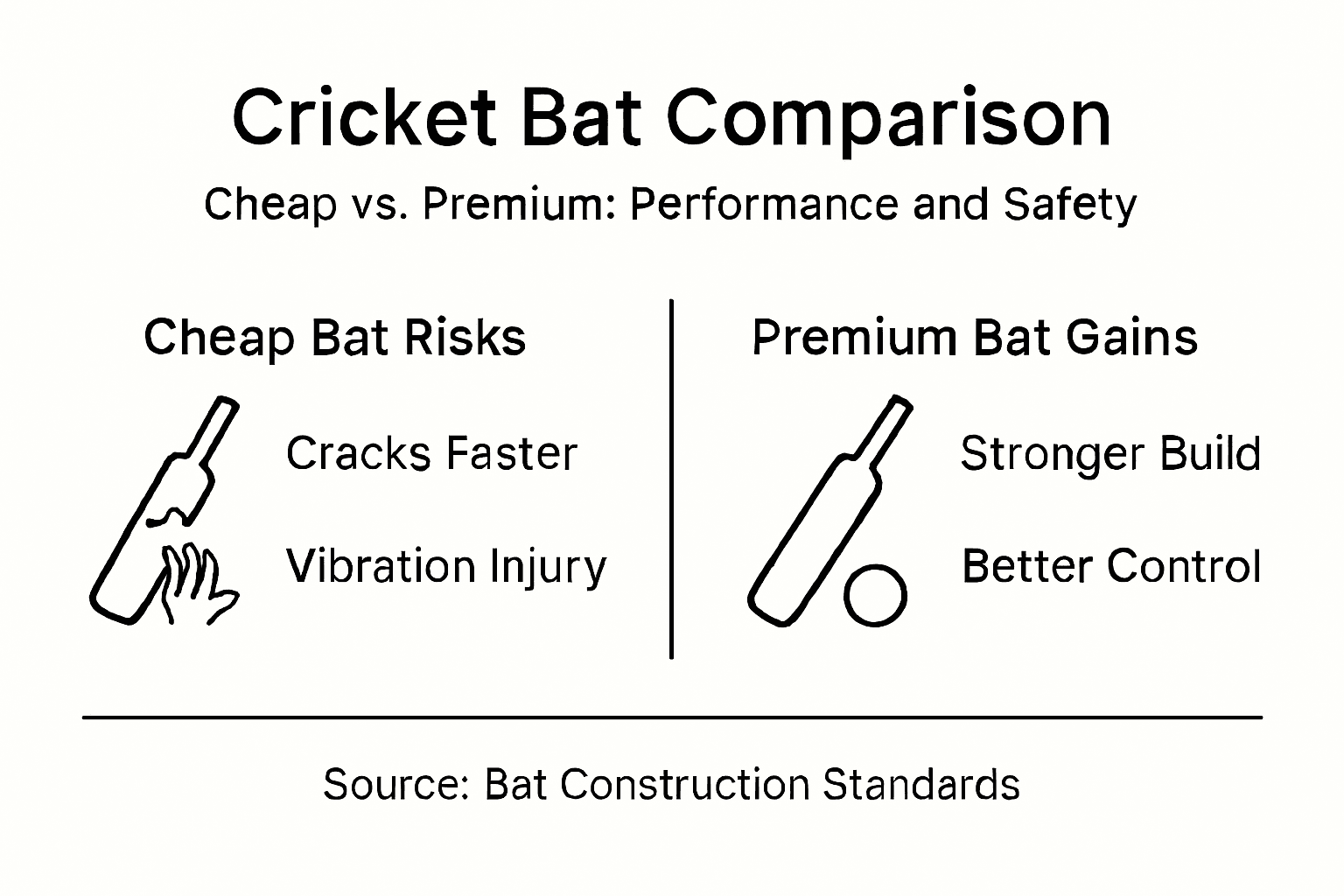
To help you choose wisely, here is a summary of risks and benefits associated with cheap versus premium cricket bats:
| Aspect | Cheap Cricket Bat Risk | Premium Cricket Bat Benefit |
|---|---|---|
| Injury Potential | Higher due to poor shock absorption | Lower with enhanced material resilience |
| Consistency in Shots | Unpredictable response | Reliable performance |
| Long-term Investment | Frequent replacements needed | Longer service life |
| Skill Development | May inhibit technique growth | Supports advanced skill progression |
Here is a comparison highlighting how material and manufacturing choices impact cricket bat performance:
| Factor | Cheap Bat Example | Premium Bat Example |
|---|---|---|
| Main Wood Type | Kashmir willow | English willow |
| Manufacturing Method | Machine-produced | Handcrafted |
| Weight Distribution | Often inconsistent | Precisely balanced |
| Sweet Spot Size | Small and inconsistent | Large and reliable |
| Vibration Control | Minimal | Advanced dampening |
| Expected Durability | 1-2 seasons maximum | Multiple seasons possible |
Pro Tip: Consider a premium bat as a long-term investment in your cricketing performance, not merely an expense.
Equip Yourself with Quality to Elevate Performance and Safety
Choosing the right cricket bat is crucial when you understand how cheap bats impact your performance and safety. This article highlights key challenges such as reduced power transfer, inconsistent shot control, and increased injury risk caused by low-quality materials and manufacturing. If you want to avoid the pitfalls of cheap cricket bats and invest in gear that truly supports your skill development and wellbeing, explore our premium range.
Discover the difference with adidas Cricket Bats – Cricket Bats Com where craftsmanship meets superior materials tailored for serious players. For young or casual cricketers seeking dependable equipment without compromising quality visit our Junior Cricket Bats | Cheap Junior Cricket Bats – Cricket Bats Com section.

Make this moment the turning point for your cricket journey by choosing bats that deliver consistent performance, enhanced durability, and improved safety. Browse our complete selection at https://cricketbats.com to find your ideal bat today and experience the confidence that comes with quality cricket equipment.
Frequently Asked Questions
What are the main risks associated with using cheap cricket bats?
Using cheap cricket bats can lead to higher risks of injury due to poor shock absorption, structural weakness, and increased likelihood of sudden bat fractures.
How do cheap cricket bats impact performance compared to premium bats?
Cheap cricket bats typically offer reduced ball rebound velocity, a smaller sweet spot, and less precise shot control, which hampers a player’s ability to perform at their best.
What material differences exist between cheap and premium cricket bats?
Cheap bats are often made from Kashmir willow, which has lower density and performance capabilities. In contrast, premium bats are crafted from English willow, providing better energy transfer and durability.
Why is the manufacturing process important for cricket bats?
The manufacturing process affects a bat’s quality; premium bats involve meticulous handcrafting that ensures optimal balance and performance, whereas cheap bats are usually machine-produced, leading to less refined characteristics.
Recommended
- Cricket Bat Certifications: What Every Player Needs – Cricket Bats Com
- The Essentials of Making a Cricket Bat With Artistry – Cricket Bats Com
- Cricket Bat Warranty Explained: Protecting Your Investment – Cricket Bats Com
- Understanding GM Cricket Bats Price Variations – Cricket Bats Com
- 12 Best Golf Balls For High Handicappers: UK 2026 Guide – More Sports
Struggling to find a cricket bat that lasts through intense practice sessions is a common frustration for young players worldwide. As research highlights, the difference between premium English willow and lower-grade Kashmir willow bats is more than price alone – it affects durability, power, and how consistently you can improve your skills. This guide demystifies budget cricket bats, clears up common misconceptions, and helps you choose gear that supports both performance and long-term reliability.
Table of Contents
- Cheap Cricket Bats Defined And Misconceptions
- Materials And Construction Differences Explained
- Performance Impacts Of Budget Cricket Bats
- Durability And Safety Concerns For Players
- Comparing Cheap Versus Premium Cricket Bats
Key Takeaways
| Point | Details |
|---|---|
| Material Quality Matters | Cheap cricket bats often use lower-grade woods, diminishing performance and durability. |
| Craftsmanship Impacts Performance | Handcrafted bats offer superior quality over machine-produced options, affecting shot consistency and power. |
| Potential Safety Risks | Budget bats may lead to injury due to inadequate shock absorption and structural integrity. |
| Long-term Investment Considerations | Premium bats, while costlier, provide enhanced durability and performance, making them a better investment for serious players. |
Cheap Cricket Bats Defined And Misconceptions
Understanding what constitutes a cheap cricket bat requires a nuanced perspective beyond simple price tags. Historical bat development research reveals that low-cost bats typically emerge from compromises in material quality, craftsmanship, and manufacturing standards.
Cheap cricket bats generally share several defining characteristics:
- Made from lower-grade timber like Kashmir willow instead of premium English willow
- Minimal hand-crafting or machine-produced manufacturing
- Thinner wood grains with less structural integrity
- Reduced moisture content and improper wood seasoning
- Limited durability and performance consistency
Many amateur players harbour misconceptions about budget cricket bats, believing price is the sole determinant of quality. However, comprehensive material analyses demonstrate significant performance variations between different wood grades and manufacturing techniques.
The primary misconceptions include:
- Believing all willow woods perform equally
- Assuming cheaper bats provide comparable power and control
- Thinking manufacturing standards are uniform across price points
- Underestimating the impact of material selection on bat longevity
Performance limitations in cheap bats often manifest through reduced power transfer, increased likelihood of structural failure, and inconsistent ball response. Professional players understand that a cricket bat represents an investment in one’s sporting capabilities, not merely a purchasing decision.
Pro Tip: Always inspect wood grain density, moisture content, and manufacturing certifications before purchasing a budget cricket bat.
Materials And Construction Differences Explained
Cricket bat materials are far more complex than most players realise. Cricket bat materials research reveals profound differences between premium and budget bat constructions that directly impact performance and durability.
Two primary wood types dominate cricket bat manufacturing:
-
English Willow:
- Premium grade with tight, straight wood grains
- Lighter weight and superior power transfer
- Preferred by professional players
- Excellent rebound characteristics
-
Kashmir Willow:
- Denser and heavier timber
- Less responsive ball striking surface
- Lower cost alternative
- More suitable for casual or junior players
Construction techniques further differentiate bat quality. Handcrafted bats involve meticulous processes where skilled artisans carefully shape, balance, and finish each bat. Machine-produced bats, conversely, prioritise volume over precision, resulting in less refined performance characteristics.
The manufacturing nuances significantly impact bat behaviour:
- Grain straightness determines power transmission
- Wood moisture content affects long-term durability
- Pressing techniques influence bat responsiveness
- Craftsmanship determines overall structural integrity
Professional-grade bats represent precision engineering, not merely wooden implements for striking a ball.
Structural differences between cheap and premium bats extend beyond mere visual appearance. Expensive bats undergo rigorous quality control, ensuring consistent weight distribution, balanced pick-up, and optimal grain alignment.
Pro Tip: Always examine wood grain alignment and request detailed bat specifications before making a purchase.
Performance Impacts Of Budget Cricket Bats
Performance analysis research reveals critical insights into how budget cricket bats dramatically compromise a player’s technical capabilities. Cheap bats are not merely affordable alternatives but significant performance limiters that can hinder skill development and match-day effectiveness.
The primary performance impacts of budget cricket bats include:
- Reduced ball rebound velocity
- Smaller effective sweet spot
- Increased unwanted bat vibration
- Less precise shot control
- Inconsistent weight distribution
Technical limitations emerge from fundamental manufacturing constraints. Budget bats typically suffer from inferior wood quality, which directly translates to suboptimal energy transfer during ball striking. This means less power, reduced accuracy, and diminished shot precision.
Cheap cricket bats transform potential batting brilliance into mediocre performance.
The performance penalties become increasingly pronounced at higher skill levels. Systematic performance reviews demonstrate that equipment quality significantly influences a player’s ability to adapt to complex batting scenarios. Specifically, budget bats create challenges in:
- Maintaining consistent bat speed
- Managing shot trajectory
- Controlling ball deflection angles
- Minimising unnecessary energy loss
Skill progression depends on equipment that provides reliable, predictable feedback. Budget bats introduce unpredictability that can fundamentally impede a player’s technical refinement.
Pro Tip: Invest in quality bats that offer consistent performance characteristics to support your skill development.
Durability And Safety Concerns For Players
Cricket bat durability research reveals critical safety challenges associated with budget cricket equipment. Cheap bats compromise player protection through fundamental structural weaknesses that extend far beyond mere monetary considerations.
Key durability and safety risks include:
- Increased likelihood of sudden bat fracture
- Higher vibration transmission to player’s hands
- Reduced shock absorption capabilities
- Greater potential for unpredictable ball rebounds
- Compromised structural integrity under repeated impacts
The material composition of budget bats significantly elevates injury risks. Lower-quality woods lack the resilience required to dissipate energy effectively, creating dangerous playing conditions that can lead to hand, wrist, and arm strain.
Cheap cricket bats are not just poor performance tools, but potential injury hazards.
Safety impact studies demonstrate that inferior bat materials dramatically increase player vulnerability. Specifically, budget bats create safety challenges through:
- Inadequate vibration dampening
- Reduced structural stability
- Higher risk of unexpected equipment failure
- Compromised energy dissipation mechanisms
Biomechanical risks emerge from prolonged use of low-quality equipment. Repeated exposure to excessive vibration can lead to cumulative musculoskeletal stress, potentially causing long-term physiological damage.
Pro Tip: Prioritise professional-grade equipment that meets stringent safety standards and provides comprehensive impact protection.
Comparing Cheap Versus Premium Cricket Bats
When evaluating cricket bats, players must understand the profound differences between budget and premium options. Comparing cricket bat features reveals a comprehensive landscape of performance, durability, and long-term value.
Key distinguishing characteristics between cheap and premium bats include:
-
Material Quality:
- Cheap Bats: Kashmir willow, lower wood density
- Premium Bats: English willow, tightly packed grains
-
Manufacturing Process:
- Cheap Bats: Machine-pressed, minimal craftsmanship
- Premium Bats: Hand-crafted, precision engineering
-
Performance Parameters:
- Cheap Bats: Limited sweet spot, reduced power transfer
- Premium Bats: Consistent performance, larger sweet spot
The true cost of a cheap bat is not its price tag, but the potential limitations it imposes on your game.
Financial considerations extend beyond initial purchase price. While premium bats represent a higher upfront investment, their superior construction delivers significant advantages:
- Enhanced durability
- More consistent shot performance
- Better energy transfer
- Reduced long-term replacement costs
Structural integrity separates budget from professional-grade equipment. Premium bats undergo rigorous quality control, ensuring each bat meets exacting standards for weight, balance, and responsiveness.
To help you choose wisely, here is a summary of risks and benefits associated with cheap versus premium cricket bats:
| Aspect | Cheap Cricket Bat Risk | Premium Cricket Bat Benefit |
|---|---|---|
| Injury Potential | Higher due to poor shock absorption | Lower with enhanced material resilience |
| Consistency in Shots | Unpredictable response | Reliable performance |
| Long-term Investment | Frequent replacements needed | Longer service life |
| Skill Development | May inhibit technique growth | Supports advanced skill progression |
Here is a comparison highlighting how material and manufacturing choices impact cricket bat performance:
| Factor | Cheap Bat Example | Premium Bat Example |
|---|---|---|
| Main Wood Type | Kashmir willow | English willow |
| Manufacturing Method | Machine-produced | Handcrafted |
| Weight Distribution | Often inconsistent | Precisely balanced |
| Sweet Spot Size | Small and inconsistent | Large and reliable |
| Vibration Control | Minimal | Advanced dampening |
| Expected Durability | 1-2 seasons maximum | Multiple seasons possible |
Pro Tip: Consider a premium bat as a long-term investment in your cricketing performance, not merely an expense.
Equip Yourself with Quality to Elevate Performance and Safety
Choosing the right cricket bat is crucial when you understand how cheap bats impact your performance and safety. This article highlights key challenges such as reduced power transfer, inconsistent shot control, and increased injury risk caused by low-quality materials and manufacturing. If you want to avoid the pitfalls of cheap cricket bats and invest in gear that truly supports your skill development and wellbeing, explore our premium range.
Discover the difference with adidas Cricket Bats – Cricket Bats Com where craftsmanship meets superior materials tailored for serious players. For young or casual cricketers seeking dependable equipment without compromising quality visit our Junior Cricket Bats | Cheap Junior Cricket Bats – Cricket Bats Com section.
Make this moment the turning point for your cricket journey by choosing bats that deliver consistent performance, enhanced durability, and improved safety. Browse our complete selection at https://cricketbats.com to find your ideal bat today and experience the confidence that comes with quality cricket equipment.
Frequently Asked Questions
What are the main risks associated with using cheap cricket bats?
Using cheap cricket bats can lead to higher risks of injury due to poor shock absorption, structural weakness, and increased likelihood of sudden bat fractures.
How do cheap cricket bats impact performance compared to premium bats?
Cheap cricket bats typically offer reduced ball rebound velocity, a smaller sweet spot, and less precise shot control, which hampers a player’s ability to perform at their best.
What material differences exist between cheap and premium cricket bats?
Cheap bats are often made from Kashmir willow, which has lower density and performance capabilities. In contrast, premium bats are crafted from English willow, providing better energy transfer and durability.
Why is the manufacturing process important for cricket bats?
The manufacturing process affects a bat’s quality; premium bats involve meticulous handcrafting that ensures optimal balance and performance, whereas cheap bats are usually machine-produced, leading to less refined characteristics.
Recommended
- Cricket Bat Certifications: What Every Player Needs – Cricket Bats Com
- The Essentials of Making a Cricket Bat With Artistry – Cricket Bats Com
- Cricket Bat Warranty Explained: Protecting Your Investment – Cricket Bats Com
- Understanding GM Cricket Bats Price Variations – Cricket Bats Com
- 12 Best Golf Balls For High Handicappers: UK 2026 Guide – More Sports