
News News
What Is a Cricket Bat and How It Impacts Your Game What Is a Cricket Bat and How It Impacts Your Game
Choosing the right cricket bat can completely change your game, especially since more than 80 percent of amateur players admit struggling to find the perfect fit online. Finding the ideal bat is about much more than tradition—modern british craftsmanship and innovative materials now play a crucial role in shaping performance on global pitches. Whether you prefer the heritage of English Willow or need guidance to match a bat to your playing style, understanding these details helps you unlock true confidence each time you step up to bat.
Table of Contents
- Defining A Cricket Bat And Its Purpose
- Different Types Of Cricket Bats Compared
- Key Materials And Construction Techniques
- How Design Affects Bat Performance
- Choosing The Right Bat For Your Needs
Key Takeaways
| Point | Details |
|---|---|
| Cricket Bat Design is Crucial | The construction and materials of a cricket bat directly influence player performance, with a focus on weight distribution and the sweet spot being essential for effective ball striking. |
| Choosing the Right Material Matters | Players typically opt for English Willow for advanced performance, while Kashmir Willow provides durability and cost-effectiveness for beginners. |
| Individual Fit is Key | Selecting a bat that matches your height, weight, and playing style is vital for optimum control and comfort on the pitch. |
| Test Before Purchase | Always physically test bats for weight and balance to ensure they feel comfortable and suit your batting technique during practice. |
Defining a Cricket Bat and Its Purpose
A cricket bat is a specialised sporting implement designed specifically for striking a cricket ball during gameplay, with its fundamental structure and composition critically influencing player performance. Traditionally crafted from willow wood, these precision-engineered instruments represent the primary interface between a player and the sport’s core dynamic of ball striking.
The cricket bat’s fundamental design features a flat striking surface and a distinctive ridge along its back, strategically concentrating wood in the central region where most ball impacts occur. This carefully engineered construction enables players to generate maximum power and control when connecting with the ball. The blade’s composition, typically made from specific willow varieties like Salix alba var. caerulea, provides the necessary combination of strength, flexibility, and responsive performance that distinguishes a high-quality cricket bat.
Beyond its physical structure, a cricket bat serves multiple critical purposes in the game. It functions not just as a striking tool, but as an extension of the player’s technique, allowing for nuanced shot selection, precise angle control, and the translation of a player’s skill into effective ball manipulation. Understanding bat construction and design helps players select equipment that complements their individual playing style and enhances their overall performance.
Expert Tip: Select a cricket bat that feels like a natural extension of your body, ensuring it matches your height, weight, and playing technique for optimal performance and comfort.
Different Types of Cricket Bats Compared
Cricket bats are predominantly categorised into two primary types based on their wood composition: English Willow and Kashmir Willow bats. Professional players typically prefer English Willow bats due to their exceptional performance characteristics, offering superior dampening properties that minimise vibration and enhance overall ball control.
English Willow bats are renowned for their refined construction, featuring a softer wooden structure that provides players with enhanced feel and responsiveness during gameplay. In contrast, Kashmir Willow bats present a more robust alternative, characterised by their increased weight and durability. These bats are particularly suited to beginners and casual players who require a more affordable and resilient equipment option.
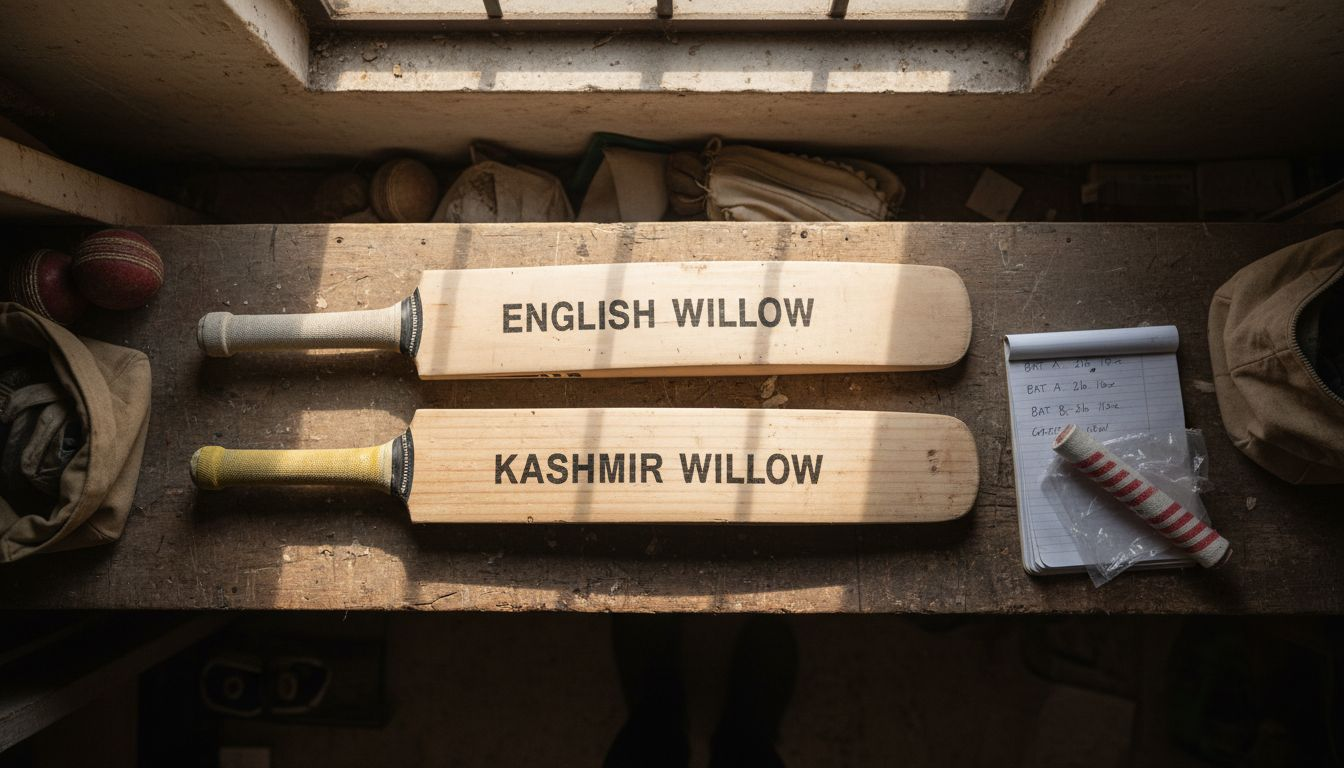
The selection between English and Kashmir Willow bats involves careful consideration of multiple factors. Understanding cricket bat selection techniques helps players make informed decisions based on their skill level, playing style, and budgetary constraints. Advanced players often invest in high-grade English Willow bats, while recreational players might find Kashmir Willow bats more practical and cost-effective.
Here is a comparison of English Willow and Kashmir Willow cricket bats by key attributes:
| Attribute | English Willow | Kashmir Willow |
|---|---|---|
| Typical User | Professionals and advanced players | Beginners and casual players |
| Weight | Typically lighter, easier to manoeuvre | Usually heavier, offers more durability |
| Ball Response | Superior feel and responsiveness | Good but less refined feedback |
| Cost | Generally higher price due to quality | More affordable and widely available |
| Durability | Requires careful maintenance | More robust, suited for rough use |
| Performance Focus | Precision and enhanced shot quality | Durability and value for money |
Expert Tip: Match your cricket bat selection to your skill level and playing frequency, ensuring you balance performance requirements with long-term equipment investment.
Key Materials and Construction Techniques
The construction of a cricket bat is a precise art that combines traditional craftsmanship with modern engineering principles. Cricket bats are traditionally crafted from a specific willow variety called cricket bat willow, scientifically known as Salix alba var. caerulea, which provides the optimal balance of strength, flexibility, and performance required for competitive play.
The structural integrity of a cricket bat relies on its unique design, particularly the critical connection between the blade and handle. The splice mechanism represents a sophisticated engineering solution, featuring a long cylindrical cane handle connected to the wooden blade through a carefully constructed joint. This specialised connection ensures a gradual and efficient transfer of kinetic energy during ball striking, minimising vibration and maximising the player’s control and power.
Manufacturers employ multiple sophisticated techniques to enhance bat performance, including precise wood selection, grain alignment, and compression processes. The blade’s construction focuses on creating an optimal sweet spot, strategically concentrating wood in the central region to provide maximum power transfer and responsive ball striking. Advanced manufacturing processes involve carefully grading willow wood, selecting premium timber with straight, evenly spaced grains that indicate superior structural integrity and potential performance.
Expert Tip: Inspect a cricket bat’s grain lines carefully before purchasing, as straight, uniform grains typically indicate higher quality and better potential performance.
How Design Affects Bat Performance
The design of a cricket bat is a complex interplay of engineering principles that directly influences a player’s performance on the pitch. Every nuanced aspect of bat construction contributes to its ability to generate power, control, and precision during ball striking. Understanding custom bat design techniques reveals the intricate considerations that transform a simple piece of wood into a sophisticated sporting instrument.
Key design elements such as weight distribution, blade profile, and handle composition play critical roles in determining a bat’s performance characteristics. The sweet spot - a bat’s optimal striking zone - is strategically positioned to maximise power transfer and minimise energy loss during contact. Advanced design techniques involve carefully calculating the bat’s centre of gravity, handle flexibility, and wood density to create an instrument that responds seamlessly to a player’s unique batting technique.
Material selection and structural engineering are fundamental to bat design, with manufacturers employing sophisticated techniques to enhance performance. The blade’s curvature, handle angle, and wood grain alignment all contribute to the bat’s responsiveness, shock absorption, and overall playing dynamics. Subtle variations in these design parameters can significantly impact a player’s ability to generate power, maintain control, and execute precise shots across different playing conditions.
Expert Tip: When selecting a cricket bat, prioritise design elements that complement your individual playing style, focusing on how the bat’s weight, balance, and sweet spot alignment match your specific batting technique.
Choosing the Right Bat for Your Needs
Selecting the perfect cricket bat involves a nuanced assessment of multiple critical factors that directly impact your performance and playing experience. Choosing the correct bat requires careful consideration of size, weight, and individual playing characteristics to ensure optimal comfort and effectiveness on the cricket pitch.
Players must evaluate several key dimensions when selecting their ideal bat, including physical height, batting style, and skill level. Junior players and beginners will require different specifications compared to advanced or professional cricketers. Bat weight and pick-up are particularly crucial considerations, with the bat’s balance and manoeuvrability determining how comfortably a player can execute different shots and maintain control throughout their innings.
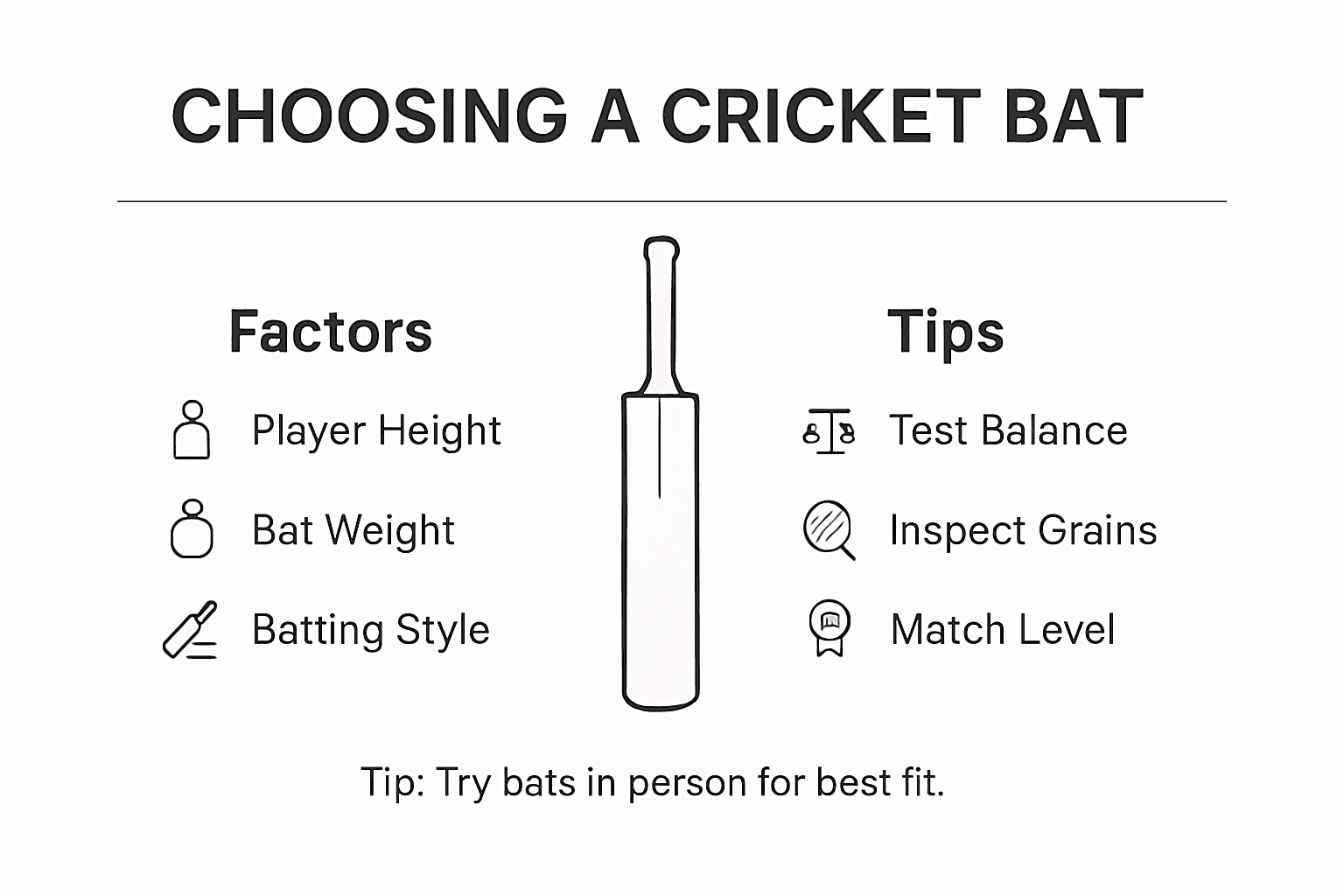
The selection process extends beyond physical measurements, encompassing personal technique and playing conditions. Understanding cricket bat selection techniques demands a holistic approach that considers factors such as wood quality, handle grip, and individual batting mechanics. Professional players often invest significant time in testing multiple bats to find the precise instrument that complements their unique playing style, recognising that the right bat can significantly enhance performance and confidence.
The following table summarises factors to consider when choosing a cricket bat:
| Factor | Why It Matters | Tip for Selection |
|---|---|---|
| Bat Weight | Affects power, control, and fatigue | Test various weights in person |
| Bat Size | Must suit player’s height and build | Follow an official size guide |
| Handle Type | Influences grip and shot control | Try both oval and round handles |
| Balance/Pick-up | Impacts shot execution and comfort | Swing bats to assess pick-up feel |
| Grain Structure | Indicates wood quality and performance | Look for straight, even grain lines |
Expert Tip: Always test a cricket bat’s weight and balance in person, ensuring it feels like a natural extension of your body and allows smooth, unrestricted movement during batting practice.
Find the Perfect Cricket Bat to Elevate Your Game
Choosing the right cricket bat can be challenging, especially when balancing factors like bat weight, wood quality, and design to match your unique playing style. This article highlights how critical these elements are for maximising your performance and comfort on the pitch. Whether you seek the precision of an English Willow bat or the durability of Kashmir Willow, understanding these differences is key to making an informed choice.
Explore our wide selection of premium cricket bats including top brands like adidas and New Balance at adidas Cricket Bats – Cricket Bats Com and New Balance Cricket Bats – Cricket Bats Com to find a bat tailored to your skill level and playing preferences.

Act now to find a cricket bat that feels like an extension of you. Visit cricketbats.com to browse our curated collection and benefit from free shipping on selected items. Your ideal cricket bat is waiting to transform your game from the very first strike.
Frequently Asked Questions
What is the main purpose of a cricket bat?
A cricket bat is primarily designed for striking the cricket ball during play. Its construction impacts a player’s ability to generate power and control shots effectively.
What are the differences between English Willow and Kashmir Willow bats?
English Willow bats are lighter, more responsive, and typically preferred by professionals for their superior performance. In contrast, Kashmir Willow bats are heavier, more durable, and suitable for beginners or casual players seeking a more affordable option.
How does the design of a cricket bat affect its performance?
The design influences weight distribution, the position of the sweet spot, and overall balance, all of which contribute to a player’s ability to generate power and maintain control while batting.
What factors should I consider when choosing a cricket bat?
When selecting a cricket bat, consider your height, playing style, bat weight, balance, and handle type. Testing different bats is crucial to find one that feels comfortable and enhances your performance.
Recommended
Choosing the right cricket bat can completely change your game, especially since more than 80 percent of amateur players admit struggling to find the perfect fit online. Finding the ideal bat is about much more than tradition—modern british craftsmanship and innovative materials now play a crucial role in shaping performance on global pitches. Whether you prefer the heritage of English Willow or need guidance to match a bat to your playing style, understanding these details helps you unlock true confidence each time you step up to bat.
Table of Contents
- Defining A Cricket Bat And Its Purpose
- Different Types Of Cricket Bats Compared
- Key Materials And Construction Techniques
- How Design Affects Bat Performance
- Choosing The Right Bat For Your Needs
Key Takeaways
| Point | Details |
|---|---|
| Cricket Bat Design is Crucial | The construction and materials of a cricket bat directly influence player performance, with a focus on weight distribution and the sweet spot being essential for effective ball striking. |
| Choosing the Right Material Matters | Players typically opt for English Willow for advanced performance, while Kashmir Willow provides durability and cost-effectiveness for beginners. |
| Individual Fit is Key | Selecting a bat that matches your height, weight, and playing style is vital for optimum control and comfort on the pitch. |
| Test Before Purchase | Always physically test bats for weight and balance to ensure they feel comfortable and suit your batting technique during practice. |
Defining a Cricket Bat and Its Purpose
A cricket bat is a specialised sporting implement designed specifically for striking a cricket ball during gameplay, with its fundamental structure and composition critically influencing player performance. Traditionally crafted from willow wood, these precision-engineered instruments represent the primary interface between a player and the sport’s core dynamic of ball striking.
The cricket bat’s fundamental design features a flat striking surface and a distinctive ridge along its back, strategically concentrating wood in the central region where most ball impacts occur. This carefully engineered construction enables players to generate maximum power and control when connecting with the ball. The blade’s composition, typically made from specific willow varieties like Salix alba var. caerulea, provides the necessary combination of strength, flexibility, and responsive performance that distinguishes a high-quality cricket bat.
Beyond its physical structure, a cricket bat serves multiple critical purposes in the game. It functions not just as a striking tool, but as an extension of the player’s technique, allowing for nuanced shot selection, precise angle control, and the translation of a player’s skill into effective ball manipulation. Understanding bat construction and design helps players select equipment that complements their individual playing style and enhances their overall performance.
Expert Tip: Select a cricket bat that feels like a natural extension of your body, ensuring it matches your height, weight, and playing technique for optimal performance and comfort.
Different Types of Cricket Bats Compared
Cricket bats are predominantly categorised into two primary types based on their wood composition: English Willow and Kashmir Willow bats. Professional players typically prefer English Willow bats due to their exceptional performance characteristics, offering superior dampening properties that minimise vibration and enhance overall ball control.
English Willow bats are renowned for their refined construction, featuring a softer wooden structure that provides players with enhanced feel and responsiveness during gameplay. In contrast, Kashmir Willow bats present a more robust alternative, characterised by their increased weight and durability. These bats are particularly suited to beginners and casual players who require a more affordable and resilient equipment option.
The selection between English and Kashmir Willow bats involves careful consideration of multiple factors. Understanding cricket bat selection techniques helps players make informed decisions based on their skill level, playing style, and budgetary constraints. Advanced players often invest in high-grade English Willow bats, while recreational players might find Kashmir Willow bats more practical and cost-effective.
Here is a comparison of English Willow and Kashmir Willow cricket bats by key attributes:
| Attribute | English Willow | Kashmir Willow |
|---|---|---|
| Typical User | Professionals and advanced players | Beginners and casual players |
| Weight | Typically lighter, easier to manoeuvre | Usually heavier, offers more durability |
| Ball Response | Superior feel and responsiveness | Good but less refined feedback |
| Cost | Generally higher price due to quality | More affordable and widely available |
| Durability | Requires careful maintenance | More robust, suited for rough use |
| Performance Focus | Precision and enhanced shot quality | Durability and value for money |
Expert Tip: Match your cricket bat selection to your skill level and playing frequency, ensuring you balance performance requirements with long-term equipment investment.
Key Materials and Construction Techniques
The construction of a cricket bat is a precise art that combines traditional craftsmanship with modern engineering principles. Cricket bats are traditionally crafted from a specific willow variety called cricket bat willow, scientifically known as Salix alba var. caerulea, which provides the optimal balance of strength, flexibility, and performance required for competitive play.
The structural integrity of a cricket bat relies on its unique design, particularly the critical connection between the blade and handle. The splice mechanism represents a sophisticated engineering solution, featuring a long cylindrical cane handle connected to the wooden blade through a carefully constructed joint. This specialised connection ensures a gradual and efficient transfer of kinetic energy during ball striking, minimising vibration and maximising the player’s control and power.
Manufacturers employ multiple sophisticated techniques to enhance bat performance, including precise wood selection, grain alignment, and compression processes. The blade’s construction focuses on creating an optimal sweet spot, strategically concentrating wood in the central region to provide maximum power transfer and responsive ball striking. Advanced manufacturing processes involve carefully grading willow wood, selecting premium timber with straight, evenly spaced grains that indicate superior structural integrity and potential performance.
Expert Tip: Inspect a cricket bat’s grain lines carefully before purchasing, as straight, uniform grains typically indicate higher quality and better potential performance.
How Design Affects Bat Performance
The design of a cricket bat is a complex interplay of engineering principles that directly influences a player’s performance on the pitch. Every nuanced aspect of bat construction contributes to its ability to generate power, control, and precision during ball striking. Understanding custom bat design techniques reveals the intricate considerations that transform a simple piece of wood into a sophisticated sporting instrument.
Key design elements such as weight distribution, blade profile, and handle composition play critical roles in determining a bat’s performance characteristics. The sweet spot - a bat’s optimal striking zone - is strategically positioned to maximise power transfer and minimise energy loss during contact. Advanced design techniques involve carefully calculating the bat’s centre of gravity, handle flexibility, and wood density to create an instrument that responds seamlessly to a player’s unique batting technique.
Material selection and structural engineering are fundamental to bat design, with manufacturers employing sophisticated techniques to enhance performance. The blade’s curvature, handle angle, and wood grain alignment all contribute to the bat’s responsiveness, shock absorption, and overall playing dynamics. Subtle variations in these design parameters can significantly impact a player’s ability to generate power, maintain control, and execute precise shots across different playing conditions.
Expert Tip: When selecting a cricket bat, prioritise design elements that complement your individual playing style, focusing on how the bat’s weight, balance, and sweet spot alignment match your specific batting technique.
Choosing the Right Bat for Your Needs
Selecting the perfect cricket bat involves a nuanced assessment of multiple critical factors that directly impact your performance and playing experience. Choosing the correct bat requires careful consideration of size, weight, and individual playing characteristics to ensure optimal comfort and effectiveness on the cricket pitch.
Players must evaluate several key dimensions when selecting their ideal bat, including physical height, batting style, and skill level. Junior players and beginners will require different specifications compared to advanced or professional cricketers. Bat weight and pick-up are particularly crucial considerations, with the bat’s balance and manoeuvrability determining how comfortably a player can execute different shots and maintain control throughout their innings.
The selection process extends beyond physical measurements, encompassing personal technique and playing conditions. Understanding cricket bat selection techniques demands a holistic approach that considers factors such as wood quality, handle grip, and individual batting mechanics. Professional players often invest significant time in testing multiple bats to find the precise instrument that complements their unique playing style, recognising that the right bat can significantly enhance performance and confidence.
The following table summarises factors to consider when choosing a cricket bat:
| Factor | Why It Matters | Tip for Selection |
|---|---|---|
| Bat Weight | Affects power, control, and fatigue | Test various weights in person |
| Bat Size | Must suit player’s height and build | Follow an official size guide |
| Handle Type | Influences grip and shot control | Try both oval and round handles |
| Balance/Pick-up | Impacts shot execution and comfort | Swing bats to assess pick-up feel |
| Grain Structure | Indicates wood quality and performance | Look for straight, even grain lines |
Expert Tip: Always test a cricket bat’s weight and balance in person, ensuring it feels like a natural extension of your body and allows smooth, unrestricted movement during batting practice.
Find the Perfect Cricket Bat to Elevate Your Game
Choosing the right cricket bat can be challenging, especially when balancing factors like bat weight, wood quality, and design to match your unique playing style. This article highlights how critical these elements are for maximising your performance and comfort on the pitch. Whether you seek the precision of an English Willow bat or the durability of Kashmir Willow, understanding these differences is key to making an informed choice.
Explore our wide selection of premium cricket bats including top brands like adidas and New Balance at adidas Cricket Bats – Cricket Bats Com and New Balance Cricket Bats – Cricket Bats Com to find a bat tailored to your skill level and playing preferences.
Act now to find a cricket bat that feels like an extension of you. Visit cricketbats.com to browse our curated collection and benefit from free shipping on selected items. Your ideal cricket bat is waiting to transform your game from the very first strike.
Frequently Asked Questions
What is the main purpose of a cricket bat?
A cricket bat is primarily designed for striking the cricket ball during play. Its construction impacts a player’s ability to generate power and control shots effectively.
What are the differences between English Willow and Kashmir Willow bats?
English Willow bats are lighter, more responsive, and typically preferred by professionals for their superior performance. In contrast, Kashmir Willow bats are heavier, more durable, and suitable for beginners or casual players seeking a more affordable option.
How does the design of a cricket bat affect its performance?
The design influences weight distribution, the position of the sweet spot, and overall balance, all of which contribute to a player’s ability to generate power and maintain control while batting.
What factors should I consider when choosing a cricket bat?
When selecting a cricket bat, consider your height, playing style, bat weight, balance, and handle type. Testing different bats is crucial to find one that feels comfortable and enhances your performance.