
News News
What are hybrid bats and how they boost cricket performance What are hybrid bats and how they boost cricket performance
Hybrid cricket bats combine different willow grades or composite materials to deliver optimised performance, blending power and control in ways traditional single-material bats cannot match. This engineering approach addresses the growing demand among amateur and professional players for equipment offering larger sweet spots, enhanced balance, and consistent hitting performance. Understanding hybrid bats helps you make informed choices that align with your batting style and elevate your game.
Table of Contents
- Introduction To Hybrid Cricket Bats
- Material Composition And Engineering Of Hybrid Bats
- Performance Benefits And Player Advantages
- Comparison With Traditional And Fully Composite Bats
- Common Misconceptions About Hybrid Cricket Bats
- Guidance On Selecting The Right Hybrid Bat For Your Gameplay
- Care, Maintenance, And Durability Considerations
- Conclusion: Making The Most Of Your Hybrid Bat
- Discover The Right Hybrid Cricket Bat For You
- FAQ
Key takeaways
| Point | Details |
|---|---|
| Material innovation | Hybrid bats blend different willow grades or composites to improve performance beyond traditional single-material construction. |
| Enhanced sweet spot | Larger hitting zones and thick edges (40mm+) deliver greater power and forgiveness on off-centre strikes. |
| Style versatility | Profiles suit power hitters, all-rounders, and touch players, making hybrid bats adaptable to diverse batting approaches. |
| Durability advances | Modern manufacturing with toe guards and anti-scuff sheets counters outdated durability myths. |
| Maintenance impact | Proper pre-oiling, knocking-in, and storage significantly extend hybrid bat lifespan and sustain performance. |
Introduction to hybrid cricket bats
Hybrid cricket bats represent a significant shift in equipment design, combining different willow grades or materials to optimise performance characteristics that traditional English willow bats cannot achieve alone. Traditional bats typically use a single grade of willow throughout the blade, limiting customisation of weight distribution, sweet spot size, and edge thickness. Hybrid construction allows manufacturers to position higher-density willow in impact zones whilst using lighter materials elsewhere, creating bats with larger profiles yet manageable weights.
This approach appeals strongly to players seeking both explosive power and refined control. You gain the thick edges and expansive sweet spots associated with heavier bats without sacrificing swing speed or manoeuvrability. The term “hybrid” in cricket bats differs entirely from hybrid cricket game formats, which refer to match structures blending Test and limited-overs elements.
Key distinctions of hybrid cricket bats include:
- Integration of multiple willow grades within one blade for strategic weight placement
- Incorporation of composite materials in handle, toe, or edge reinforcement zones
- Engineered profiles delivering professional-level features at accessible price points
- Enhanced forgiveness on mistimed shots through optimised mass distribution
Pro Tip: When examining hybrid bats, tap along the blade to identify density variations, helping you understand how the bat’s construction supports your preferred stroke zones.
Material composition and engineering of hybrid bats
The construction of hybrid cricket bats begins with selective cleft harvesting, where manufacturers choose only 35-40% of available clefts to meet strict quality standards for hybrid applications. This selectivity ensures the Grade 1 Hybrid Low Density Willow used in premium models delivers consistent performance whilst maintaining the natural resilience willow provides. Lower-density willow in the blade’s core reduces overall weight, whilst denser willow or composite inserts in edges and the toe add strength precisely where impact forces concentrate.

Advanced engineering features include concaved backs, thick edges, and duck-bill toes that fundamentally alter how bats perform. Concaving removes wood from the back of the blade without compromising structural integrity, redistributing saved weight to edges and the sweet spot. This creates bats with 40mm or thicker edges, profiles previously achievable only in much heavier traditional models. The duck-bill toe design, where the blade widens near the bottom, adds mass low in the bat for improved balance and additional power on yorker-length deliveries.
These construction elements work together to expand the sweet spot by 15-20% compared to traditional bats of equivalent weight. The enlarged hitting zone means mistimed shots still travel further, giving you greater margin for error when facing pace or spin. Balance improvements reduce the pickup weight, the sensation of heaviness when lifting the bat, making even 2lb 10oz models feel responsive and quick through the hitting zone.
Critical engineering aspects include:
- Laminated handle construction using cane and rubber for vibration dampening
- Strategic void filling with composite materials to prevent cracking in stress zones
- Precision shaping to position the bat’s centre of mass for optimal swing dynamics
- Factory-applied protective coatings on toe and edges to enhance durability from first use
Pro Tip: Test a bat’s balance by holding it at the handle’s bottom and sensing where weight concentrates; quality hybrids feel lighter than their actual mass due to engineered weight distribution, helping you identify models that match your swing mechanics.
Explore detailed guidance on choosing cricket bat performance characteristics that align with your playing conditions and technique preferences.
Performance benefits and player advantages
Hybrid bat design translates directly into measurable on-field advantages that suit diverse playing styles. The enlarged sweet spot and thick edges mean you connect cleanly more often, converting good timing into boundary-clearing power. Edges measuring 40mm or more add significant mass at the bat’s perimeter, increasing the moment of inertia and generating greater ball speed even when contact occurs away from the blade’s centre.
Despite their substantial profiles, hybrid bats maintain remarkably light pickup weights through intelligent material distribution. This balance improvement enhances bat swing speed, allowing you to play late against pace bowling or adjust shots mid-swing when reading spin variations. Reduced physical strain during long innings prevents fatigue-related technique breakdowns, particularly valuable for opening batsmen facing extended periods at the crease.
Control benefits extend across the full range of cricket strokes. Front-foot drives benefit from the bat’s stable blade plane during impact, whilst wristy flicks and cuts gain precision from the handle’s reduced vibration transmission. The combination of power and control proves particularly effective for all-rounders who need versatility rather than specialisation in a single stroke type.
Performance advantages include:
- Consistent power output across a wider hitting zone reducing dismissals from mistimed shots
- Improved stroke timing due to balanced weight distribution and responsive pickup feel
- Enhanced forgiveness on edges and toe strikes, keeping balls in play rather than offering catches
- Reduced arm and shoulder fatigue enabling sustained performance in multi-day formats
Pro Tip: Practise with your hybrid bat in net sessions replicating match pressure, focusing on discovering how the expanded sweet spot changes your optimal contact point for different deliveries, allowing you to recalibrate your technique for maximum effectiveness.
For comprehensive guidance on matching bat characteristics to your game, review our resource on choosing your cricket bat based on playing style and skill level.
Comparison with traditional and fully composite bats
Understanding where hybrid bats sit within the broader market clarifies their unique value proposition. Traditional English willow bats use a single willow grade throughout the blade, typically resulting in heavier models with smaller sweet spots concentrated in the blade’s middle third. Whilst these bats deliver authentic feel and sound, they demand precise timing and offer less forgiveness on mishits.
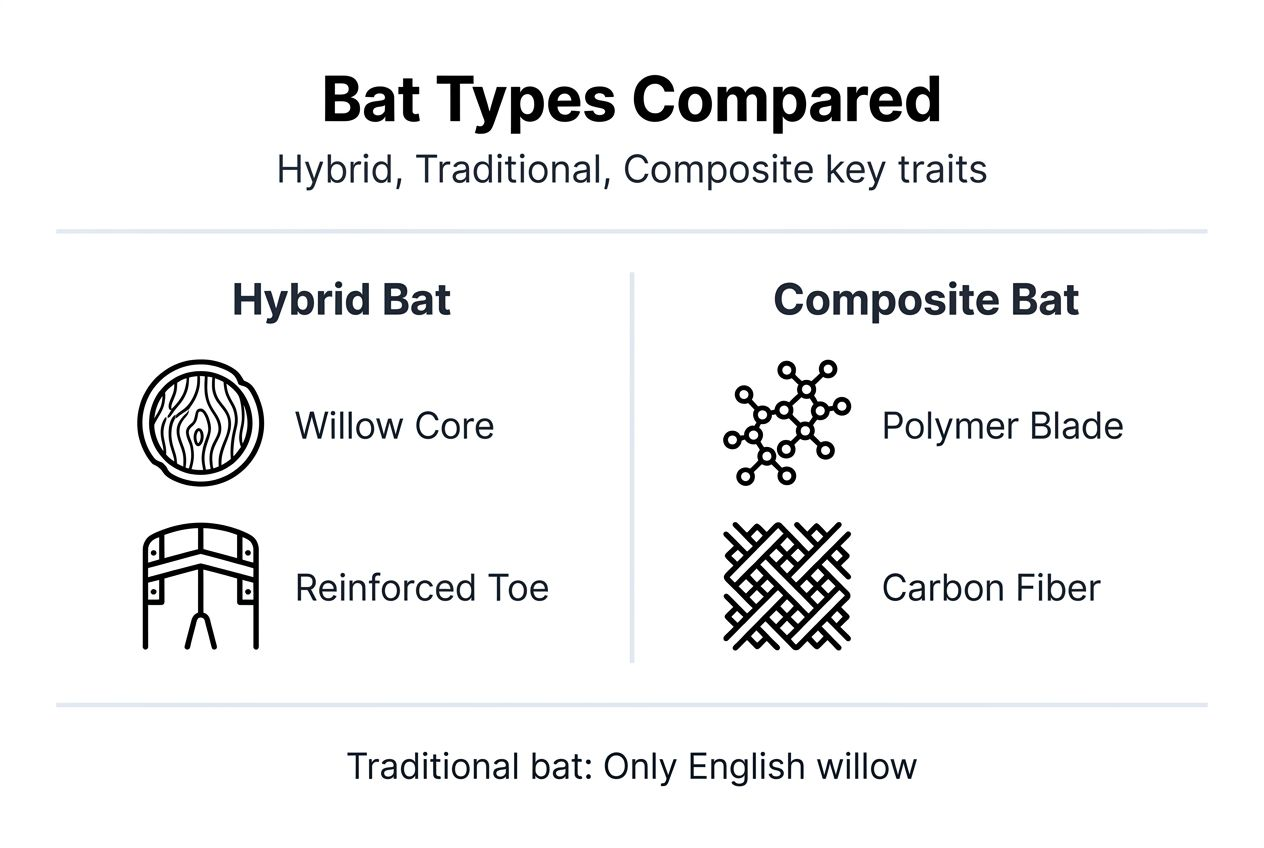
Fully composite bats prioritise extreme durability and lightweight construction, often using polymer or carbon-fibre materials throughout. These models excel in junior cricket or recreational settings where longevity outweighs traditional performance characteristics. However, many players find composite bats lack the responsive feel and acoustic feedback that willow provides, making timing adjustments more difficult during an innings.
Hybrid bats bridge these extremes, combining willow’s natural responsiveness with composite reinforcement in high-stress zones. This approach delivers the power and sweet spot size previously requiring much heavier traditional bats, whilst maintaining the tactile feedback serious players value. The versatility suits players who employ varied strokeplay rather than relying on a single dominant technique.
| Feature | Traditional English Willow | Hybrid Bat | Fully Composite |
|---|---|---|---|
| Construction | Single-grade willow throughout | Multiple willow grades plus composites | Polymer or carbon-fibre materials |
| Typical weight | 2lb 8oz to 2lb 12oz | 2lb 7oz to 2lb 10oz | 2lb 4oz to 2lb 8oz |
| Sweet spot size | Medium, concentrated mid-blade | Large, extended across blade | Variable, often smaller |
| Edge thickness | 32-38mm | 40-45mm+ | 25-35mm |
| Player suitability | Traditionalists valuing feel | All-rounders seeking versatility | Beginners and recreational players |
| Durability | Moderate, requires careful maintenance | High with protective features | Extremely high |
Key distinctions that matter for your selection include:
- Hybrid bats offer substantially larger sweet spots than traditional models of equivalent weight
- Composite bats sacrifice the natural willow feel that aids timing adjustments mid-innings
- Traditional bats demand more precise technique but reward skilled players with exceptional feedback
- Hybrids provide the widest performance envelope, accommodating both power hitting and touch play
Common misconceptions about hybrid cricket bats
Several persistent myths about hybrid cricket bats discourage players from exploring their benefits. Addressing these misconceptions builds confidence in considering hybrid options for your equipment needs.
Myth: Hybrid bats are less durable than traditional single-willow models. Modern hybrid bats incorporate advanced protection methods including reinforced toe guards, anti-scuff sheets on edges, and factory-applied sealants that often make them more durable than unprotected traditional bats. The composite elements in hybrid construction specifically target zones experiencing the highest impact forces, extending usable lifespan when properly maintained.
Myth: Hybrid bats suit only aggressive power hitters who prioritise boundaries over technique. Reality shows hybrid bats come in diverse profiles designed for front-foot attackers, defensive all-rounders, and touch players who manipulate field placements. The expanded sweet spot benefits all styles by increasing consistency rather than fundamentally changing your approach.
Myth: Hybrid construction represents a recent marketing gimmick lacking proven track record. Hybrid bat technology has evolved over more than a decade, with manufacturers refining willow selection and composite integration based on extensive player feedback and performance data. Experienced craftsmen apply traditional bat-making skills to hybrid construction, ensuring quality standards match or exceed conventional models.
Key facts countering these myths include:
- Protective features standard on hybrid bats prevent common damage points that shorten traditional bat lifespans
- Profile variety in hybrid ranges accommodates defensive techniques as effectively as attacking strokeplay
- Long-term durability testing shows properly maintained hybrid bats match traditional models in usable seasons
- Professional and first-class cricketers increasingly adopt hybrid bats, validating their performance at elite levels
“Modern manufacturing techniques have transformed hybrid bat durability, with reinforced construction zones and protective treatments addressing historical concerns whilst delivering performance benefits that traditional single-willow bats cannot match.”
Guidance on selecting the right hybrid bat for your gameplay
Choosing a hybrid bat that complements your batting style requires systematic evaluation of several key factors. This structured approach ensures your investment delivers tangible performance improvements.
-
Identify your primary batting style and stroke preferences. Power hitters benefit from heavier hybrid models (2lb 9oz to 2lb 10oz) with maximum edge thickness, whilst touch players and all-rounders often prefer lighter options (2lb 7oz to 2lb 8oz) offering quicker swing speeds. Consider which scoring zones you target most frequently, as this influences the optimal sweet spot placement.
-
Evaluate weight and balance characteristics through hands-on testing when possible. Hold candidate bats by the handle’s bottom and sense where mass concentrates. Quality hybrids position weight slightly higher than traditional bats, creating a balanced feel despite their larger profiles. The bat should feel controllable through your natural swing arc without requiring compensatory adjustments.
-
Examine material composition and construction details. Look for bats specifying Grade 1 Hybrid Low Density Willow with visible grain patterns indicating quality wood selection. Check edge thickness against your preference, remembering that 40mm+ edges add power but slightly reduce manoeuvrability. Assess handle construction, as multi-piece cane handles with rubber inserts dampen vibration more effectively than single-piece designs.
-
Verify protective features and finish quality before purchase. Ensure the model includes a substantial toe guard covering the blade’s bottom 2-3 inches, as this zone experiences frequent ground contact. Anti-scuff sheets on edges prevent surface damage from mishits, whilst factory-applied face coatings reduce moisture absorption. These features significantly impact long-term durability.
-
Factor your maintenance commitment and typical playing conditions into the selection. If you play frequently on abrasive synthetic surfaces or in humid climates, prioritise hybrid models with comprehensive protective treatments. Players willing to invest time in regular maintenance can opt for models with minimal factory finishing, allowing you to customise preparation based on your preferences.
For additional guidance tailored to your experience level, explore resources on choosing your cricket bat, cricket bat performance characteristics, and choosing cricket bats for beginners.
Care, maintenance, and durability considerations
Proper maintenance transforms a hybrid bat from a seasonal purchase into a multi-year investment that maintains performance characteristics throughout its lifespan. The preparation and care regimen differs slightly from traditional bats due to hybrid construction elements.
Pre-oiling and knocking-in remain essential preparation steps before match use. Apply raw linseed oil sparingly to the face, edges, and toe (avoiding the splice area) to seal the willow’s pores against moisture whilst maintaining flexibility. Allow 24 hours between oil applications, typically requiring 2-3 treatments. Knocking-in compresses the willow fibres gradually using a mallet or old cricket ball, starting gently and increasing force over 4-6 hours of total knocking time. This process prevents surface cracking when facing hard new balls.
Protective features including toe guards and anti-scuff sheets significantly extend hybrid bat durability by shielding vulnerable zones. Ensure these elements remain securely attached, reapplying adhesive or replacing damaged guards as needed. Some players add additional edge tape for extra protection in particularly demanding conditions.
Maintenance best practices include:
- Store bats in cool, dry environments away from direct sunlight and heat sources to prevent willow warping
- Clean the blade after each use with a slightly damp cloth, removing dirt and grass stains before they set
- Inspect edges, toe, and face regularly for cracks or damage, addressing minor issues immediately with wood glue
- Avoid using hybrid bats against new hard balls before complete knocking-in, as premature use causes surface damage
- Re-oil the blade every 4-6 weeks during active playing seasons to maintain moisture balance
With consistent care, quality hybrid bats deliver 3-4 seasons of regular use whilst maintaining their balance and sweet spot characteristics. Neglected bats often fail within a single season due to preventable moisture damage or stress cracks from insufficient preparation.
Detailed maintenance guidance is available in our resources on cricket bat maintenance explained, the cricket bat maintenance checklist, and cricket bat care 2026 best practices.
Conclusion: making the most of your hybrid bat
Hybrid cricket bats deliver measurable performance advantages through intelligent material combinations and engineering innovations that expand sweet spots, enhance balance, and increase power output. These benefits suit diverse batting styles from aggressive power hitting to nuanced strokeplay, making hybrids versatile choices for players at various skill levels.
Selecting the right hybrid bat requires matching construction characteristics to your playing style, weight preferences, and maintenance commitment. Understanding how willow grades, edge thickness, and protective features influence performance enables informed decisions that elevate your game. Regular maintenance preserving the bat’s structural integrity and moisture balance ensures you extract maximum value from your investment across multiple seasons.
Applying this knowledge positions you to choose and care for hybrid bats effectively, translating equipment advantages into improved consistency and enjoyment at the crease. The combination of modern engineering and traditional craftsmanship in hybrid construction represents the current pinnacle of cricket bat design, offering performance characteristics that enhance your natural abilities.
Discover the right hybrid cricket bat for you
Now that you understand hybrid bat construction and benefits, exploring the available range helps you identify models matching your specific requirements. The cricket bats for sale at cricketbats.com include hybrid options from leading manufacturers, each with detailed specifications covering willow grade, edge thickness, weight, and balance characteristics.

Expert guidance supports your selection process, with product descriptions highlighting which profiles suit power hitters, all-rounders, or touch players. Compare models side-by-side to identify optimal combinations of features for your batting style and playing conditions. Site filters enable quick matching to your preferred weight range, edge thickness, and price point.
Pro Tip: Use the comparison tools to evaluate multiple hybrid models simultaneously, focusing on specifications that matter most for your game rather than getting distracted by minor feature variations.
FAQ
What are the main benefits of using a hybrid cricket bat?
Hybrid bats offer significantly larger sweet spots than traditional models, improving consistency on mistimed shots and increasing your scoring range. The combination of different willow grades with composite reinforcement creates better balance and enhanced power without adding weight. These advantages suit players seeking forgiveness and versatility across varied strokeplay.
How do hybrid cricket bats differ from traditional English willow bats?
Hybrid bats combine multiple willow grades or integrate composite materials in strategic zones, whilst traditional bats use a single willow grade throughout the blade. This construction difference allows hybrids to achieve thicker edges (40mm+) and larger profiles at lighter weights than traditional models. The result is expanded sweet spots and improved balance that traditional single-material construction cannot match at comparable weights.
Are hybrid cricket bats suitable for all playing styles?
Yes, hybrid bat ranges include profiles tailored for power hitters, defensive all-rounders, and touch players who manipulate field placements. Manufacturers design models with varying edge thickness, blade concaving, and weight distribution to accommodate different techniques. The expanded sweet spot benefits all styles by increasing consistency rather than forcing you to change your natural approach.
What maintenance is needed to keep a hybrid bat in good condition?
Essential maintenance includes pre-oiling with raw linseed oil (2-3 applications before first use), thorough knocking-in for 4-6 hours to compress willow fibres, and storing in cool, dry conditions away from moisture. Regular cleaning after matches, inspection for cracks or damage, and re-oiling every 4-6 weeks during active seasons preserve performance and extend lifespan. Detailed guidance is available in our cricket bat maintenance explained resource.
Recommended
- Cricket Bat Maintenance Explained: Boost Performance & Lifespan – Cricket Bats Com
- Cricket Bat Customisation Guide for Optimal Performance – Cricket Bats Com
- Why Invest in Good Bats: Boosting Cricket Success – Cricket Bats Com
- Cricket Bat Performance Factors: Maximising Your Game – Cricket Bats Com
- Speedminton Schläger: Optimale Wahl für Vereine
Hybrid cricket bats combine different willow grades or composite materials to deliver optimised performance, blending power and control in ways traditional single-material bats cannot match. This engineering approach addresses the growing demand among amateur and professional players for equipment offering larger sweet spots, enhanced balance, and consistent hitting performance. Understanding hybrid bats helps you make informed choices that align with your batting style and elevate your game.
Table of Contents
- Introduction To Hybrid Cricket Bats
- Material Composition And Engineering Of Hybrid Bats
- Performance Benefits And Player Advantages
- Comparison With Traditional And Fully Composite Bats
- Common Misconceptions About Hybrid Cricket Bats
- Guidance On Selecting The Right Hybrid Bat For Your Gameplay
- Care, Maintenance, And Durability Considerations
- Conclusion: Making The Most Of Your Hybrid Bat
- Discover The Right Hybrid Cricket Bat For You
- FAQ
Key takeaways
| Point | Details |
|---|---|
| Material innovation | Hybrid bats blend different willow grades or composites to improve performance beyond traditional single-material construction. |
| Enhanced sweet spot | Larger hitting zones and thick edges (40mm+) deliver greater power and forgiveness on off-centre strikes. |
| Style versatility | Profiles suit power hitters, all-rounders, and touch players, making hybrid bats adaptable to diverse batting approaches. |
| Durability advances | Modern manufacturing with toe guards and anti-scuff sheets counters outdated durability myths. |
| Maintenance impact | Proper pre-oiling, knocking-in, and storage significantly extend hybrid bat lifespan and sustain performance. |
Introduction to hybrid cricket bats
Hybrid cricket bats represent a significant shift in equipment design, combining different willow grades or materials to optimise performance characteristics that traditional English willow bats cannot achieve alone. Traditional bats typically use a single grade of willow throughout the blade, limiting customisation of weight distribution, sweet spot size, and edge thickness. Hybrid construction allows manufacturers to position higher-density willow in impact zones whilst using lighter materials elsewhere, creating bats with larger profiles yet manageable weights.
This approach appeals strongly to players seeking both explosive power and refined control. You gain the thick edges and expansive sweet spots associated with heavier bats without sacrificing swing speed or manoeuvrability. The term “hybrid” in cricket bats differs entirely from hybrid cricket game formats, which refer to match structures blending Test and limited-overs elements.
Key distinctions of hybrid cricket bats include:
- Integration of multiple willow grades within one blade for strategic weight placement
- Incorporation of composite materials in handle, toe, or edge reinforcement zones
- Engineered profiles delivering professional-level features at accessible price points
- Enhanced forgiveness on mistimed shots through optimised mass distribution
Pro Tip: When examining hybrid bats, tap along the blade to identify density variations, helping you understand how the bat’s construction supports your preferred stroke zones.
Material composition and engineering of hybrid bats
The construction of hybrid cricket bats begins with selective cleft harvesting, where manufacturers choose only 35-40% of available clefts to meet strict quality standards for hybrid applications. This selectivity ensures the Grade 1 Hybrid Low Density Willow used in premium models delivers consistent performance whilst maintaining the natural resilience willow provides. Lower-density willow in the blade’s core reduces overall weight, whilst denser willow or composite inserts in edges and the toe add strength precisely where impact forces concentrate.
Advanced engineering features include concaved backs, thick edges, and duck-bill toes that fundamentally alter how bats perform. Concaving removes wood from the back of the blade without compromising structural integrity, redistributing saved weight to edges and the sweet spot. This creates bats with 40mm or thicker edges, profiles previously achievable only in much heavier traditional models. The duck-bill toe design, where the blade widens near the bottom, adds mass low in the bat for improved balance and additional power on yorker-length deliveries.
These construction elements work together to expand the sweet spot by 15-20% compared to traditional bats of equivalent weight. The enlarged hitting zone means mistimed shots still travel further, giving you greater margin for error when facing pace or spin. Balance improvements reduce the pickup weight, the sensation of heaviness when lifting the bat, making even 2lb 10oz models feel responsive and quick through the hitting zone.
Critical engineering aspects include:
- Laminated handle construction using cane and rubber for vibration dampening
- Strategic void filling with composite materials to prevent cracking in stress zones
- Precision shaping to position the bat’s centre of mass for optimal swing dynamics
- Factory-applied protective coatings on toe and edges to enhance durability from first use
Pro Tip: Test a bat’s balance by holding it at the handle’s bottom and sensing where weight concentrates; quality hybrids feel lighter than their actual mass due to engineered weight distribution, helping you identify models that match your swing mechanics.
Explore detailed guidance on choosing cricket bat performance characteristics that align with your playing conditions and technique preferences.
Performance benefits and player advantages
Hybrid bat design translates directly into measurable on-field advantages that suit diverse playing styles. The enlarged sweet spot and thick edges mean you connect cleanly more often, converting good timing into boundary-clearing power. Edges measuring 40mm or more add significant mass at the bat’s perimeter, increasing the moment of inertia and generating greater ball speed even when contact occurs away from the blade’s centre.
Despite their substantial profiles, hybrid bats maintain remarkably light pickup weights through intelligent material distribution. This balance improvement enhances bat swing speed, allowing you to play late against pace bowling or adjust shots mid-swing when reading spin variations. Reduced physical strain during long innings prevents fatigue-related technique breakdowns, particularly valuable for opening batsmen facing extended periods at the crease.
Control benefits extend across the full range of cricket strokes. Front-foot drives benefit from the bat’s stable blade plane during impact, whilst wristy flicks and cuts gain precision from the handle’s reduced vibration transmission. The combination of power and control proves particularly effective for all-rounders who need versatility rather than specialisation in a single stroke type.
Performance advantages include:
- Consistent power output across a wider hitting zone reducing dismissals from mistimed shots
- Improved stroke timing due to balanced weight distribution and responsive pickup feel
- Enhanced forgiveness on edges and toe strikes, keeping balls in play rather than offering catches
- Reduced arm and shoulder fatigue enabling sustained performance in multi-day formats
Pro Tip: Practise with your hybrid bat in net sessions replicating match pressure, focusing on discovering how the expanded sweet spot changes your optimal contact point for different deliveries, allowing you to recalibrate your technique for maximum effectiveness.
For comprehensive guidance on matching bat characteristics to your game, review our resource on choosing your cricket bat based on playing style and skill level.
Comparison with traditional and fully composite bats
Understanding where hybrid bats sit within the broader market clarifies their unique value proposition. Traditional English willow bats use a single willow grade throughout the blade, typically resulting in heavier models with smaller sweet spots concentrated in the blade’s middle third. Whilst these bats deliver authentic feel and sound, they demand precise timing and offer less forgiveness on mishits.
Fully composite bats prioritise extreme durability and lightweight construction, often using polymer or carbon-fibre materials throughout. These models excel in junior cricket or recreational settings where longevity outweighs traditional performance characteristics. However, many players find composite bats lack the responsive feel and acoustic feedback that willow provides, making timing adjustments more difficult during an innings.
Hybrid bats bridge these extremes, combining willow’s natural responsiveness with composite reinforcement in high-stress zones. This approach delivers the power and sweet spot size previously requiring much heavier traditional bats, whilst maintaining the tactile feedback serious players value. The versatility suits players who employ varied strokeplay rather than relying on a single dominant technique.
| Feature | Traditional English Willow | Hybrid Bat | Fully Composite |
|---|---|---|---|
| Construction | Single-grade willow throughout | Multiple willow grades plus composites | Polymer or carbon-fibre materials |
| Typical weight | 2lb 8oz to 2lb 12oz | 2lb 7oz to 2lb 10oz | 2lb 4oz to 2lb 8oz |
| Sweet spot size | Medium, concentrated mid-blade | Large, extended across blade | Variable, often smaller |
| Edge thickness | 32-38mm | 40-45mm+ | 25-35mm |
| Player suitability | Traditionalists valuing feel | All-rounders seeking versatility | Beginners and recreational players |
| Durability | Moderate, requires careful maintenance | High with protective features | Extremely high |
Key distinctions that matter for your selection include:
- Hybrid bats offer substantially larger sweet spots than traditional models of equivalent weight
- Composite bats sacrifice the natural willow feel that aids timing adjustments mid-innings
- Traditional bats demand more precise technique but reward skilled players with exceptional feedback
- Hybrids provide the widest performance envelope, accommodating both power hitting and touch play
Common misconceptions about hybrid cricket bats
Several persistent myths about hybrid cricket bats discourage players from exploring their benefits. Addressing these misconceptions builds confidence in considering hybrid options for your equipment needs.
Myth: Hybrid bats are less durable than traditional single-willow models. Modern hybrid bats incorporate advanced protection methods including reinforced toe guards, anti-scuff sheets on edges, and factory-applied sealants that often make them more durable than unprotected traditional bats. The composite elements in hybrid construction specifically target zones experiencing the highest impact forces, extending usable lifespan when properly maintained.
Myth: Hybrid bats suit only aggressive power hitters who prioritise boundaries over technique. Reality shows hybrid bats come in diverse profiles designed for front-foot attackers, defensive all-rounders, and touch players who manipulate field placements. The expanded sweet spot benefits all styles by increasing consistency rather than fundamentally changing your approach.
Myth: Hybrid construction represents a recent marketing gimmick lacking proven track record. Hybrid bat technology has evolved over more than a decade, with manufacturers refining willow selection and composite integration based on extensive player feedback and performance data. Experienced craftsmen apply traditional bat-making skills to hybrid construction, ensuring quality standards match or exceed conventional models.
Key facts countering these myths include:
- Protective features standard on hybrid bats prevent common damage points that shorten traditional bat lifespans
- Profile variety in hybrid ranges accommodates defensive techniques as effectively as attacking strokeplay
- Long-term durability testing shows properly maintained hybrid bats match traditional models in usable seasons
- Professional and first-class cricketers increasingly adopt hybrid bats, validating their performance at elite levels
“Modern manufacturing techniques have transformed hybrid bat durability, with reinforced construction zones and protective treatments addressing historical concerns whilst delivering performance benefits that traditional single-willow bats cannot match.”
Guidance on selecting the right hybrid bat for your gameplay
Choosing a hybrid bat that complements your batting style requires systematic evaluation of several key factors. This structured approach ensures your investment delivers tangible performance improvements.
-
Identify your primary batting style and stroke preferences. Power hitters benefit from heavier hybrid models (2lb 9oz to 2lb 10oz) with maximum edge thickness, whilst touch players and all-rounders often prefer lighter options (2lb 7oz to 2lb 8oz) offering quicker swing speeds. Consider which scoring zones you target most frequently, as this influences the optimal sweet spot placement.
-
Evaluate weight and balance characteristics through hands-on testing when possible. Hold candidate bats by the handle’s bottom and sense where mass concentrates. Quality hybrids position weight slightly higher than traditional bats, creating a balanced feel despite their larger profiles. The bat should feel controllable through your natural swing arc without requiring compensatory adjustments.
-
Examine material composition and construction details. Look for bats specifying Grade 1 Hybrid Low Density Willow with visible grain patterns indicating quality wood selection. Check edge thickness against your preference, remembering that 40mm+ edges add power but slightly reduce manoeuvrability. Assess handle construction, as multi-piece cane handles with rubber inserts dampen vibration more effectively than single-piece designs.
-
Verify protective features and finish quality before purchase. Ensure the model includes a substantial toe guard covering the blade’s bottom 2-3 inches, as this zone experiences frequent ground contact. Anti-scuff sheets on edges prevent surface damage from mishits, whilst factory-applied face coatings reduce moisture absorption. These features significantly impact long-term durability.
-
Factor your maintenance commitment and typical playing conditions into the selection. If you play frequently on abrasive synthetic surfaces or in humid climates, prioritise hybrid models with comprehensive protective treatments. Players willing to invest time in regular maintenance can opt for models with minimal factory finishing, allowing you to customise preparation based on your preferences.
For additional guidance tailored to your experience level, explore resources on choosing your cricket bat, cricket bat performance characteristics, and choosing cricket bats for beginners.
Care, maintenance, and durability considerations
Proper maintenance transforms a hybrid bat from a seasonal purchase into a multi-year investment that maintains performance characteristics throughout its lifespan. The preparation and care regimen differs slightly from traditional bats due to hybrid construction elements.
Pre-oiling and knocking-in remain essential preparation steps before match use. Apply raw linseed oil sparingly to the face, edges, and toe (avoiding the splice area) to seal the willow’s pores against moisture whilst maintaining flexibility. Allow 24 hours between oil applications, typically requiring 2-3 treatments. Knocking-in compresses the willow fibres gradually using a mallet or old cricket ball, starting gently and increasing force over 4-6 hours of total knocking time. This process prevents surface cracking when facing hard new balls.
Protective features including toe guards and anti-scuff sheets significantly extend hybrid bat durability by shielding vulnerable zones. Ensure these elements remain securely attached, reapplying adhesive or replacing damaged guards as needed. Some players add additional edge tape for extra protection in particularly demanding conditions.
Maintenance best practices include:
- Store bats in cool, dry environments away from direct sunlight and heat sources to prevent willow warping
- Clean the blade after each use with a slightly damp cloth, removing dirt and grass stains before they set
- Inspect edges, toe, and face regularly for cracks or damage, addressing minor issues immediately with wood glue
- Avoid using hybrid bats against new hard balls before complete knocking-in, as premature use causes surface damage
- Re-oil the blade every 4-6 weeks during active playing seasons to maintain moisture balance
With consistent care, quality hybrid bats deliver 3-4 seasons of regular use whilst maintaining their balance and sweet spot characteristics. Neglected bats often fail within a single season due to preventable moisture damage or stress cracks from insufficient preparation.
Detailed maintenance guidance is available in our resources on cricket bat maintenance explained, the cricket bat maintenance checklist, and cricket bat care 2026 best practices.
Conclusion: making the most of your hybrid bat
Hybrid cricket bats deliver measurable performance advantages through intelligent material combinations and engineering innovations that expand sweet spots, enhance balance, and increase power output. These benefits suit diverse batting styles from aggressive power hitting to nuanced strokeplay, making hybrids versatile choices for players at various skill levels.
Selecting the right hybrid bat requires matching construction characteristics to your playing style, weight preferences, and maintenance commitment. Understanding how willow grades, edge thickness, and protective features influence performance enables informed decisions that elevate your game. Regular maintenance preserving the bat’s structural integrity and moisture balance ensures you extract maximum value from your investment across multiple seasons.
Applying this knowledge positions you to choose and care for hybrid bats effectively, translating equipment advantages into improved consistency and enjoyment at the crease. The combination of modern engineering and traditional craftsmanship in hybrid construction represents the current pinnacle of cricket bat design, offering performance characteristics that enhance your natural abilities.
Discover the right hybrid cricket bat for you
Now that you understand hybrid bat construction and benefits, exploring the available range helps you identify models matching your specific requirements. The cricket bats for sale at cricketbats.com include hybrid options from leading manufacturers, each with detailed specifications covering willow grade, edge thickness, weight, and balance characteristics.
Expert guidance supports your selection process, with product descriptions highlighting which profiles suit power hitters, all-rounders, or touch players. Compare models side-by-side to identify optimal combinations of features for your batting style and playing conditions. Site filters enable quick matching to your preferred weight range, edge thickness, and price point.
Pro Tip: Use the comparison tools to evaluate multiple hybrid models simultaneously, focusing on specifications that matter most for your game rather than getting distracted by minor feature variations.
FAQ
What are the main benefits of using a hybrid cricket bat?
Hybrid bats offer significantly larger sweet spots than traditional models, improving consistency on mistimed shots and increasing your scoring range. The combination of different willow grades with composite reinforcement creates better balance and enhanced power without adding weight. These advantages suit players seeking forgiveness and versatility across varied strokeplay.
How do hybrid cricket bats differ from traditional English willow bats?
Hybrid bats combine multiple willow grades or integrate composite materials in strategic zones, whilst traditional bats use a single willow grade throughout the blade. This construction difference allows hybrids to achieve thicker edges (40mm+) and larger profiles at lighter weights than traditional models. The result is expanded sweet spots and improved balance that traditional single-material construction cannot match at comparable weights.
Are hybrid cricket bats suitable for all playing styles?
Yes, hybrid bat ranges include profiles tailored for power hitters, defensive all-rounders, and touch players who manipulate field placements. Manufacturers design models with varying edge thickness, blade concaving, and weight distribution to accommodate different techniques. The expanded sweet spot benefits all styles by increasing consistency rather than forcing you to change your natural approach.
What maintenance is needed to keep a hybrid bat in good condition?
Essential maintenance includes pre-oiling with raw linseed oil (2-3 applications before first use), thorough knocking-in for 4-6 hours to compress willow fibres, and storing in cool, dry conditions away from moisture. Regular cleaning after matches, inspection for cracks or damage, and re-oiling every 4-6 weeks during active seasons preserve performance and extend lifespan. Detailed guidance is available in our cricket bat maintenance explained resource.
Recommended
- Cricket Bat Maintenance Explained: Boost Performance & Lifespan – Cricket Bats Com
- Cricket Bat Customisation Guide for Optimal Performance – Cricket Bats Com
- Why Invest in Good Bats: Boosting Cricket Success – Cricket Bats Com
- Cricket Bat Performance Factors: Maximising Your Game – Cricket Bats Com
- Speedminton Schläger: Optimale Wahl für Vereine