
News News
How to Compare Cricket Bats for Performance and Value How to Compare Cricket Bats for Performance and Value
Over 85 percent of British amateur cricket players admit that choosing the right bat feels like facing a fast bowler on a wet pitch. With performance on the line, understanding bat specifications and materials can be the difference between a solid innings and a missed shot. This guide breaks down how to assess every critical aspect from willow quality to handle comfort, helping you confidently compare bats that suit your skills and style.
Table of Contents
- Step 1: Assess Bat Specifications And Materials
- Step 2: Inspect Weight And Balance Physically
- Step 3: Evaluate Handle And Grip Comfort
- Step 4: Test Performance Through Gentle Play
- Step 5: Verify Bat Quality And Finish
Quick Summary
| Key Insight | Explanation |
|---|---|
| 1. Assess bat materials carefully | Choose bats made from quality English willow for superior performance and lightweight characteristics. |
| 2. Evaluate weight and balance physically | Hold the bat and tilt it to check weight distribution; a well-balanced bat will feel natural during swings. |
| 3. Inspect handle and grip comfort | Ensure the handle fits well in your hand; it should enhance your comfort and control during play. |
| 4. Test performance through gentle play | Make practice shots to understand how the bat responds, ensuring it aligns with your batting style. |
| 5. Verify bat quality and finish | Examine the bat’s wood grain, surface smoothness, and craftsmanship for maximum durability and performance. |
Step 1: Assess bat specifications and materials
Selecting the right cricket bat requires a strategic understanding of its core specifications and materials. The quality of a bat can significantly impact your performance on the pitch, making careful assessment crucial. Understanding how different materials influence bat characteristics will help you make an informed choice.
When examining cricket bat specifications, you need to focus on key attributes like wood quality, weight distribution, and structural design. Cricket bat construction has evolved dramatically from traditional hockey stick shapes to modern flat-fronted willow designs. Professional-grade bats are crafted from specific willow varieties chosen for their exceptional properties. Cricket bat willow, scientifically known as Salix alba var. caerulea, stands out for its remarkable combination of toughness, shock resistance, and lightweight characteristics.
The bat’s blade design plays a critical role in performance. Most high-quality bats feature a flat striking surface with a pronounced ridge on the back, strategically concentrating wood in the middle section where most ball impacts occur. Professional players carefully evaluate wood grain density, handle splice quality, and overall weight balance. Look for bats with tight, straight grain lines running parallel to the bat’s length, which typically indicate superior structural integrity and potential performance.
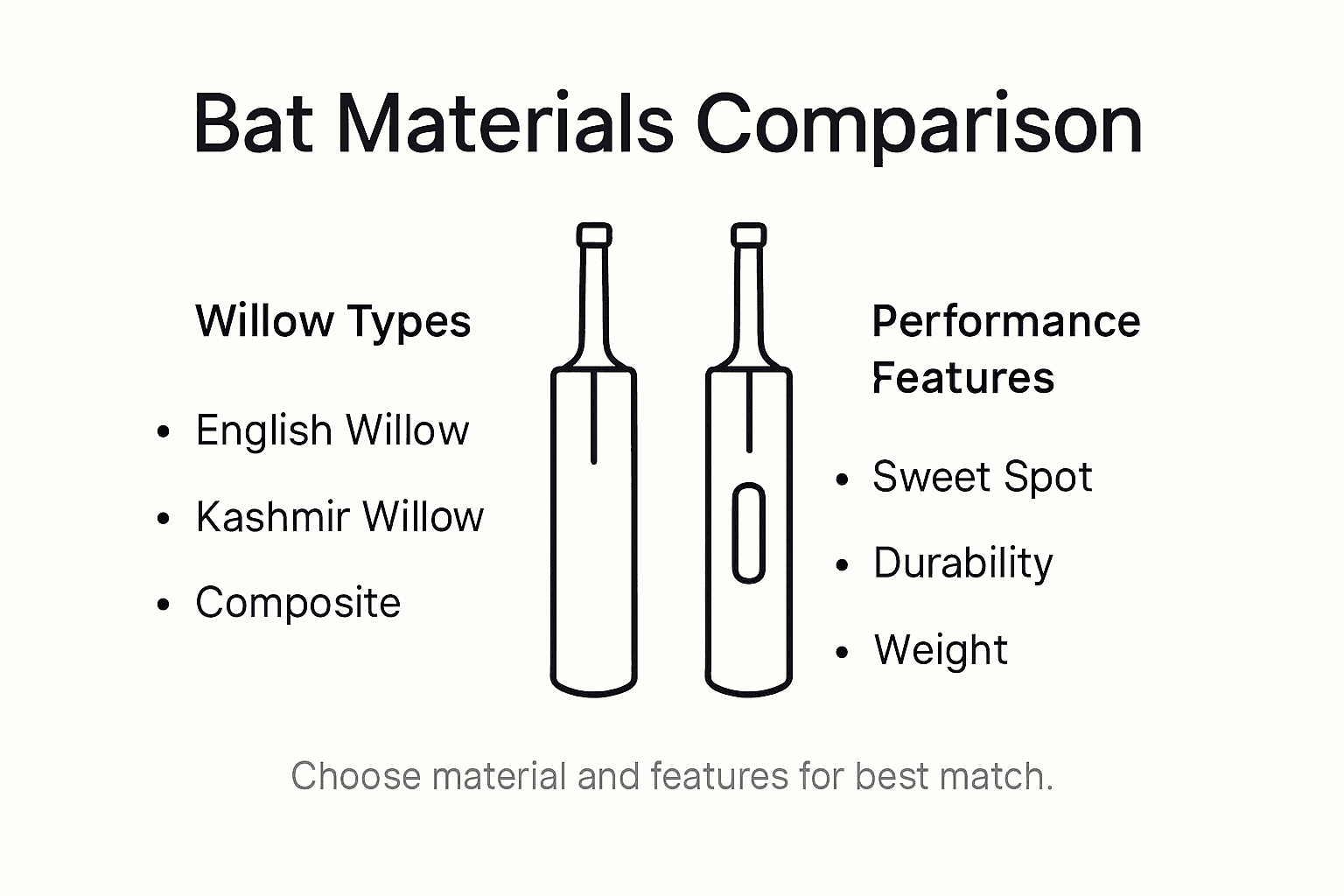
Here’s how key cricket bat materials compare in terms of playing performance:
| Material Type | Benefits | Drawbacks |
|---|---|---|
| English willow | Superior performance, light | More expensive, needs care |
| Kashmir willow | Affordable, durable | Heavier, less responsive |
| Composite (mixed) | Enhanced durability, cheaper | Less shock absorption, stiff |
| Laminated willow | Consistent quality, affordable | Slightly less power |
Expert Tip: Always inspect the wood grain carefully and tap the bat to assess its resonance, which can reveal subtle differences in material quality and potential performance characteristics.
Step 2: Inspect weight and balance physically
Physically assessing your cricket bat’s weight and balance is a critical skill that can dramatically improve your batting performance. Understanding how a bat feels and moves will help you select an implement that complements your unique playing style and technique.
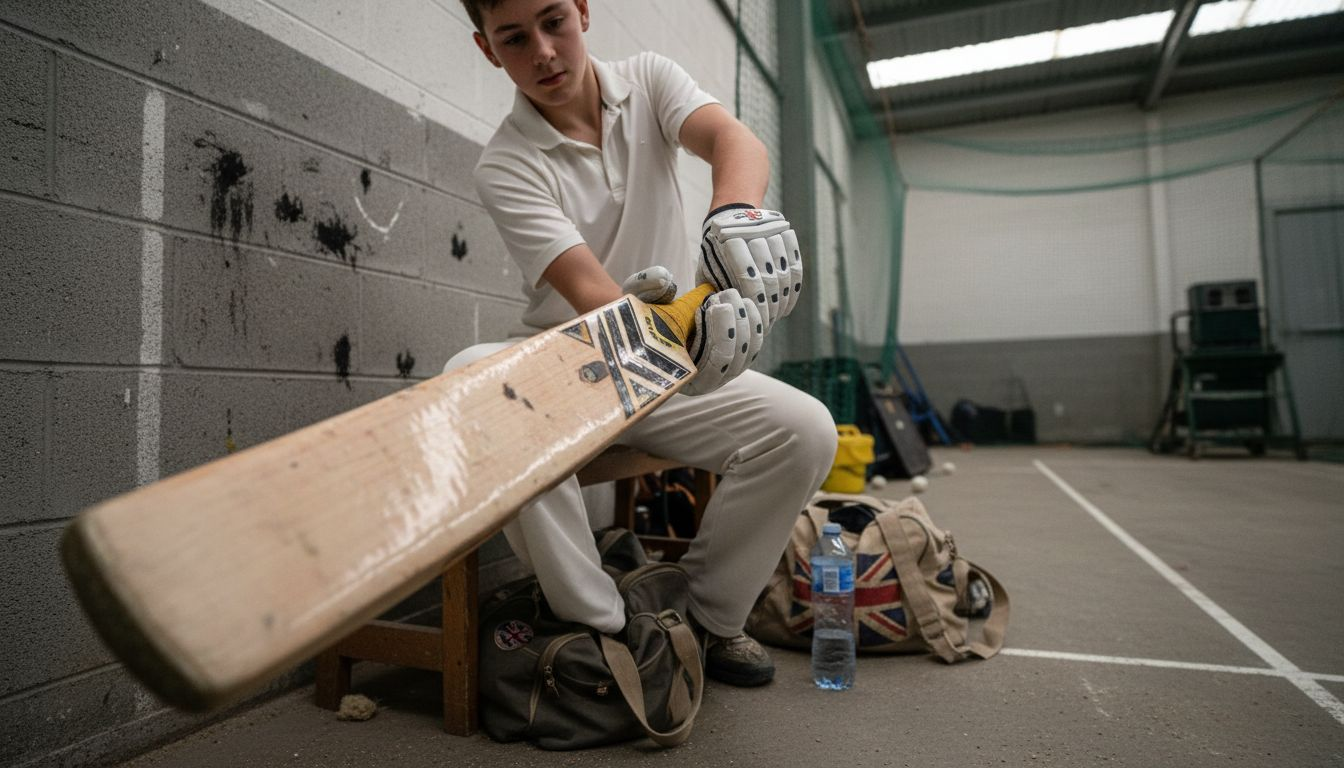
The weight distribution of a cricket bat plays a fundamental role in its overall performance, with professional players paying meticulous attention to how the bat feels during swing and impact. When inspecting a bat, start by holding it vertically with the blade facing upwards and gripping the handle. Gently tilt the bat and observe how the weight shifts. A well-balanced bat will feel natural and smooth, with wood concentrated in the middle section to optimise power transfer and control.
To conduct a thorough physical assessment, perform several practical tests. First, grip the bat at its handle and simulate a few practice swings to understand its manoeuvrability. Pay attention to how the weight feels during different motion ranges. Next, balance the bat horizontally on your palm near the handle splice. A high-quality bat will remain relatively level, indicating consistent wood density and balanced construction. Listen for subtle resonance when tapping the blade lightly this can reveal insights about wood quality and structural integrity.
Expert Tip: Always test multiple bats and compare their physical characteristics to develop a nuanced understanding of what feels most comfortable and responsive for your individual playing technique.
Step 3: Evaluate handle and grip comfort
Choosing the right cricket bat handle can significantly impact your performance, comfort, and overall playing experience. The connection between your hand and the bat is crucial for delivering powerful and precise shots.
Cricket bat handles are traditionally crafted with intricate design considerations that directly influence player comfort and control. When evaluating a handle, begin by assessing its circumference and texture. Wrap your hand around the grip and pay attention to how naturally it fits. A well-designed handle should feel like an extension of your arm, allowing seamless movement and minimal grip tension. Consider the rubber covering material its softness, tackiness, and ability to absorb moisture will determine how securely you can hold the bat during intense playing conditions.
To thoroughly assess handle comfort, perform a series of practical tests. Simulate batting motions by gripping the bat and making controlled swings. Notice how the handle feels during different wrist movements and arm angles. Check for any pressure points or areas that cause discomfort. A superior handle will provide consistent support across your entire grip, reducing hand fatigue and allowing more extended, more comfortable playing sessions. Look for handles with strategic shock absorption properties that can minimise vibration and reduce strain during ball impact.
The following table summarises grip and handle features and their effects on comfort and control:
| Handle Feature | Impact on Performance | Typical Player Preference |
|---|---|---|
| Thick circumference | Reduces vibration, more cushioning | Aggressive hitters, power players |
| Thin circumference | Lighter feel, more control | Players favouring finesse and touch |
| Soft rubber grip | Improved comfort, absorbs sweat | All-rounders, long sessions |
| Hard textured grip | Enhanced feedback, better control | Batsmen who prefer a firm connection |
Expert Tip: Try holding multiple bats with different handle designs and pay attention to subtle differences in grip comfort and responsiveness to find your perfect match.
Step 4: Test performance through gentle play
Testing your cricket bat through gentle play is a crucial step in understanding its true potential and compatibility with your unique batting style. This process allows you to gain intimate knowledge of how the bat responds during actual gameplay scenarios.
Batting performance involves carefully observing how equipment interacts with different playing conditions), making gentle practice shots an essential evaluation technique. Start by finding a suitable practice area with consistent ground conditions. Begin with soft defensive strokes, paying close attention to how the bat feels when making contact with practice balls. Notice the responsiveness of the bat’s sweet spot, the smoothness of your swing, and how naturally the bat moves through different motion ranges. Look for consistent power transfer and minimal vibration during impact, which indicate superior bat construction and design.
During your gentle play assessment, experiment with various shot types to comprehensively understand the bat’s characteristics. Practice forward defensive shots, gentle drives, and defensive blocks to see how the bat performs across different techniques. Observe how the bat’s weight distribution influences your stroke precision and how comfortable you feel during extended practice sessions. Pay attention to subtle feedback from the bat such as vibration levels, sound upon ball contact, and how effortlessly you can control your shots. A high quality bat will provide consistent performance and feel like a natural extension of your batting technique.
Expert Tip: Record your practice session on video to analyse your bat’s performance more objectively and identify nuanced characteristics that might not be immediately apparent during play.
Step 5: Verify bat quality and finish
Carefully examining the quality and finish of your cricket bat is essential to ensure you invest in a superior piece of sporting equipment that will enhance your performance and endure rigorous play.
Cricket bat quality verification involves systematic examination of wood characteristics and surface craftsmanship, focusing on several critical aspects. Begin by inspecting the wood grain carefully under good lighting. Premium bats feature straight, uniform grain lines running parallel to the bat’s length, indicating high quality willow selection. Run your fingers gently across the bat’s surface to assess smoothness and check for any irregularities. The surface should feel consistently even without bumps or uneven patches. Pay special attention to the edges and spine of the bat where craftsmanship details become most apparent.
Examine the bat’s protective finish by looking at its overall treatment and oiling. A well-maintained bat will have a smooth, slightly glossy surface treated with raw linseed oil, which helps preserve the wood and prevent cracking. Check the handle splice for precise alignment and the grip for uniform application. Look for signs of professional finishing such as clean edges, symmetrical shape, and no visible wood imperfections. Remember that a superior bat will demonstrate meticulous attention to detail in every aspect of its construction.
Expert Tip: Always inspect a bat under natural daylight and rotate it multiple times to catch subtle variations in finish and grain that might not be immediately visible.
Find Your Perfect Cricket Bat with Confidence and Clarity
Choosing the right cricket bat is more than just a purchase it is a crucial investment in your game. This article clearly highlights the challenges of comparing bats based on quality, weight, balance, and handle comfort all essential for maximising performance and value. You want a bat that feels like a natural extension of your technique and delivers consistent power without compromising control or comfort.
Explore our extensive collection at adidas Cricket Bats – Cricket Bats Com where you can physically compare high-quality bats crafted from premium English willow and other trusted materials.

Start your journey to enhanced batting performance by visiting Cricket Bats Com. Experience our carefully curated selection designed for all levels from junior to professional players. Visit Junior Cricket Bats | Cheap Junior Cricket Bats – Cricket Bats Com if you are looking for beginner-friendly options. Don’t wait to arm yourself with a bat that matches your style and ambitions. Shop now and feel the difference on the pitch.
Frequently Asked Questions
How do I assess the quality of a cricket bat?
Begin by inspecting the wood grain, looking for straight, uniform lines that indicate quality. Check the overall smoothness of the surface and ensure there are no irregularities, particularly at the edges and spine.
What factors affect the performance of a cricket bat?
Key factors include the type of wood, the bat’s weight distribution, and the design of the handle. Evaluate these characteristics in conjunction with your batting style to select a bat that enhances your performance.
How can I determine the right weight for my cricket bat?
Hold the bat vertically and tilt it to assess how naturally it feels. Perform practice swings to ensure the weight is comfortable and allows for controlled movement, aiming for a bat that feels balanced and easy to manoeuvre.
What should I look for in the handle and grip of a cricket bat?
Evaluate the handle’s circumference and texture to ensure it fits comfortably in your hand. Test the grip by making swings to identify any pressure points and assess how well the material absorbs moisture during play.
How do I test a cricket bat’s performance?
Execute gentle practice shots in a suitable area to observe how the bat responds during play. Focus on the sweet spot, power transfer, and any vibrations felt during impact, ensuring the bat complements your unique technique.
What details in the finish of a cricket bat should I check?
Examine the bat under good lighting, ensuring the wood grain is straight and the surface smooth. Look for signs of quality treatment, such as a glossy finish from linseed oil, and check for precise craftsmanship around the handle splice and edges.
Recommended
Over 85 percent of British amateur cricket players admit that choosing the right bat feels like facing a fast bowler on a wet pitch. With performance on the line, understanding bat specifications and materials can be the difference between a solid innings and a missed shot. This guide breaks down how to assess every critical aspect from willow quality to handle comfort, helping you confidently compare bats that suit your skills and style.
Table of Contents
- Step 1: Assess Bat Specifications And Materials
- Step 2: Inspect Weight And Balance Physically
- Step 3: Evaluate Handle And Grip Comfort
- Step 4: Test Performance Through Gentle Play
- Step 5: Verify Bat Quality And Finish
Quick Summary
| Key Insight | Explanation |
|---|---|
| 1. Assess bat materials carefully | Choose bats made from quality English willow for superior performance and lightweight characteristics. |
| 2. Evaluate weight and balance physically | Hold the bat and tilt it to check weight distribution; a well-balanced bat will feel natural during swings. |
| 3. Inspect handle and grip comfort | Ensure the handle fits well in your hand; it should enhance your comfort and control during play. |
| 4. Test performance through gentle play | Make practice shots to understand how the bat responds, ensuring it aligns with your batting style. |
| 5. Verify bat quality and finish | Examine the bat’s wood grain, surface smoothness, and craftsmanship for maximum durability and performance. |
Step 1: Assess bat specifications and materials
Selecting the right cricket bat requires a strategic understanding of its core specifications and materials. The quality of a bat can significantly impact your performance on the pitch, making careful assessment crucial. Understanding how different materials influence bat characteristics will help you make an informed choice.
When examining cricket bat specifications, you need to focus on key attributes like wood quality, weight distribution, and structural design. Cricket bat construction has evolved dramatically from traditional hockey stick shapes to modern flat-fronted willow designs. Professional-grade bats are crafted from specific willow varieties chosen for their exceptional properties. Cricket bat willow, scientifically known as Salix alba var. caerulea, stands out for its remarkable combination of toughness, shock resistance, and lightweight characteristics.
The bat’s blade design plays a critical role in performance. Most high-quality bats feature a flat striking surface with a pronounced ridge on the back, strategically concentrating wood in the middle section where most ball impacts occur. Professional players carefully evaluate wood grain density, handle splice quality, and overall weight balance. Look for bats with tight, straight grain lines running parallel to the bat’s length, which typically indicate superior structural integrity and potential performance.
Here’s how key cricket bat materials compare in terms of playing performance:
| Material Type | Benefits | Drawbacks |
|---|---|---|
| English willow | Superior performance, light | More expensive, needs care |
| Kashmir willow | Affordable, durable | Heavier, less responsive |
| Composite (mixed) | Enhanced durability, cheaper | Less shock absorption, stiff |
| Laminated willow | Consistent quality, affordable | Slightly less power |
Expert Tip: Always inspect the wood grain carefully and tap the bat to assess its resonance, which can reveal subtle differences in material quality and potential performance characteristics.
Step 2: Inspect weight and balance physically
Physically assessing your cricket bat’s weight and balance is a critical skill that can dramatically improve your batting performance. Understanding how a bat feels and moves will help you select an implement that complements your unique playing style and technique.
The weight distribution of a cricket bat plays a fundamental role in its overall performance, with professional players paying meticulous attention to how the bat feels during swing and impact. When inspecting a bat, start by holding it vertically with the blade facing upwards and gripping the handle. Gently tilt the bat and observe how the weight shifts. A well-balanced bat will feel natural and smooth, with wood concentrated in the middle section to optimise power transfer and control.
To conduct a thorough physical assessment, perform several practical tests. First, grip the bat at its handle and simulate a few practice swings to understand its manoeuvrability. Pay attention to how the weight feels during different motion ranges. Next, balance the bat horizontally on your palm near the handle splice. A high-quality bat will remain relatively level, indicating consistent wood density and balanced construction. Listen for subtle resonance when tapping the blade lightly this can reveal insights about wood quality and structural integrity.
Expert Tip: Always test multiple bats and compare their physical characteristics to develop a nuanced understanding of what feels most comfortable and responsive for your individual playing technique.
Step 3: Evaluate handle and grip comfort
Choosing the right cricket bat handle can significantly impact your performance, comfort, and overall playing experience. The connection between your hand and the bat is crucial for delivering powerful and precise shots.
Cricket bat handles are traditionally crafted with intricate design considerations that directly influence player comfort and control. When evaluating a handle, begin by assessing its circumference and texture. Wrap your hand around the grip and pay attention to how naturally it fits. A well-designed handle should feel like an extension of your arm, allowing seamless movement and minimal grip tension. Consider the rubber covering material its softness, tackiness, and ability to absorb moisture will determine how securely you can hold the bat during intense playing conditions.
To thoroughly assess handle comfort, perform a series of practical tests. Simulate batting motions by gripping the bat and making controlled swings. Notice how the handle feels during different wrist movements and arm angles. Check for any pressure points or areas that cause discomfort. A superior handle will provide consistent support across your entire grip, reducing hand fatigue and allowing more extended, more comfortable playing sessions. Look for handles with strategic shock absorption properties that can minimise vibration and reduce strain during ball impact.
The following table summarises grip and handle features and their effects on comfort and control:
| Handle Feature | Impact on Performance | Typical Player Preference |
|---|---|---|
| Thick circumference | Reduces vibration, more cushioning | Aggressive hitters, power players |
| Thin circumference | Lighter feel, more control | Players favouring finesse and touch |
| Soft rubber grip | Improved comfort, absorbs sweat | All-rounders, long sessions |
| Hard textured grip | Enhanced feedback, better control | Batsmen who prefer a firm connection |
Expert Tip: Try holding multiple bats with different handle designs and pay attention to subtle differences in grip comfort and responsiveness to find your perfect match.
Step 4: Test performance through gentle play
Testing your cricket bat through gentle play is a crucial step in understanding its true potential and compatibility with your unique batting style. This process allows you to gain intimate knowledge of how the bat responds during actual gameplay scenarios.
Batting performance involves carefully observing how equipment interacts with different playing conditions), making gentle practice shots an essential evaluation technique. Start by finding a suitable practice area with consistent ground conditions. Begin with soft defensive strokes, paying close attention to how the bat feels when making contact with practice balls. Notice the responsiveness of the bat’s sweet spot, the smoothness of your swing, and how naturally the bat moves through different motion ranges. Look for consistent power transfer and minimal vibration during impact, which indicate superior bat construction and design.
During your gentle play assessment, experiment with various shot types to comprehensively understand the bat’s characteristics. Practice forward defensive shots, gentle drives, and defensive blocks to see how the bat performs across different techniques. Observe how the bat’s weight distribution influences your stroke precision and how comfortable you feel during extended practice sessions. Pay attention to subtle feedback from the bat such as vibration levels, sound upon ball contact, and how effortlessly you can control your shots. A high quality bat will provide consistent performance and feel like a natural extension of your batting technique.
Expert Tip: Record your practice session on video to analyse your bat’s performance more objectively and identify nuanced characteristics that might not be immediately apparent during play.
Step 5: Verify bat quality and finish
Carefully examining the quality and finish of your cricket bat is essential to ensure you invest in a superior piece of sporting equipment that will enhance your performance and endure rigorous play.
Cricket bat quality verification involves systematic examination of wood characteristics and surface craftsmanship, focusing on several critical aspects. Begin by inspecting the wood grain carefully under good lighting. Premium bats feature straight, uniform grain lines running parallel to the bat’s length, indicating high quality willow selection. Run your fingers gently across the bat’s surface to assess smoothness and check for any irregularities. The surface should feel consistently even without bumps or uneven patches. Pay special attention to the edges and spine of the bat where craftsmanship details become most apparent.
Examine the bat’s protective finish by looking at its overall treatment and oiling. A well-maintained bat will have a smooth, slightly glossy surface treated with raw linseed oil, which helps preserve the wood and prevent cracking. Check the handle splice for precise alignment and the grip for uniform application. Look for signs of professional finishing such as clean edges, symmetrical shape, and no visible wood imperfections. Remember that a superior bat will demonstrate meticulous attention to detail in every aspect of its construction.
Expert Tip: Always inspect a bat under natural daylight and rotate it multiple times to catch subtle variations in finish and grain that might not be immediately visible.
Find Your Perfect Cricket Bat with Confidence and Clarity
Choosing the right cricket bat is more than just a purchase it is a crucial investment in your game. This article clearly highlights the challenges of comparing bats based on quality, weight, balance, and handle comfort all essential for maximising performance and value. You want a bat that feels like a natural extension of your technique and delivers consistent power without compromising control or comfort.
Explore our extensive collection at adidas Cricket Bats – Cricket Bats Com where you can physically compare high-quality bats crafted from premium English willow and other trusted materials.
Start your journey to enhanced batting performance by visiting Cricket Bats Com. Experience our carefully curated selection designed for all levels from junior to professional players. Visit Junior Cricket Bats | Cheap Junior Cricket Bats – Cricket Bats Com if you are looking for beginner-friendly options. Don’t wait to arm yourself with a bat that matches your style and ambitions. Shop now and feel the difference on the pitch.
Frequently Asked Questions
How do I assess the quality of a cricket bat?
Begin by inspecting the wood grain, looking for straight, uniform lines that indicate quality. Check the overall smoothness of the surface and ensure there are no irregularities, particularly at the edges and spine.
What factors affect the performance of a cricket bat?
Key factors include the type of wood, the bat’s weight distribution, and the design of the handle. Evaluate these characteristics in conjunction with your batting style to select a bat that enhances your performance.
How can I determine the right weight for my cricket bat?
Hold the bat vertically and tilt it to assess how naturally it feels. Perform practice swings to ensure the weight is comfortable and allows for controlled movement, aiming for a bat that feels balanced and easy to manoeuvre.
What should I look for in the handle and grip of a cricket bat?
Evaluate the handle’s circumference and texture to ensure it fits comfortably in your hand. Test the grip by making swings to identify any pressure points and assess how well the material absorbs moisture during play.
How do I test a cricket bat’s performance?
Execute gentle practice shots in a suitable area to observe how the bat responds during play. Focus on the sweet spot, power transfer, and any vibrations felt during impact, ensuring the bat complements your unique technique.
What details in the finish of a cricket bat should I check?
Examine the bat under good lighting, ensuring the wood grain is straight and the surface smooth. Look for signs of quality treatment, such as a glossy finish from linseed oil, and check for precise craftsmanship around the handle splice and edges.