
News News
Cricket Bat vs Tennis Bat: Key Differences for UK Players Cricket Bat vs Tennis Bat: Key Differences for UK Players
Choosing the right equipment can make or break your performance on the cricket pitch. For amateur players across the United Kingdom, understanding the technical differences between a cricket bat and a tennis racquet means more than just knowing what looks good. Each is engineered with unique materials and design philosophies, shaping the way you hit the ball and interact with your sport. Unlock the knowledge you need to boost your confidence, avoid common gear mistakes, and fine-tune your game with a clear breakdown of these essential sporting tools.
Table of Contents
- Cricket Bat And Tennis Bat Defined
- Materials And Construction Differences
- Design, Weight, And Sweet Spot Comparison
- Which Bat For Each Cricket Format
- Performance And Safety Implications
- Avoiding Common Equipment Mistakes
Key Takeaways
| Point | Details |
|---|---|
| Material Distinction | Cricket bats are primarily made from white willow wood for impact resistance, while tennis racquets use lightweight composites for flexibility and control. |
| Design Purpose | The engineering of cricket bats focuses on direct, heavy strikes, whilst tennis racquets are designed for spin and precision. |
| Sweet Spot Importance | Understanding the sweet spot is crucial for optimising performance in both cricket and tennis, influencing energy transfer efficiency and shot accuracy. |
| Format-Specific Selection | Choosing the appropriate bat characteristics for different cricket formats is essential for maximising player performance and adapting strategies accordingly. |
Cricket bat and tennis bat defined
Cricket bats and tennis racquets represent distinctly different pieces of sporting equipment designed for specific gameplay and ball interaction. While both are used in hitting scenarios, their fundamental design and purpose vary significantly.
A cricket bat is a specialised piece of equipment constructed primarily from white willow wood, featuring a flat striking surface and a robust wooden blade. Key characteristics include:
- Solid wooden construction
- Flat striking face
- Typically weighing between 1.1-1.4 pounds
- Maximum width of 4.25 inches
- Length around 38 inches long
By contrast, a tennis racquet represents an entirely different engineering approach. Tennis racquets are constructed with:
- A lightweight frame
- Strung surface made of tightly woven strings
- Designed for high-velocity ball striking
- Typically weighing between 9-11 ounces
- Oval or rounded head shape
Material differences fundamentally separate these sporting tools. Cricket bats demand a solid, dense wooden construction that can withstand high-impact ball strikes, whereas tennis racquets prioritise flexibility and string tension for precise ball control and spin generation.
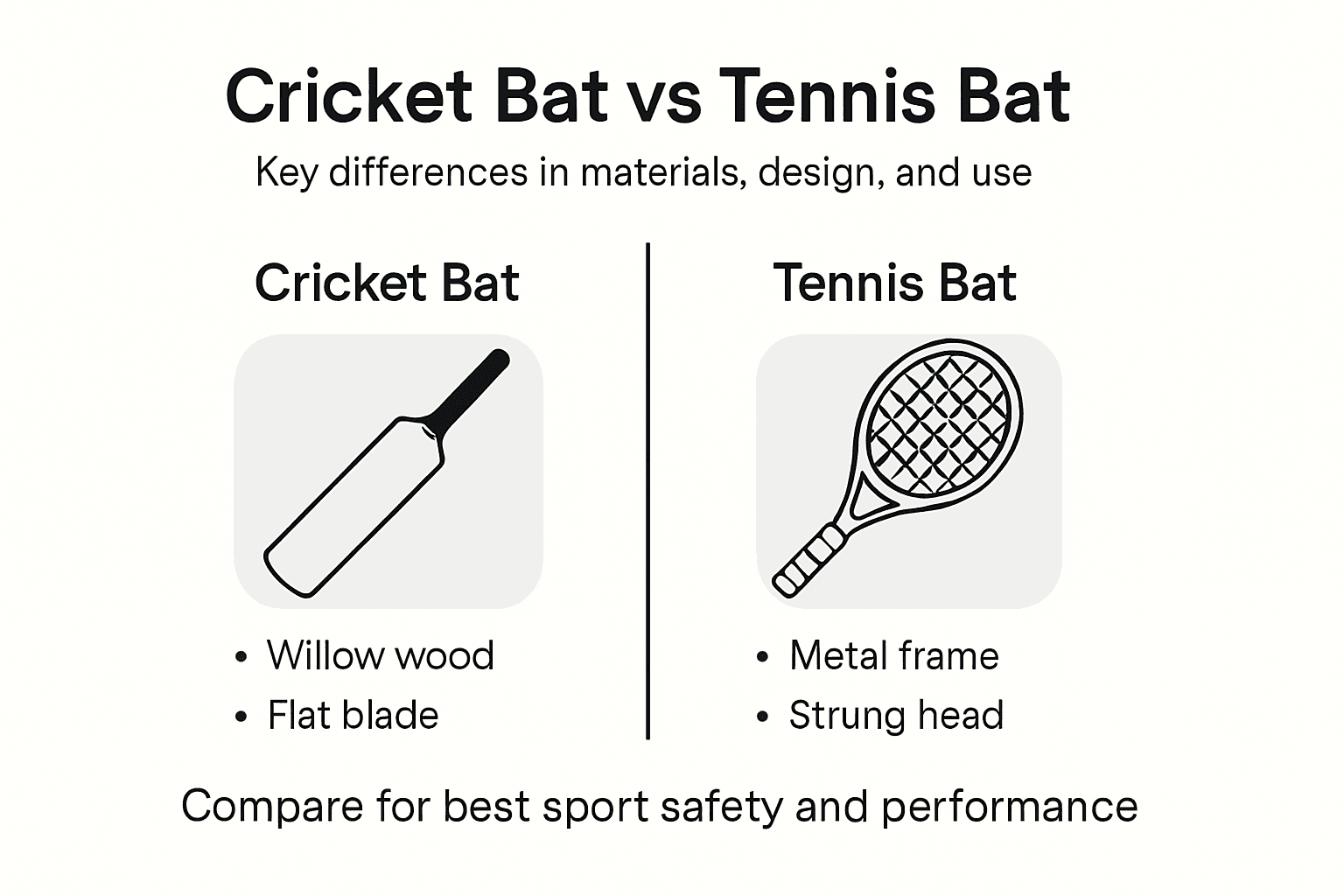
Below is a concise comparison of cricket bats and tennis racquets across multiple critical engineering and sporting factors:
| Factor | Cricket Bat | Tennis Racquet |
|---|---|---|
| Primary Material | White willow wood | Graphite composites |
| Key Engineering Goal | Maximise impact resistance | Optimise flexibility and control |
| Striking Surface | Solid flat blade | Strung string-bed |
| Weight Range | 1.1–1.4 pounds | 9–11 ounces |
| Energy Transfer | Direct, heavy strikes | Spin and rebounding |
| Suitability | Hard, heavy balls | Lightweight, fast balls |
This table highlights the technological and sporting distinctions between the two implements.
The primary distinction lies not just in materials, but in the precise engineering required for each sport’s unique ball dynamics.
Pro tip: Always choose sport-specific equipment designed precisely for your intended gameplay to maximise performance and prevent potential equipment failure.
Materials and construction differences
The materials and construction of cricket bats and tennis racquets represent fundamentally different engineering approaches tailored to their specific sporting requirements. Cricket bats are traditionally crafted from willow wood, a material chosen specifically for its unique performance characteristics in cricket gameplay.
Cricket bat materials and construction typically feature:
- 100% white willow wood (Salix alba var. caerulea)
- Flat fronted wooden blade
- Treated with raw linseed oil for protection
- Cane handle attached via tapered splice
- Designed for high-impact ball resistance
- Weight optimised for power and control
In contrast, modern tennis racquets utilise advanced composite materials that prioritise lightweight flexibility and performance. These include:
- Graphite frame construction
- Carbon fibre reinforcement
- Fiberglass components
- Synthetic string beds
- Engineered for maximum power transfer
- Designed to absorb and rebound ball impact
Material engineering plays a crucial role in differentiating these sporting tools. Cricket bats require a solid, dense wooden construction capable of withstanding direct, high-velocity ball strikes, whereas tennis racquets demand intricate material science to balance power, control, and responsiveness.
The fundamental difference lies not just in materials, but in the precise engineering philosophy behind each sporting implement.
Pro tip: Invest in sport-specific equipment engineered precisely for your playing style to maximise performance and reduce risk of equipment failure.
Design, weight, and sweet spot comparison
Cricket bats and tennis racquets represent remarkably different sporting implements, each engineered with precision to maximise performance in their respective games. The sweet spot plays a critical role in both implements), determining the efficiency of energy transfer during ball strikes.
Cricket bat characteristics include:
- Typical weight range: 1.1-1.4 pounds
- Length approximately 38 inches
- Sweet spot located 150-160mm from toe
- Wooden blade with concentrated mass
- Designed for powerful, direct strikes
- Maximum width restricted to 4.25 inches
In contrast, tennis racquets feature distinctly different design specifications that prioritise flexibility and controlled movement:
- Weight range: 9-11 ounces
- Longer overall length
- Adjustable head sizes
- String bed sweet spot
- Engineered for spin and precision
- Lightweight composite materials
Performance engineering distinguishes these sporting tools fundamentally. Cricket bats demand a robust, dense construction capable of withstanding direct, high-velocity impacts, whereas tennis racquets require intricate balance between power, control, and manoeuvrability.
The sweet spot represents more than a physical location - it’s the essence of sporting equipment’s performance potential.
Pro tip: Understand your sporting equipment’s unique design characteristics to optimise your technique and maximise performance.
Which bat for each cricket format
Cricket formats demand nuanced bat selections that dramatically impact player performance and strategy. Different cricket formats require specific bat characteristics) that optimise a player’s approach to the game.
Bat specifications for various cricket formats:
Test Cricket Bats:
- Emphasise traditional willow construction
- Thicker, more durable blade
- Heavier overall weight
- Focused on defensive play
- Designed for extended innings
- Smaller sweet spot for controlled shots
One Day International (ODI) Bats:
- Medium-weight profile
- Balanced between power and control
- Moderate edge thickness
- Versatile sweet spot
- Supports varied batting techniques
- Suitable for mixed scoring approaches
Twenty20 (T20) Bats:
- Lighter overall weight
- Significantly larger sweet spot
- Thicker bat edges
- Engineered for aggressive hitting
- Maximum power transfer
- Designed for rapid scoring
Cricket batting techniques adapt across different match formats, with bat design playing a crucial role in supporting specific playing styles. Performance engineering means understanding how bat characteristics align with match requirements becomes essential for serious players.
Selecting the right bat is not just about equipment - it’s about matching your tool to your tactical approach.
Pro tip: Always trial multiple bat styles within your preferred format to discover the perfect balance between weight, sweet spot, and personal technique.
To assist with equipment selection, here is an overview of how cricket bat characteristics align with different cricket formats:
| Format | Ideal Bat Weight | Sweet Spot Focus | Power or Control Priority |
|---|---|---|---|
| Test | Heavier | Smaller for control | Defensive accuracy |
| ODI | Medium | Versatile | Mixed, adaptable |
| T20 | Lighter | Large for easy hits | Maximum power |
Reference this table for optimal bat attributes when playing various cricket match types.
Performance and safety implications
Cricket equipment design goes far beyond aesthetic considerations, with musculoskeletal health playing a critical role in player safety. The interaction between bat design, player technique, and potential injury risk demands careful understanding and strategic equipment selection.
Key performance and safety considerations include:
Biomechanical Stress Factors:
- Impact force distribution
- Weight balance and ergonomics
- Vibration absorption capabilities
- Handle grip and shock mitigation
- Material flexibility
- Potential strain points
Injury Prevention Strategies:
- Select bats matching individual physique
- Consider weight distribution carefully
- Use protective equipment consistently
- Develop proper batting techniques
- Regular equipment maintenance
- Professional equipment assessment
Performance Impact Analysis:
- Optimal bat weight for individual technique
- Sweet spot positioning
- Energy transfer efficiency
- Stroke power generation
- Reduced muscle fatigue
- Enhanced playing consistency
Understanding the intricate relationship between bat mechanics and player physiology becomes essential for minimising injury risk and maximising on-field performance. Professional players invest considerable time in selecting equipment that complements their unique physical capabilities.
Equipment is not just a tool - it’s an extension of the player’s body and technical capabilities.
Pro tip: Consult sports physiotherapists and professional coaches when selecting cricket equipment to ensure optimal performance and personal safety.
Avoiding common equipment mistakes
Biomechanical assessment is crucial for preventing equipment-related errors that can compromise performance and increase injury risks for cricket players. Understanding the nuanced relationship between player physique and equipment selection becomes paramount.
Common equipment selection mistakes include:
Bat Weight Mismatches:
- Choosing bats too heavy for personal strength
- Ignoring individual physique requirements
- Neglecting weight distribution analysis
- Selecting generic bat designs
- Overlooking personal batting technique
- Disregarding format-specific equipment needs
Technical Selection Errors:
- Improper bat size for body height
- Using inappropriate handle grip
- Neglecting bat balance assessment
- Ignoring personal swing mechanics
- Failing to consider playing position
- Underestimating equipment customisation importance
Performance Compromise Indicators:
- Reduced stroke power
- Increased muscular strain
- Higher injury probability
- Limited shot execution range
- Inconsistent batting performance
- Diminished technical confidence
Professional players understand that equipment selection is a sophisticated process requiring comprehensive evaluation of individual physical characteristics, playing style, and specific format requirements.
Equipment adaptation is not a luxury - it’s a fundamental performance strategy.
Pro tip: Invest in professional biomechanical assessment to identify the perfect bat that complements your unique physical attributes and playing technique.
Discover the Perfect Cricket Bat for Your Game
Choosing the right cricket bat is essential for maximising your performance and avoiding common equipment mistakes highlighted in the article. Whether you are playing Test, ODI, or T20 formats, understanding bat weight, sweet spot placement, and material construction makes all the difference. If you want a bat engineered for power and control tailored to UK players you can find a wide selection of expertly crafted options at cricketbats.com.

Explore our range of premium cricket bats from leading brands like New Balance and adidas to find the ideal match for your playing style. Protect your performance and reduce injury risks by choosing a bat that complements your physique and game format. Start your search with our specialised collections of New Balance Cricket Bats and adidas Cricket Bats today. Visit cricketbats.com now and gear up with confidence.
Frequently Asked Questions
What is the primary material used in cricket bats?
Cricket bats are primarily made from 100% white willow wood, chosen for its performance characteristics in cricket.
How do the designs of cricket bats and tennis racquets differ?
Cricket bats feature a solid flat blade for powerful strikes, while tennis racquets have a lightweight frame with a strung surface designed for flexibility and control.
What should I consider when choosing a cricket bat for different formats of the game?
Consider the weight and sweet spot of the bat. For Test cricket, opt for a heavier bat with a smaller sweet spot, whereas for T20, a lighter bat with a larger sweet spot is advisable.
How does bat selection affect player safety and performance?
Selecting the right bat is crucial for minimizing injury risks and maximizing performance, as an ill-fitting bat can lead to increased strain and reduced efficiency in stroke play.
Recommended
- Cricket Bat Certifications: What Every Player Needs – Cricket Bats Com
- 7 Types of Cricket Bats Every Amateur Should Know – Cricket Bats Com
- Cricket Bat Certifications Explained: Ensuring Legal Play – Cricket Bats Com
- What Is a Cricket Bat and How It Impacts Your Game – Cricket Bats Com
- Why Choose Plant-Based Supplements for UK Female Athletes – Interval
- What Is Vitamin D and Why Athletes Need It – MyGymSupplements
Choosing the right equipment can make or break your performance on the cricket pitch. For amateur players across the United Kingdom, understanding the technical differences between a cricket bat and a tennis racquet means more than just knowing what looks good. Each is engineered with unique materials and design philosophies, shaping the way you hit the ball and interact with your sport. Unlock the knowledge you need to boost your confidence, avoid common gear mistakes, and fine-tune your game with a clear breakdown of these essential sporting tools.
Table of Contents
- Cricket Bat And Tennis Bat Defined
- Materials And Construction Differences
- Design, Weight, And Sweet Spot Comparison
- Which Bat For Each Cricket Format
- Performance And Safety Implications
- Avoiding Common Equipment Mistakes
Key Takeaways
| Point | Details |
|---|---|
| Material Distinction | Cricket bats are primarily made from white willow wood for impact resistance, while tennis racquets use lightweight composites for flexibility and control. |
| Design Purpose | The engineering of cricket bats focuses on direct, heavy strikes, whilst tennis racquets are designed for spin and precision. |
| Sweet Spot Importance | Understanding the sweet spot is crucial for optimising performance in both cricket and tennis, influencing energy transfer efficiency and shot accuracy. |
| Format-Specific Selection | Choosing the appropriate bat characteristics for different cricket formats is essential for maximising player performance and adapting strategies accordingly. |
Cricket bat and tennis bat defined
Cricket bats and tennis racquets represent distinctly different pieces of sporting equipment designed for specific gameplay and ball interaction. While both are used in hitting scenarios, their fundamental design and purpose vary significantly.
A cricket bat is a specialised piece of equipment constructed primarily from white willow wood, featuring a flat striking surface and a robust wooden blade. Key characteristics include:
- Solid wooden construction
- Flat striking face
- Typically weighing between 1.1-1.4 pounds
- Maximum width of 4.25 inches
- Length around 38 inches long
By contrast, a tennis racquet represents an entirely different engineering approach. Tennis racquets are constructed with:
- A lightweight frame
- Strung surface made of tightly woven strings
- Designed for high-velocity ball striking
- Typically weighing between 9-11 ounces
- Oval or rounded head shape
Material differences fundamentally separate these sporting tools. Cricket bats demand a solid, dense wooden construction that can withstand high-impact ball strikes, whereas tennis racquets prioritise flexibility and string tension for precise ball control and spin generation.
Below is a concise comparison of cricket bats and tennis racquets across multiple critical engineering and sporting factors:
| Factor | Cricket Bat | Tennis Racquet |
|---|---|---|
| Primary Material | White willow wood | Graphite composites |
| Key Engineering Goal | Maximise impact resistance | Optimise flexibility and control |
| Striking Surface | Solid flat blade | Strung string-bed |
| Weight Range | 1.1–1.4 pounds | 9–11 ounces |
| Energy Transfer | Direct, heavy strikes | Spin and rebounding |
| Suitability | Hard, heavy balls | Lightweight, fast balls |
This table highlights the technological and sporting distinctions between the two implements.
The primary distinction lies not just in materials, but in the precise engineering required for each sport’s unique ball dynamics.
Pro tip: Always choose sport-specific equipment designed precisely for your intended gameplay to maximise performance and prevent potential equipment failure.
Materials and construction differences
The materials and construction of cricket bats and tennis racquets represent fundamentally different engineering approaches tailored to their specific sporting requirements. Cricket bats are traditionally crafted from willow wood, a material chosen specifically for its unique performance characteristics in cricket gameplay.
Cricket bat materials and construction typically feature:
- 100% white willow wood (Salix alba var. caerulea)
- Flat fronted wooden blade
- Treated with raw linseed oil for protection
- Cane handle attached via tapered splice
- Designed for high-impact ball resistance
- Weight optimised for power and control
In contrast, modern tennis racquets utilise advanced composite materials that prioritise lightweight flexibility and performance. These include:
- Graphite frame construction
- Carbon fibre reinforcement
- Fiberglass components
- Synthetic string beds
- Engineered for maximum power transfer
- Designed to absorb and rebound ball impact
Material engineering plays a crucial role in differentiating these sporting tools. Cricket bats require a solid, dense wooden construction capable of withstanding direct, high-velocity ball strikes, whereas tennis racquets demand intricate material science to balance power, control, and responsiveness.
The fundamental difference lies not just in materials, but in the precise engineering philosophy behind each sporting implement.
Pro tip: Invest in sport-specific equipment engineered precisely for your playing style to maximise performance and reduce risk of equipment failure.
Design, weight, and sweet spot comparison
Cricket bats and tennis racquets represent remarkably different sporting implements, each engineered with precision to maximise performance in their respective games. The sweet spot plays a critical role in both implements), determining the efficiency of energy transfer during ball strikes.
Cricket bat characteristics include:
- Typical weight range: 1.1-1.4 pounds
- Length approximately 38 inches
- Sweet spot located 150-160mm from toe
- Wooden blade with concentrated mass
- Designed for powerful, direct strikes
- Maximum width restricted to 4.25 inches
In contrast, tennis racquets feature distinctly different design specifications that prioritise flexibility and controlled movement:
- Weight range: 9-11 ounces
- Longer overall length
- Adjustable head sizes
- String bed sweet spot
- Engineered for spin and precision
- Lightweight composite materials
Performance engineering distinguishes these sporting tools fundamentally. Cricket bats demand a robust, dense construction capable of withstanding direct, high-velocity impacts, whereas tennis racquets require intricate balance between power, control, and manoeuvrability.
The sweet spot represents more than a physical location - it’s the essence of sporting equipment’s performance potential.
Pro tip: Understand your sporting equipment’s unique design characteristics to optimise your technique and maximise performance.
Which bat for each cricket format
Cricket formats demand nuanced bat selections that dramatically impact player performance and strategy. Different cricket formats require specific bat characteristics) that optimise a player’s approach to the game.
Bat specifications for various cricket formats:
Test Cricket Bats:
- Emphasise traditional willow construction
- Thicker, more durable blade
- Heavier overall weight
- Focused on defensive play
- Designed for extended innings
- Smaller sweet spot for controlled shots
One Day International (ODI) Bats:
- Medium-weight profile
- Balanced between power and control
- Moderate edge thickness
- Versatile sweet spot
- Supports varied batting techniques
- Suitable for mixed scoring approaches
Twenty20 (T20) Bats:
- Lighter overall weight
- Significantly larger sweet spot
- Thicker bat edges
- Engineered for aggressive hitting
- Maximum power transfer
- Designed for rapid scoring
Cricket batting techniques adapt across different match formats, with bat design playing a crucial role in supporting specific playing styles. Performance engineering means understanding how bat characteristics align with match requirements becomes essential for serious players.
Selecting the right bat is not just about equipment - it’s about matching your tool to your tactical approach.
Pro tip: Always trial multiple bat styles within your preferred format to discover the perfect balance between weight, sweet spot, and personal technique.
To assist with equipment selection, here is an overview of how cricket bat characteristics align with different cricket formats:
| Format | Ideal Bat Weight | Sweet Spot Focus | Power or Control Priority |
|---|---|---|---|
| Test | Heavier | Smaller for control | Defensive accuracy |
| ODI | Medium | Versatile | Mixed, adaptable |
| T20 | Lighter | Large for easy hits | Maximum power |
Reference this table for optimal bat attributes when playing various cricket match types.
Performance and safety implications
Cricket equipment design goes far beyond aesthetic considerations, with musculoskeletal health playing a critical role in player safety. The interaction between bat design, player technique, and potential injury risk demands careful understanding and strategic equipment selection.
Key performance and safety considerations include:
Biomechanical Stress Factors:
- Impact force distribution
- Weight balance and ergonomics
- Vibration absorption capabilities
- Handle grip and shock mitigation
- Material flexibility
- Potential strain points
Injury Prevention Strategies:
- Select bats matching individual physique
- Consider weight distribution carefully
- Use protective equipment consistently
- Develop proper batting techniques
- Regular equipment maintenance
- Professional equipment assessment
Performance Impact Analysis:
- Optimal bat weight for individual technique
- Sweet spot positioning
- Energy transfer efficiency
- Stroke power generation
- Reduced muscle fatigue
- Enhanced playing consistency
Understanding the intricate relationship between bat mechanics and player physiology becomes essential for minimising injury risk and maximising on-field performance. Professional players invest considerable time in selecting equipment that complements their unique physical capabilities.
Equipment is not just a tool - it’s an extension of the player’s body and technical capabilities.
Pro tip: Consult sports physiotherapists and professional coaches when selecting cricket equipment to ensure optimal performance and personal safety.
Avoiding common equipment mistakes
Biomechanical assessment is crucial for preventing equipment-related errors that can compromise performance and increase injury risks for cricket players. Understanding the nuanced relationship between player physique and equipment selection becomes paramount.
Common equipment selection mistakes include:
Bat Weight Mismatches:
- Choosing bats too heavy for personal strength
- Ignoring individual physique requirements
- Neglecting weight distribution analysis
- Selecting generic bat designs
- Overlooking personal batting technique
- Disregarding format-specific equipment needs
Technical Selection Errors:
- Improper bat size for body height
- Using inappropriate handle grip
- Neglecting bat balance assessment
- Ignoring personal swing mechanics
- Failing to consider playing position
- Underestimating equipment customisation importance
Performance Compromise Indicators:
- Reduced stroke power
- Increased muscular strain
- Higher injury probability
- Limited shot execution range
- Inconsistent batting performance
- Diminished technical confidence
Professional players understand that equipment selection is a sophisticated process requiring comprehensive evaluation of individual physical characteristics, playing style, and specific format requirements.
Equipment adaptation is not a luxury - it’s a fundamental performance strategy.
Pro tip: Invest in professional biomechanical assessment to identify the perfect bat that complements your unique physical attributes and playing technique.
Discover the Perfect Cricket Bat for Your Game
Choosing the right cricket bat is essential for maximising your performance and avoiding common equipment mistakes highlighted in the article. Whether you are playing Test, ODI, or T20 formats, understanding bat weight, sweet spot placement, and material construction makes all the difference. If you want a bat engineered for power and control tailored to UK players you can find a wide selection of expertly crafted options at cricketbats.com.
Explore our range of premium cricket bats from leading brands like New Balance and adidas to find the ideal match for your playing style. Protect your performance and reduce injury risks by choosing a bat that complements your physique and game format. Start your search with our specialised collections of New Balance Cricket Bats and adidas Cricket Bats today. Visit cricketbats.com now and gear up with confidence.
Frequently Asked Questions
What is the primary material used in cricket bats?
Cricket bats are primarily made from 100% white willow wood, chosen for its performance characteristics in cricket.
How do the designs of cricket bats and tennis racquets differ?
Cricket bats feature a solid flat blade for powerful strikes, while tennis racquets have a lightweight frame with a strung surface designed for flexibility and control.
What should I consider when choosing a cricket bat for different formats of the game?
Consider the weight and sweet spot of the bat. For Test cricket, opt for a heavier bat with a smaller sweet spot, whereas for T20, a lighter bat with a larger sweet spot is advisable.
How does bat selection affect player safety and performance?
Selecting the right bat is crucial for minimizing injury risks and maximizing performance, as an ill-fitting bat can lead to increased strain and reduced efficiency in stroke play.
Recommended
- Cricket Bat Certifications: What Every Player Needs – Cricket Bats Com
- 7 Types of Cricket Bats Every Amateur Should Know – Cricket Bats Com
- Cricket Bat Certifications Explained: Ensuring Legal Play – Cricket Bats Com
- What Is a Cricket Bat and How It Impacts Your Game – Cricket Bats Com
- Why Choose Plant-Based Supplements for UK Female Athletes – Interval
- What Is Vitamin D and Why Athletes Need It – MyGymSupplements