
News News
Cricket Bat Certifications Explained: Ensuring Legal Play Cricket Bat Certifications Explained: Ensuring Legal Play
Choosing a new bat for league or club cricket in Australia can feel confusing with all the official rules and labels. Bat certifications are not just paperwork—they directly affect whether your equipment is legal for play and can stand up to match-day scrutiny. Understanding the strict specifications set by the International Cricket Council and Marylebone Cricket Club, from exact length and width limits to material rules, helps you buy confidently and avoid costly mistakes that could see your bat disqualified.
Table of Contents
- What Cricket Bat Certifications Involve
- Types of Bat Certifications Worldwide
- Key Standards and Legal Specifications
- Testing Procedures for Certified Bats
- Common Compliance Mistakes to Avoid
Key Takeaways
| Point | Details |
|---|---|
| Cricket Bat Certifications | Ensure compliance with stringent specifications to maintain fair play across all levels. |
| Certification Levels | Bats are categorised from Type A to Type D, with varying requirements based on competitive context. |
| Legal Specifications | Bats must adhere to strict dimensions and materials to avoid disqualification during matches. |
| Common Compliance Mistakes | Frequent errors include dimensional inaccuracies and incorrect bat classification, leading to penalties in competitions. |
What Cricket Bat Certifications Involve
Cricket bat certifications represent critical regulatory mechanisms ensuring fair play and standardisation across competitive cricket. These comprehensive assessment processes verify that cricket bats meet stringent specifications defined by international governing bodies like the International Cricket Council (ICC) and Marylebone Cricket Club (MCC). ICC regulations on bat specifications establish precise dimensional and material requirements that every professional and amateur cricket bat must satisfy.
The certification process examines multiple critical aspects of bat construction, including maximum dimensional limits. Specifically, certified bats must adhere to strict parameters: a maximum length of 38 inches, width restricted to 4.25 inches, and blade depth limited to 2.64 inches. These measurements ensure no team gains unfair competitive advantages through equipment manipulation. Materials used in bat construction also undergo rigorous scrutiny, with handles traditionally composed of cane or wood and blade surfaces subject to specific protective material regulations.
Bat certifications are categorised into different compliance levels ranging from Type A to Type D, each corresponding to specific competitive contexts. Professional international matches demand the highest certification standards, while junior and domestic competitions might permit slightly more flexible specifications. This graduated approach allows appropriate equipment standards across various playing levels while maintaining core principles of fair competitive play.
Pro Tip: Before purchasing a cricket bat, always request official certification documentation to guarantee compliance with competitive standards and ensure your equipment meets professional regulations.
Types of Bat Certifications Worldwide
Cricket bat certifications worldwide represent a complex system of regulatory standards designed to ensure fair play and equipment consistency across different competitive levels. Global bat certification systems demonstrate significant variation depending on regional sporting bodies, league requirements, and competitive contexts. These certifications fundamentally categorise bats into hierarchical types that reflect their intended use and performance standards.
The primary certification types range from professional-grade bats (Type A) to junior and amateur-level equipment (Type D). International cricket governing bodies like the ICC establish baseline standards, but individual countries and leagues often implement nuanced grading systems. English Willow bats, typically preferred in professional matches, undergo more rigorous certification processes compared to Kashmir Willow bats used predominantly in amateur and local cricket circuits. These classifications ensure that equipment meets specific dimensional, material, and performance criteria appropriate to each competitive context.
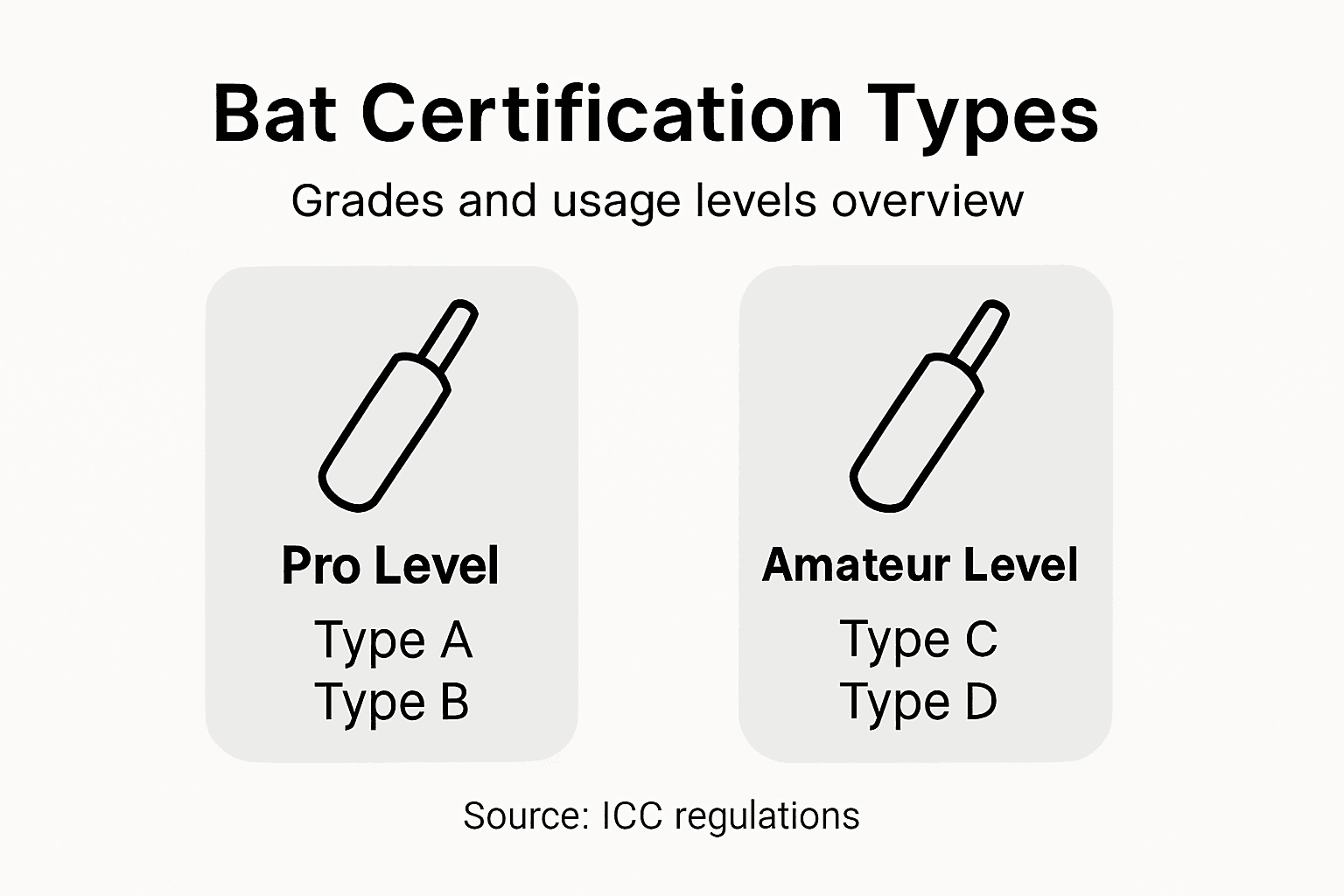
Here’s a comparison of cricket bat certification types and their intended use:
| Certification Type | Intended Use Level | Common Bat Material | Certification Rigor |
|---|---|---|---|
| Type A | International matches | English Willow | Extremely strict |
| Type B | Domestic senior leagues | English/Kashmir Willow | Stringent |
| Type C | Club and school cricket | Kashmir Willow | Moderate |
| Type D | Junior, amateur levels | Mixed woods | More flexible |
Regional variations in certification are particularly notable across different cricket-playing nations. Some regions emphasise performance factors and material quality, while others focus more strictly on dimensional compliance. Training and softball bats represent unique categories rarely certified for official international matches but critical for skill development and local league participation. These specialised bat types demonstrate the adaptability of cricket equipment certification systems to diverse playing environments and skill levels.
Pro Tip: Always verify the specific certification requirements of your intended competitive league before purchasing a cricket bat to ensure full compliance and avoid potential equipment disqualification.
Key Standards and Legal Specifications
The legal specifications for cricket bats are meticulously defined by international governing bodies to maintain fair competitive conditions. Precise cricket bat measurements are established under Law 5 of the Laws of Cricket, jointly enforced by the Marylebone Cricket Club (MCC) and International Cricket Council (ICC). These comprehensive regulations govern every aspect of bat construction, from dimensional constraints to permitted materials, ensuring a standardised approach to equipment across global cricket competitions.
Critical dimensional restrictions form the cornerstone of these legal specifications. Bats are strictly limited to a maximum length of 38 inches, with width capped at 4.25 inches and blade depth restricted to 2.64 inches. Wooden construction remains mandatory, with handles primarily composed of cane or wood. Manufacturers must navigate these precise parameters, which define not just the bat’s overall size but also specify details about blade face, back, shoulders, sides, and toe. Prohibited materials that could potentially damage the cricket ball are rigorously excluded, maintaining the delicate balance between bat performance and sporting fairness.
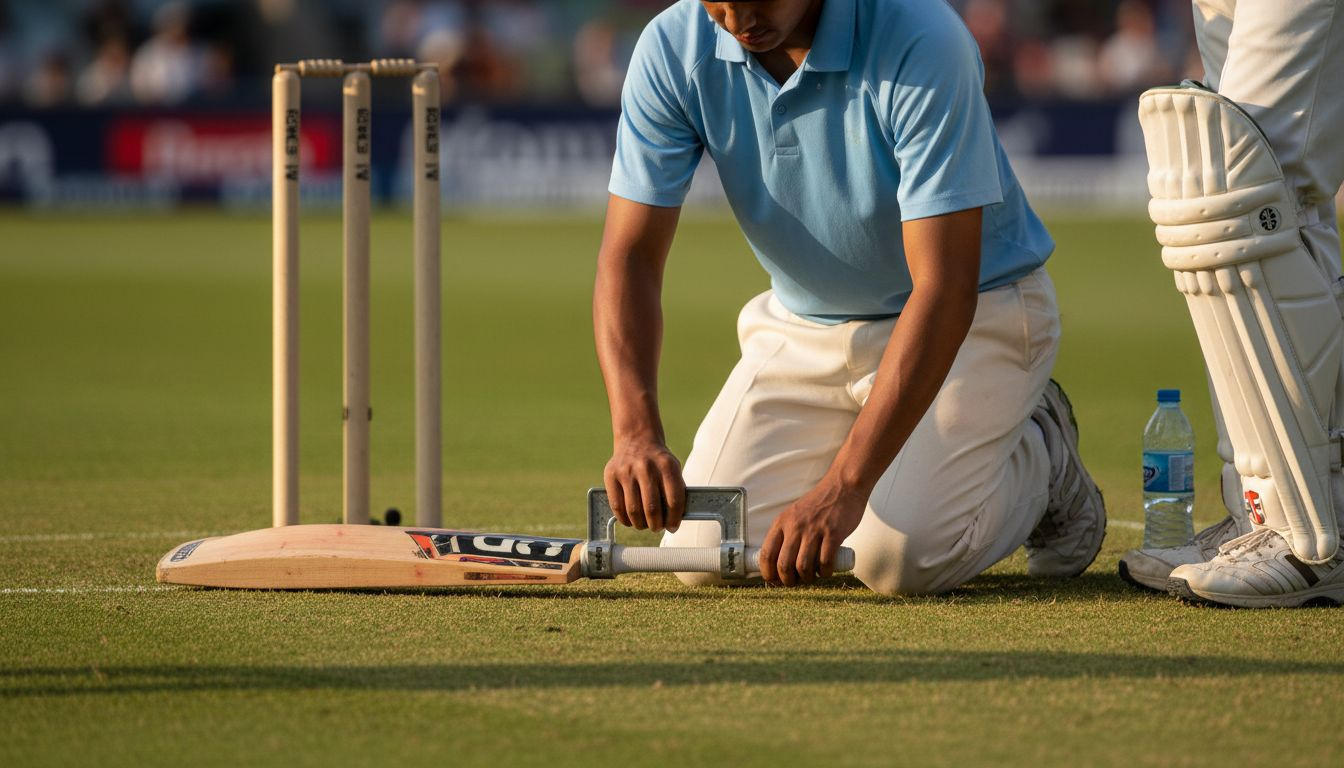
The enforcement of these specifications extends beyond mere measurement. International and domestic cricket bodies conduct thorough equipment inspections to ensure compliance, with potential disqualification for bats failing to meet the established standards. Regional variations exist, but the fundamental principles remain consistent: protecting the integrity of the game by preventing technological advantages that could compromise the balance between bat and ball. Protective materials are permitted within strict thickness limits, allowing for modest technological innovations while preserving the sport’s traditional equipment principles.
Pro Tip: Always have your cricket bat professionally measured and verified before important matches to ensure it meets the precise legal specifications required for competitive play.
Testing Procedures for Certified Bats
The International Cricket Council (ICC) implements comprehensive testing protocols for cricket bat certification that ensure rigorous equipment standards across competitive cricket. These intricate procedures involve multiple stages of examination designed to verify compliance with precise regulatory requirements. Specialized technicians and on-field umpires collaborate to assess bat specifications, focusing on dimensional accuracy, material composition, and potential performance advantages that could compromise fair play.
Critical testing components include detailed dimensional verification using sophisticated bat gauge systems. These precision instruments measure critical parameters such as bat width, depth, edge thickness, and overall profile. Manufacturers must demonstrate that their equipment meets exact specifications: maximum length of 38 inches, width capped at 4.25 inches, and blade depth restricted to prescribed limits. Beyond physical measurements, performance evaluations assess material properties to confirm that bats do not provide undue advantages or risk damaging cricket balls during competitive matches.
On-field inspections represent the final layer of certification enforcement. Umpires conduct random equipment checks before and during matches, with immediate disqualification potential for non-compliant bats. This multi-stage verification process includes laboratory testing, manufacturer documentation review, and live match inspections. The systematic approach ensures that cricket bat certification is not merely a bureaucratic exercise but a dynamic mechanism protecting the sport’s competitive integrity. Regional variations exist, but the fundamental principles of maintaining equipment fairness remain consistent across international and domestic cricket competitions.
Pro Tip: Regularly calibrate your cricket bat’s measurements and maintain detailed documentation to streamline certification processes and prevent potential match-day equipment disputes.
Common Compliance Mistakes to Avoid
Cricket equipment compliance demands meticulous attention to detail, with numerous potential rule violations that can unexpectedly disqualify players. The most frequent errors stem from misunderstanding dimensional restrictions and material specifications. Manufacturers and players must navigate a complex landscape of regulatory requirements, where even minor deviations can result in significant competitive penalties.
Dimensional non-compliance represents the most common certification pitfall. Bat specifications are strictly defined, with maximum limits for length (38 inches), width (4.25 inches), and edge thickness that leave minimal room for error. Improper handle construction, unauthorized grip extensions, or materials that could potentially damage cricket balls frequently trigger immediate disqualification. Players often underestimate the precision required, assuming slight variations will be overlooked. However, on-field umpires conduct rigorous equipment inspections that can instantly invalidate equipment, potentially compromising an entire match performance.
Classification errors present another critical compliance challenge. Cricket bats are categorised into specific types (A through D) corresponding to competitive levels, and incorrectly matching bat specifications to tournament requirements can result in immediate equipment rejection. Professional players must maintain detailed documentation and regularly verify their equipment meets the exact standards for their competitive context. Regional variations add complexity, with some leagues implementing additional local regulations beyond international standards, creating a multilayered compliance landscape that demands continuous vigilance.
Below is a summary of common compliance mistakes and their possible consequences in cricket bat certification:
| Mistake Type | Typical Cause | Possible Outcome |
|---|---|---|
| Dimensional error | Poor measurement tools | Immediate disqualification |
| Incorrect bat type | Misreading regulations | Bat rejection on inspection |
| Unauthorised material use | Lack of documentation | Ban from competition |
| Ignoring local rules | Overlooking league variations | Match penalties or fine |
Pro Tip: Maintain a professional equipment log documenting your cricket bat’s measurements, certification status, and competition-specific compliance details to preempt potential regulatory challenges.
Ensure Your Cricket Bat Meets Certification Standards Before You Play
Navigating the strict requirements of cricket bat certifications can be challenging. Adhering to precise dimensions and material rules is essential to avoid disqualification and maintain fair play. At cricketbats.com, we understand your goal to find certified, competition-ready equipment that complies with the latest international and domestic regulations.
Choose from trusted brands that uphold the highest standards such as New Balance Cricket Bats – Cricket Bats Com. Every bat in our collection is selected with certification compliance in mind, helping you avoid common pitfalls like dimensional errors and unauthorised materials that could jeopardise your game.

Ready to equip yourself with a legal, professionally certified cricket bat? Visit cricketbats.com now and browse our range designed for players committed to legal play and peak performance. Check out our Home page – Cricket Bats Com for the latest featured cricket bats and take the first step towards equipment confidence today.
Frequently Asked Questions
What are the main dimensions that cricket bats must adhere to for certification?
Cricket bats must be a maximum length of 38 inches, width of 4.25 inches, and blade depth restricted to 2.64 inches to meet certification standards.
What materials are typically used in the construction of certified cricket bats?
Certified cricket bats are primarily made from wood, with handles traditionally composed of cane or wood, and the blade surface may have specific protective materials that comply with regulations.
How is the certification level of a cricket bat determined?
The certification level of a cricket bat is categorised from Type A (for international matches) to Type D (for junior and amateur levels), reflecting their intended use and performance standards as defined by cricket governing bodies.
What common mistakes should be avoided to ensure compliance with cricket bat regulations?
Common mistakes include failing to meet dimensional specifications, using incorrect materials, and misclassifying the bat type, which can lead to immediate disqualification during equipment inspections.
Recommended
- The Essentials of Making a Cricket Bat With Artistry – Cricket Bats Com
- Cricket Bat Maintenance Explained: Boost Performance & Lifespan – Cricket Bats Com
- Cricket Bat Accessories: Enhancing Your Game Impact – Cricket Bats Com
- Cricket Bat Manufacturing Process: What Buyers Should Know – Cricket Bats Com
Choosing a new bat for league or club cricket in Australia can feel confusing with all the official rules and labels. Bat certifications are not just paperwork—they directly affect whether your equipment is legal for play and can stand up to match-day scrutiny. Understanding the strict specifications set by the International Cricket Council and Marylebone Cricket Club, from exact length and width limits to material rules, helps you buy confidently and avoid costly mistakes that could see your bat disqualified.
Table of Contents
- What Cricket Bat Certifications Involve
- Types of Bat Certifications Worldwide
- Key Standards and Legal Specifications
- Testing Procedures for Certified Bats
- Common Compliance Mistakes to Avoid
Key Takeaways
| Point | Details |
|---|---|
| Cricket Bat Certifications | Ensure compliance with stringent specifications to maintain fair play across all levels. |
| Certification Levels | Bats are categorised from Type A to Type D, with varying requirements based on competitive context. |
| Legal Specifications | Bats must adhere to strict dimensions and materials to avoid disqualification during matches. |
| Common Compliance Mistakes | Frequent errors include dimensional inaccuracies and incorrect bat classification, leading to penalties in competitions. |
What Cricket Bat Certifications Involve
Cricket bat certifications represent critical regulatory mechanisms ensuring fair play and standardisation across competitive cricket. These comprehensive assessment processes verify that cricket bats meet stringent specifications defined by international governing bodies like the International Cricket Council (ICC) and Marylebone Cricket Club (MCC). ICC regulations on bat specifications establish precise dimensional and material requirements that every professional and amateur cricket bat must satisfy.
The certification process examines multiple critical aspects of bat construction, including maximum dimensional limits. Specifically, certified bats must adhere to strict parameters: a maximum length of 38 inches, width restricted to 4.25 inches, and blade depth limited to 2.64 inches. These measurements ensure no team gains unfair competitive advantages through equipment manipulation. Materials used in bat construction also undergo rigorous scrutiny, with handles traditionally composed of cane or wood and blade surfaces subject to specific protective material regulations.
Bat certifications are categorised into different compliance levels ranging from Type A to Type D, each corresponding to specific competitive contexts. Professional international matches demand the highest certification standards, while junior and domestic competitions might permit slightly more flexible specifications. This graduated approach allows appropriate equipment standards across various playing levels while maintaining core principles of fair competitive play.
Pro Tip: Before purchasing a cricket bat, always request official certification documentation to guarantee compliance with competitive standards and ensure your equipment meets professional regulations.
Types of Bat Certifications Worldwide
Cricket bat certifications worldwide represent a complex system of regulatory standards designed to ensure fair play and equipment consistency across different competitive levels. Global bat certification systems demonstrate significant variation depending on regional sporting bodies, league requirements, and competitive contexts. These certifications fundamentally categorise bats into hierarchical types that reflect their intended use and performance standards.
The primary certification types range from professional-grade bats (Type A) to junior and amateur-level equipment (Type D). International cricket governing bodies like the ICC establish baseline standards, but individual countries and leagues often implement nuanced grading systems. English Willow bats, typically preferred in professional matches, undergo more rigorous certification processes compared to Kashmir Willow bats used predominantly in amateur and local cricket circuits. These classifications ensure that equipment meets specific dimensional, material, and performance criteria appropriate to each competitive context.
Here’s a comparison of cricket bat certification types and their intended use:
| Certification Type | Intended Use Level | Common Bat Material | Certification Rigor |
|---|---|---|---|
| Type A | International matches | English Willow | Extremely strict |
| Type B | Domestic senior leagues | English/Kashmir Willow | Stringent |
| Type C | Club and school cricket | Kashmir Willow | Moderate |
| Type D | Junior, amateur levels | Mixed woods | More flexible |
Regional variations in certification are particularly notable across different cricket-playing nations. Some regions emphasise performance factors and material quality, while others focus more strictly on dimensional compliance. Training and softball bats represent unique categories rarely certified for official international matches but critical for skill development and local league participation. These specialised bat types demonstrate the adaptability of cricket equipment certification systems to diverse playing environments and skill levels.
Pro Tip: Always verify the specific certification requirements of your intended competitive league before purchasing a cricket bat to ensure full compliance and avoid potential equipment disqualification.
Key Standards and Legal Specifications
The legal specifications for cricket bats are meticulously defined by international governing bodies to maintain fair competitive conditions. Precise cricket bat measurements are established under Law 5 of the Laws of Cricket, jointly enforced by the Marylebone Cricket Club (MCC) and International Cricket Council (ICC). These comprehensive regulations govern every aspect of bat construction, from dimensional constraints to permitted materials, ensuring a standardised approach to equipment across global cricket competitions.
Critical dimensional restrictions form the cornerstone of these legal specifications. Bats are strictly limited to a maximum length of 38 inches, with width capped at 4.25 inches and blade depth restricted to 2.64 inches. Wooden construction remains mandatory, with handles primarily composed of cane or wood. Manufacturers must navigate these precise parameters, which define not just the bat’s overall size but also specify details about blade face, back, shoulders, sides, and toe. Prohibited materials that could potentially damage the cricket ball are rigorously excluded, maintaining the delicate balance between bat performance and sporting fairness.
The enforcement of these specifications extends beyond mere measurement. International and domestic cricket bodies conduct thorough equipment inspections to ensure compliance, with potential disqualification for bats failing to meet the established standards. Regional variations exist, but the fundamental principles remain consistent: protecting the integrity of the game by preventing technological advantages that could compromise the balance between bat and ball. Protective materials are permitted within strict thickness limits, allowing for modest technological innovations while preserving the sport’s traditional equipment principles.
Pro Tip: Always have your cricket bat professionally measured and verified before important matches to ensure it meets the precise legal specifications required for competitive play.
Testing Procedures for Certified Bats
The International Cricket Council (ICC) implements comprehensive testing protocols for cricket bat certification that ensure rigorous equipment standards across competitive cricket. These intricate procedures involve multiple stages of examination designed to verify compliance with precise regulatory requirements. Specialized technicians and on-field umpires collaborate to assess bat specifications, focusing on dimensional accuracy, material composition, and potential performance advantages that could compromise fair play.
Critical testing components include detailed dimensional verification using sophisticated bat gauge systems. These precision instruments measure critical parameters such as bat width, depth, edge thickness, and overall profile. Manufacturers must demonstrate that their equipment meets exact specifications: maximum length of 38 inches, width capped at 4.25 inches, and blade depth restricted to prescribed limits. Beyond physical measurements, performance evaluations assess material properties to confirm that bats do not provide undue advantages or risk damaging cricket balls during competitive matches.
On-field inspections represent the final layer of certification enforcement. Umpires conduct random equipment checks before and during matches, with immediate disqualification potential for non-compliant bats. This multi-stage verification process includes laboratory testing, manufacturer documentation review, and live match inspections. The systematic approach ensures that cricket bat certification is not merely a bureaucratic exercise but a dynamic mechanism protecting the sport’s competitive integrity. Regional variations exist, but the fundamental principles of maintaining equipment fairness remain consistent across international and domestic cricket competitions.
Pro Tip: Regularly calibrate your cricket bat’s measurements and maintain detailed documentation to streamline certification processes and prevent potential match-day equipment disputes.
Common Compliance Mistakes to Avoid
Cricket equipment compliance demands meticulous attention to detail, with numerous potential rule violations that can unexpectedly disqualify players. The most frequent errors stem from misunderstanding dimensional restrictions and material specifications. Manufacturers and players must navigate a complex landscape of regulatory requirements, where even minor deviations can result in significant competitive penalties.
Dimensional non-compliance represents the most common certification pitfall. Bat specifications are strictly defined, with maximum limits for length (38 inches), width (4.25 inches), and edge thickness that leave minimal room for error. Improper handle construction, unauthorized grip extensions, or materials that could potentially damage cricket balls frequently trigger immediate disqualification. Players often underestimate the precision required, assuming slight variations will be overlooked. However, on-field umpires conduct rigorous equipment inspections that can instantly invalidate equipment, potentially compromising an entire match performance.
Classification errors present another critical compliance challenge. Cricket bats are categorised into specific types (A through D) corresponding to competitive levels, and incorrectly matching bat specifications to tournament requirements can result in immediate equipment rejection. Professional players must maintain detailed documentation and regularly verify their equipment meets the exact standards for their competitive context. Regional variations add complexity, with some leagues implementing additional local regulations beyond international standards, creating a multilayered compliance landscape that demands continuous vigilance.
Below is a summary of common compliance mistakes and their possible consequences in cricket bat certification:
| Mistake Type | Typical Cause | Possible Outcome |
|---|---|---|
| Dimensional error | Poor measurement tools | Immediate disqualification |
| Incorrect bat type | Misreading regulations | Bat rejection on inspection |
| Unauthorised material use | Lack of documentation | Ban from competition |
| Ignoring local rules | Overlooking league variations | Match penalties or fine |
Pro Tip: Maintain a professional equipment log documenting your cricket bat’s measurements, certification status, and competition-specific compliance details to preempt potential regulatory challenges.
Ensure Your Cricket Bat Meets Certification Standards Before You Play
Navigating the strict requirements of cricket bat certifications can be challenging. Adhering to precise dimensions and material rules is essential to avoid disqualification and maintain fair play. At cricketbats.com, we understand your goal to find certified, competition-ready equipment that complies with the latest international and domestic regulations.
Choose from trusted brands that uphold the highest standards such as New Balance Cricket Bats – Cricket Bats Com. Every bat in our collection is selected with certification compliance in mind, helping you avoid common pitfalls like dimensional errors and unauthorised materials that could jeopardise your game.
Ready to equip yourself with a legal, professionally certified cricket bat? Visit cricketbats.com now and browse our range designed for players committed to legal play and peak performance. Check out our Home page – Cricket Bats Com for the latest featured cricket bats and take the first step towards equipment confidence today.
Frequently Asked Questions
What are the main dimensions that cricket bats must adhere to for certification?
Cricket bats must be a maximum length of 38 inches, width of 4.25 inches, and blade depth restricted to 2.64 inches to meet certification standards.
What materials are typically used in the construction of certified cricket bats?
Certified cricket bats are primarily made from wood, with handles traditionally composed of cane or wood, and the blade surface may have specific protective materials that comply with regulations.
How is the certification level of a cricket bat determined?
The certification level of a cricket bat is categorised from Type A (for international matches) to Type D (for junior and amateur levels), reflecting their intended use and performance standards as defined by cricket governing bodies.
What common mistakes should be avoided to ensure compliance with cricket bat regulations?
Common mistakes include failing to meet dimensional specifications, using incorrect materials, and misclassifying the bat type, which can lead to immediate disqualification during equipment inspections.
Recommended
- The Essentials of Making a Cricket Bat With Artistry – Cricket Bats Com
- Cricket Bat Maintenance Explained: Boost Performance & Lifespan – Cricket Bats Com
- Cricket Bat Accessories: Enhancing Your Game Impact – Cricket Bats Com
- Cricket Bat Manufacturing Process: What Buyers Should Know – Cricket Bats Com